Texas Supreme Court Lets Death Star Law Stand
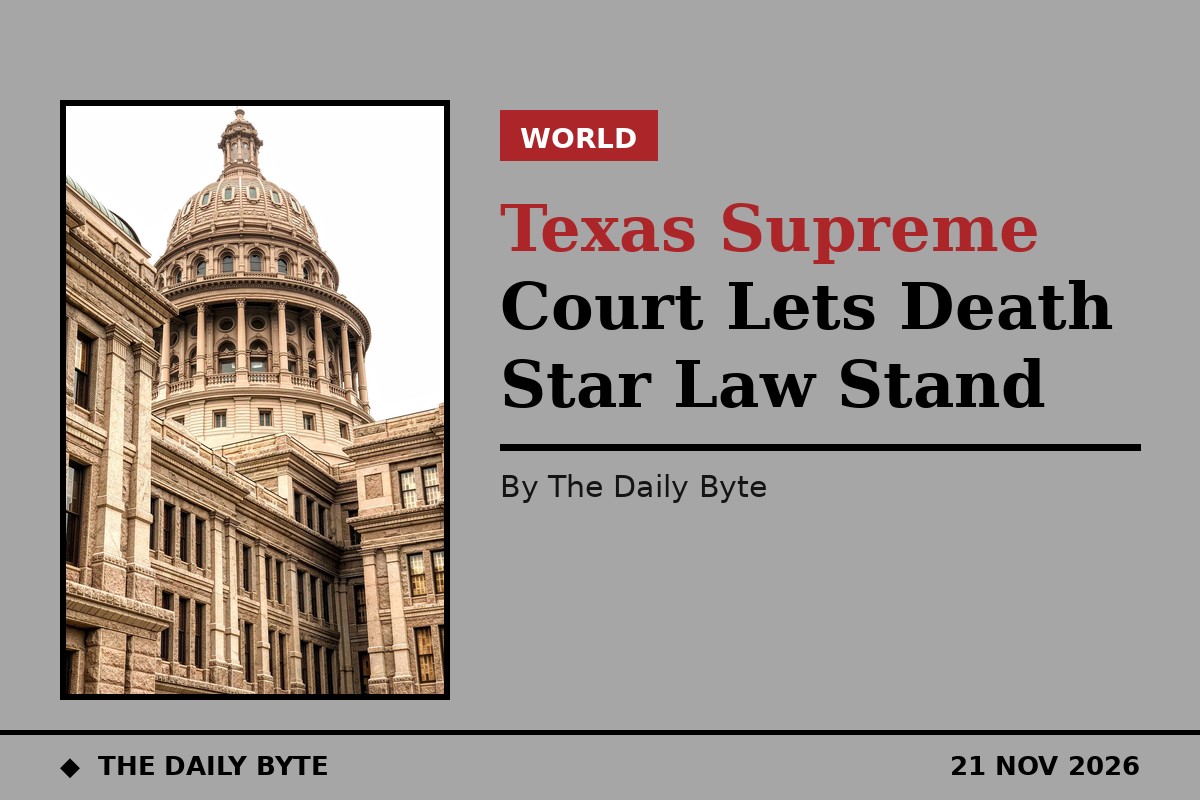
The Texas Supreme Court has declined to hear a challenge to the state's sweeping 2023 law limiting what cities and counties can regulate, leaving the statute known to critics as the "Death Star" law in force. The court said on Friday, 20 November, that it would not take up the case brought by Houston, San Antonio and El Paso, so the lower court ruling that upheld the law will stand.
The decision does not settle whether the law is constitutional. The justices refused to hear the case without hearing arguments, which means the fight over local control in Texas now moves from the courtroom to the state Capitol, where Democrats who won power this month have promised to try to repeal the law when the Legislature convenes in January.
Standing, not the merits
The cities had asked the state's highest court to overturn a ruling by the Austin-based 3rd Court of Appeals, which threw out their lawsuit. That court's July 2025 decision remains the governing interpretation: Houston, San Antonio and El Paso had not shown how the law had injured them, or why the state was to blame for that injury. Standing, not the merits of the law, decided the appeal.
The case has a long history. A Travis County judge ruled the law unconstitutional in August 2023 but allowed it to take effect. Officials in Houston, San Antonio and El Paso then sued the state, arguing that the law conflicts with the part of the Texas Constitution that enables cities to enact their own laws. The 3rd Court of Appeals overturned the lower court's ruling, and the Supreme Court's refusal to intervene leaves that appellate decision as the final judicial word on the cities' challenge.
The question the cities raised — whether the statute conflicts with the constitutional provision allowing municipalities to write their own ordinances — is now unresolved at the state's highest court. The law stays on the books while it waits for another case, or for the Legislature, to change its status.
What the law blocks
House Bill 2127, formally the Texas Regulatory Consistency Act, was signed by Governor Greg Abbott in 2023 and took effect on 1 September that year. It prohibits cities and counties from adopting ordinances or rules that go further than state law in eight broad areas: agriculture, business and commerce, finance, insurance, labor, local government, natural resources, and property.
Supporters, including Abbott, Republican lawmakers and business lobbying groups, argued that the state needed a single rule book so employers, lenders and property owners would not face a different set of local requirements in every city and county. Critics saw it as an attempt by Republican lawmakers to stop cities and counties from adopting progressive policies.
The effects were immediate. Local ordinances regulating noise levels and car towing fell off the books, and rules on construction workers' water breaks and payday lending lapsed. Local officials have complained that the law is so broad it is nearly impossible to know exactly which ordinances might now be illegal, and that the uncertainty itself stops cities from pursuing policies they worry could draw lawsuits. Enforcement does not depend on a state agency: residents and businesses can sue a city they believe has adopted a rule exceeding state law.
A repeal fight in January
With Democrats now in charge of the Texas House and in statewide office, lawmakers will seek to repeal the statute next year. Governor-elect Gina Hinojosa wants to see the law repealed, she told The Texas Tribune this week. State Senator Jose Menendez, a San Antonio Democrat, has filed a bill to do just that.
The repeal effort faces a difficult path. Republicans still hold a majority in the Texas Senate, so the idea is likely to face stiff resistance there. The Legislature convenes on 12 January 2027, and even if repeal succeeded, the ordinances that lapsed in 2023 would not automatically return — cities would have to decide whether to adopt them again.
Nothing in Friday's order changes any local ordinance by itself. It confirms the rules local officials have worked under since the autumn of 2023 and closes the last pending avenue for the cities that challenged them. The next answer, if there is one, will come from the Legislature.


