Thailand Informal Economy Worth 48% of GDP, Bank Says
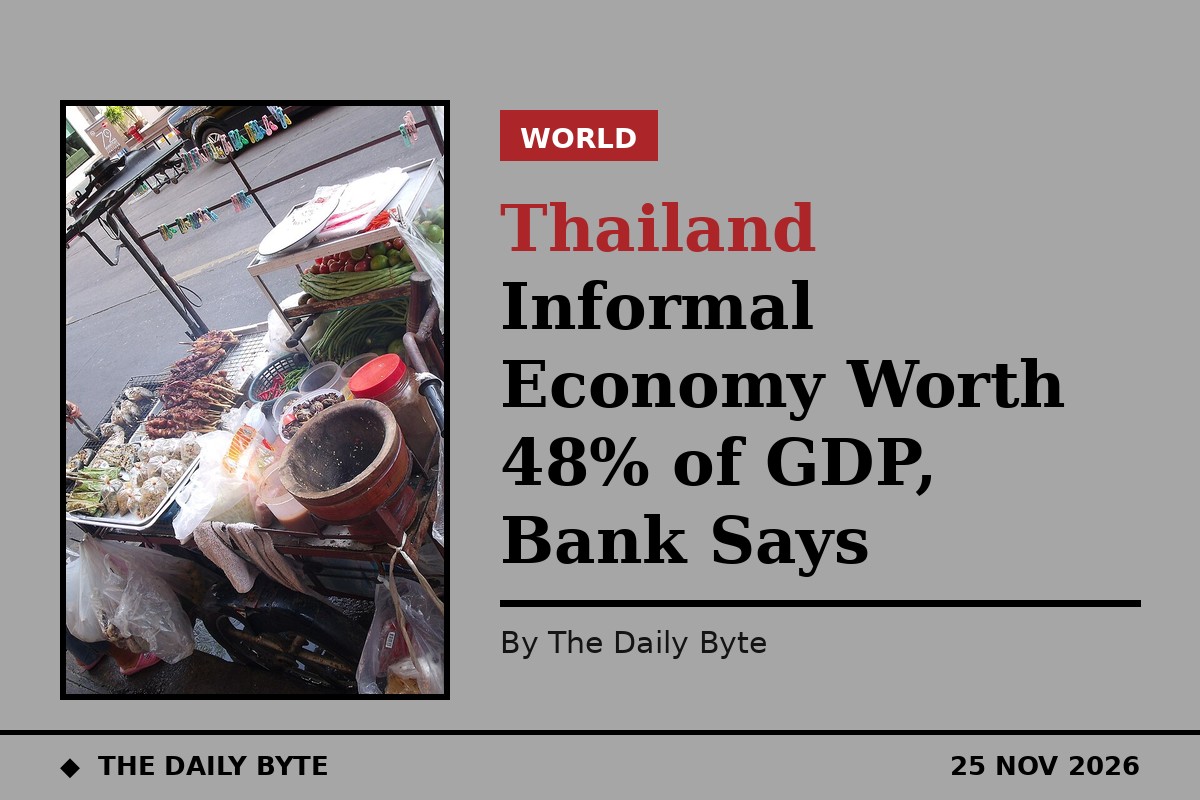
Nearly half of Thailand’s economy operates outside the formal system, the Bank of Thailand has warned, in a picture that leaves millions of workers without social protection and the state short of tax revenue.
Bank of Thailand Governor Vitai Ratanakorn told the Bank of Thailand Symposium 2026 on Tuesday 24 November that the informal economy is worth about 48 percent of gross domestic product, ranking Thailand 14th among 158 countries assessed by the World Bank, against a global average of about 33 percent.
Two very different informal economies
Vitai split the informal economy into two parts. The first is the legal informal economy: traders, market vendors, freelancers and farmers who are not breaking the law but operate outside business registration, accounting and tax systems. Research by the Puey Ungphakorn Institute for Economic Research puts this segment at around 21 to 35 percent of GDP.
The second part is the grey economy, where resources deliberately evade state oversight. This covers kickbacks, corruption, scams and online gambling, along with activity hidden to avoid tax. A Havoscope study estimates the grey economy at 13 percent of GDP.
The scale is striking. Around 2.5 million businesses operate informally, out of roughly 3.2 million businesses in total, meaning more than 70 percent of all firms are unregistered. About 26 million people work informally, equivalent to 65 percent of the country’s workers. Informal businesses account for about 75 percent of all businesses but generate only 5 percent of total revenue, according to the Business and Industrial Census.
Around a quarter of informal workers have only primary-level education or are older than 60, making them especially vulnerable as they age, the central bank’s research found.
Trapped without credit or protection
Operating outside the system carries a heavy cost. Informal businesses have no standard accounts and no tax history, which makes it hard for financial institutions to assess their income and ability to repay. As a result, they rely on informal debt or can only get short-term working capital to buy and resell goods, and without long-term loans to build capacity they cannot raise their productivity or competitiveness.
The 26 million informal workers lack benefits, provident funds and social security, leaving them exposed to hardship and insecurity in retirement. The gap also squeezes public finances: with businesses and workers outside the system, the government collects less tax, even as public debt rises close to its 70 percent of GDP ceiling.
“Both parts of the informal economy are structural problems that affect the country’s long-term development, and it’s a challenge we must all start tackling today,” Governor Vitai said, according to The Standard.
The central bank’s plan
The Bank of Thailand laid out plans to tackle the problem from both sides. For legitimate businesses, it will create incentives to join the formal system, such as access to credit and worker benefits. In tandem, controls on cash withdrawals, account crackdowns and blocks on converting funds into gold and foreign currency will be used to tackle the grey economy.
Fiscal assistance will help bridge the gap between formal and informal businesses, especially for those operating legitimately. But the shift will not be easy: bringing more businesses into the fold would raise government revenue without relying on higher tax rates, while businesses will be concerned about losing income in a sluggish economy.
The warning comes as Thailand’s economy grew 2.9 percent in the third quarter, though the Bank of Thailand has held its key interest rate at 1 percent as it weighs growth against household debt. Inflation hit 3.9 percent in October, a 45-month high driven by fuel costs. Without bringing more businesses into the formal system, the central bank warned, Thailand’s growth rate will remain below its full potential.


