Thailand PM defends US trade deal amid pork fears
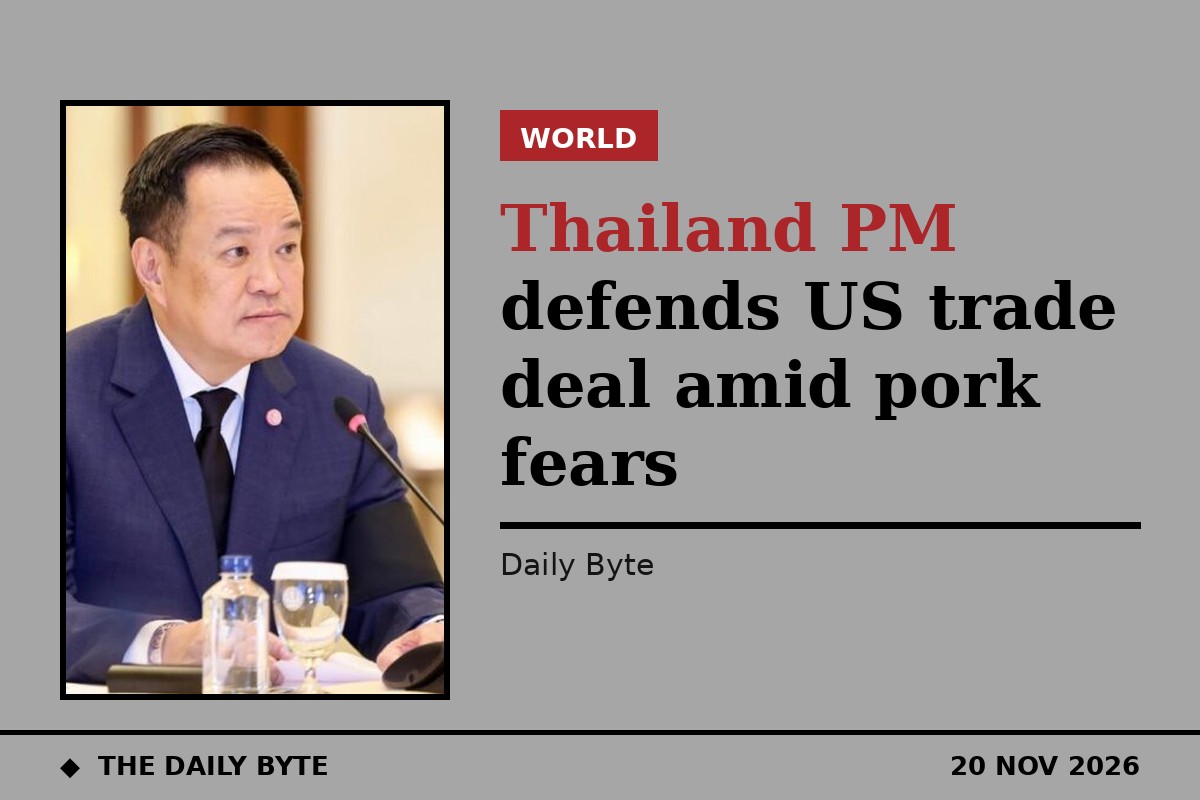
Thailand must keep the United States as a major trade partner and cannot lose it to its competitors, Prime Minister Anutin Charnvirakul said on Friday, as his government defended a trade deal with Washington that has alarmed the country’s farmers.
Thailand and the United States this week signed a joint statement about a “substantial conclusion” to negotiations on reciprocal trade. Anutin later pushed back against a claim by US President Donald Trump that Thailand had scrapped all tariffs on American goods.
Commerce Minister Suphajee Suthumpun told a briefing that opening Thailand’s market to more US goods would not require government purchases, but would give private importers another source for products. Thailand is in talks with Washington to cut a US tariff on Thai exports to 10 percent from 12.5 percent.
She said Thailand should not face less favourable terms than neighbouring countries that have signed reciprocal trade agreements with the US, warning that a widening tariff gap could hurt exports and employment.
America is Thailand’s biggest export market
The stakes are high. The United States is Thailand’s largest export market, with exports worth about 2.37 trillion baht, or 69.81 billion dollars, in 2025 and linked to around 1.25 million jobs, according to the commerce ministry.
Under the framework published by the White House, Thailand would eliminate tariffs on 99 percent of American goods entering the country and remove non-tariff barriers in sectors including vehicles, medical devices, pharmaceuticals, ethanol and poultry. Thailand also plans to spend up to 123 million dollars on American-made HIMARS rocket systems under a separate defence agreement.
But the joint statement is not the final agreement. A legal review, a signing and some domestic procedures still have to be completed before it takes effect, Suphajee said.
Farmers fear a pork flood
The terms have alarmed the farm sector. Former prime minister and Democrat Party leader Abhisit Vejjajiva said Thailand had reportedly agreed to open its market to up to 2.6 billion dollars a year in American agricultural imports, including pork, chicken, corn and soybeans, in exchange for only a 2.5-percentage-point cut in US tariffs on Thai exports.
Abhisit questioned whether the concessions outweighed the benefits and demanded greater transparency and a clear explanation from the government of the deal’s true net benefits and who would bear its economic costs.
The National Swine Raisers Association warned that opening the pork market would devastate local farmers, who have accumulated losses over three consecutive years as high feed costs kept selling prices close to production costs. Its president, Sitthiphan Thanapaipinya, said the association objected particularly to ractopamine, a feed additive permitted in US pig production but banned in Thailand, and warned that opening the market could undermine the country’s food safety standards.
Thailand already produces more pork than domestic demand requires and is seeking to expand exports to neighbouring countries, the association said. Instead of pork, it urged the government to offer alternative concessions such as importing American corn and soybeans.
Government insists red lines hold
The commerce ministry said Thailand will not allow imports of US pork containing ractopamine. Deputy Agriculture Minister Watcharaphong Khukham told parliament on Thursday that the Agreement on Reciprocal Tariffs remained an initial framework requiring further negotiations, legal review, cabinet approval, public consultation and parliamentary consideration.
He said Thailand would not accept pork from countries using growth-promoting substances prohibited under Thai standards, and that the government’s FTA Fund could support producers affected by trade liberalisation. Abhisit questioned whether the fund, which he estimated contained no more than five billion baht, would be enough to compensate farmers for potential losses.
Not everyone sees the deal as a bad bargain. Thanavath Phonvichai, chief adviser to the University of the Thai Chamber of Commerce’s forecasting centre, said the agreement would bring net positive benefits, securing a competitive 10 percent tariff rate and reducing the risk of further US trade action. The university maintains its growth forecast at 2.5 percent.
Sources: Reuters; The Thaiger.


