Thailand Warns Halt to Talks in Cambodia Sea Row
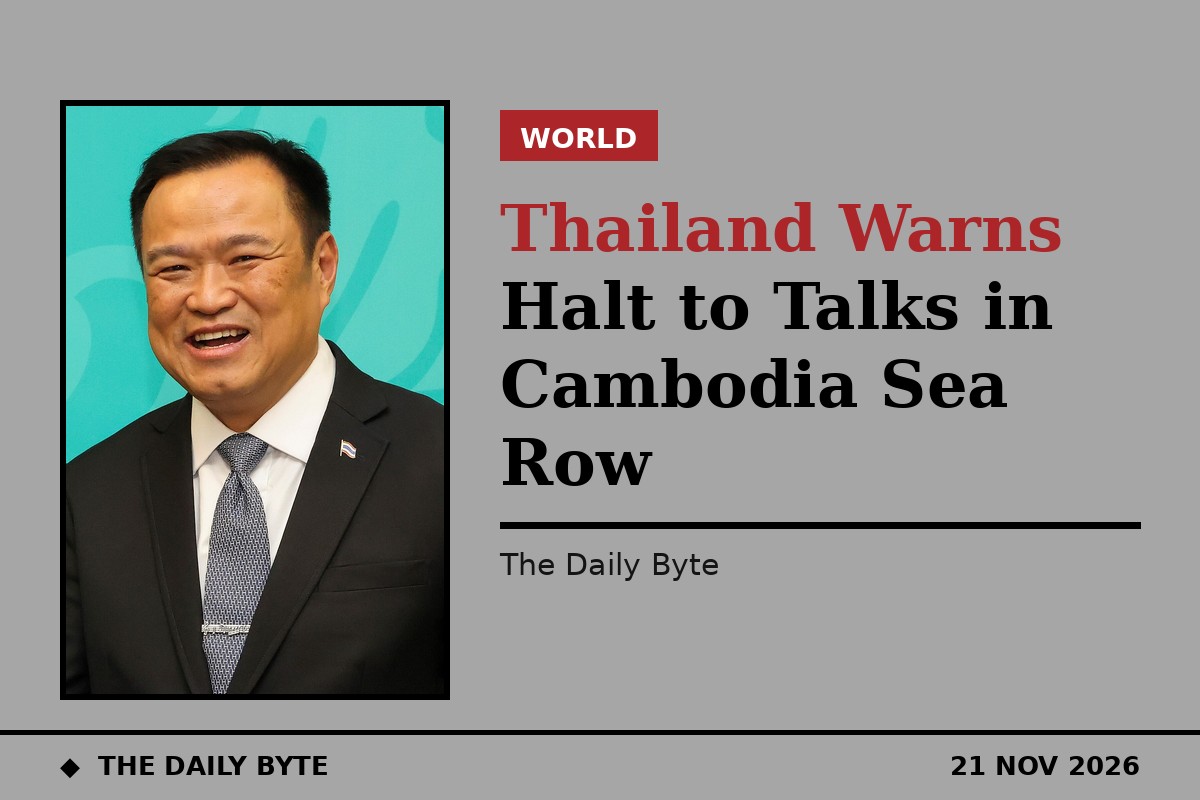
Thailand has warned Cambodia that it will suspend all other bilateral negotiations if Phnom Penh keeps pursuing compulsory conciliation over their disputed maritime boundary in the Gulf of Thailand.
Prime Minister Anutin Charnvirakul issued the warning on Saturday 21 November, speaking from Shenzhen in China during his regular programme. He said the two leaders had discussed ways to restore normal relations, but that Thailand would not keep other talks going while Cambodia pressed ahead with the legal process over the sea border.
"As long as you keep using the word compulsory, the other talks have to stop too," Anutin said, describing Cambodia's choice of compulsory conciliation as bypassing standard bilateral diplomacy. He compared the legal move to walking into the back of a dead-end alley and trying to work backwards, and said he could not explain to the Thai public why the government should accept such a binding legal condition while territorial disputes remain unresolved.
The dispute centres on overlapping claims in the Gulf of Thailand, an area of about 26,000 square kilometres believed to hold substantial reserves of natural gas and oil. Cambodia wants either a treaty establishing a single maritime boundary or an interim agreement to develop and share the offshore resources jointly. Thailand insists the boundary line must be drawn first, and has rejected immediate resource-sharing arrangements.
A legal process with a meeting days away
Cambodia launched compulsory conciliation proceedings on 2 June under the United Nations Convention on the Law of the Sea, known as UNCLOS, after Thailand withdrew from a 2001 memorandum of understanding that had provided the framework for discussing the overlapping claims. Under the UNCLOS framework, a five-member commission of international lawyers examines the dispute and recommends terms for a settlement, although its recommendations are not binding. The Permanent Court of Arbitration serves as the registry for the proceedings.
The commission was constituted on 14 September. Delegations from both countries have already met it twice, in Singapore in September and at the Peace Palace in The Hague in October, where they agreed measures intended to build trust. A third round is scheduled in Kuala Lumpur from 24 to 27 November.
The Thai delegation to Kuala Lumpur will be led by Deputy Prime Minister and Foreign Minister Sihasak Phuangketkeow, acting as Agent, accompanied by Deputy Prime Minister Pakorn Nilprapunt as Adviser. Cambodia's delegation includes specialist legal and border affairs officials.
Anutin's warning restates a position Thailand first set out in June, when it said it would join the UNCLOS process but put other two-way efforts on hold. At the time, Sihasak said Cambodia had made its decision public before officially notifying Thailand, and that the two sides had held no discussions since 2 June.
Land borders still closed
Beyond the sea dispute, all seven land border checkpoints between the two countries have remained completely closed to people and goods since June 2025, following armed clashes that erupted the following month. Fighting between the two countries over their border killed at least 150 people and displaced almost a million more during 2025, according to the International Crisis Group, with a second round of hostilities in December before a ceasefire was agreed on 27 December.
Anutin said reopening the checkpoints had not yet been discussed by the two leaders, and that restoring trust had to begin with foundational steps such as land border demarcation and joint demining. Unexploded landmines along forested stretches of the border continue to threaten villagers and soldiers on patrol, and clearing them is seen as an essential step before relations can improve.
Cambodian Prime Minister Hun Manet told leaders at the Francophonie Summit in Phnom Penh on 15 November that about 20,000 Cambodians remained unable to return home after the fighting in 2025, and called for joint surveying and demarcation of the border to resume. Thai officials have countered that security conditions and proper coordination must be established first.
With the Kuala Lumpur conciliation meeting days away and the land border still shut, the two governments are talking through lawyers about the sea while barely talking at all about the land. The commission can recommend, but it cannot compel, and any settlement will still have to be negotiated directly between Bangkok and Phnom Penh.


