Thomson Reuters to Launch Thomson 1.1 AI Model
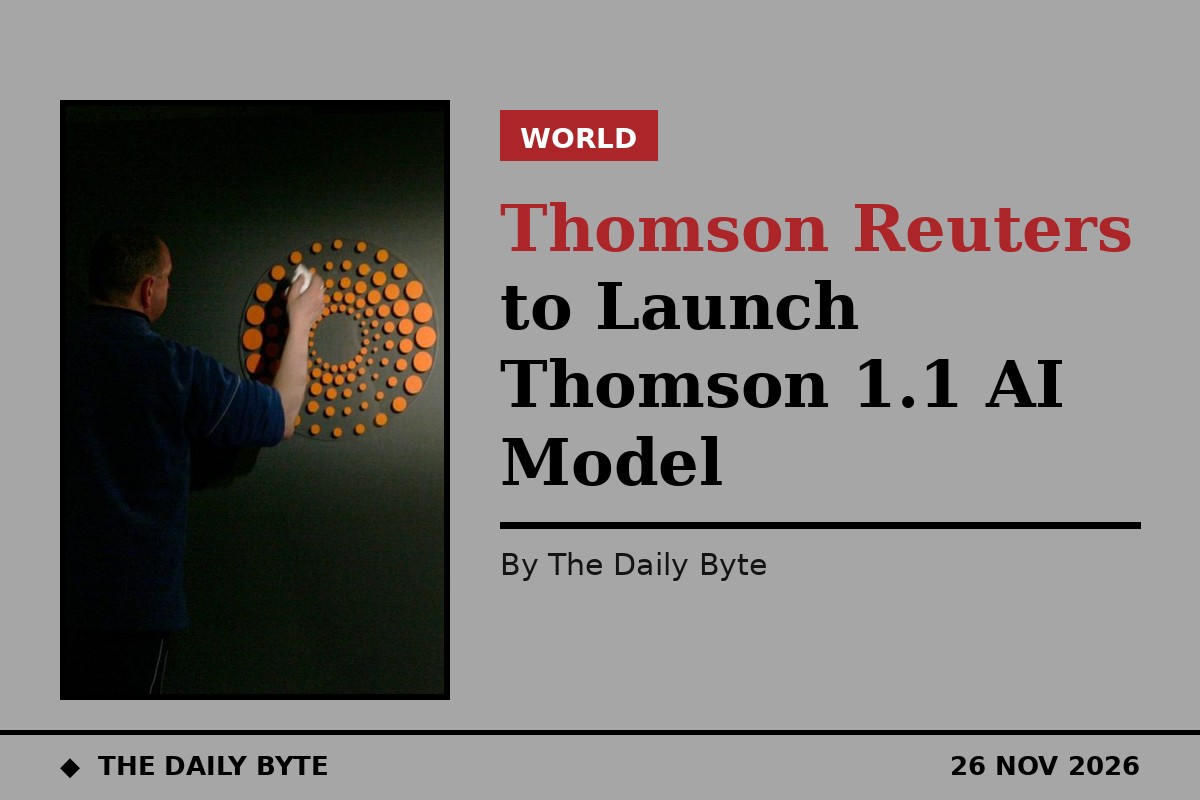
Thomson Reuters plans to launch a new in-house artificial intelligence model, Thomson 1.1, by the end of 2026, building it on open-source technology from both sides of the AI race: China's Z.ai and Google of the United States.
The company told Business Insider that the model will use Z.ai's GLM model alongside Google's Gemma model. Because both are downloadable and can be hosted in-house, Thomson Reuters expects the approach to cut its AI costs and give it greater control over its own intellectual property.
The plan marks a change of direction. Its previous in-house model, Thomson 1.0, was built on Qwen, the AI model from Chinese company Alibaba, and used no American AI technology at all. Thomson 1.1 deliberately mixes the two.
Why mix American and Chinese models
Chief technology officer Joel Hron said governments, including the United States government, prefer Western models at the foundation of the AI systems they use. Thomson Reuters will use Western and American labs to ground its model wherever it can, he said.
Each half of the pairing has a specific job. Hron said the company kept Z.ai's GLM because it is strong at using computers, a capability AI agents need to carry out tasks on a user's behalf. Google's Gemma was chosen for the opposite reason: it is small and efficient, making it cheap to run at scale.
The model is aimed at the middle of the company's legal and tax work, such as advising clients on tax, rather than the hardest tasks. Those will still go to OpenAI and Anthropic models. "There's a lot of work that happens in the middle, and that's where we get real economic benefit," Hron said.
A $40 million bet that is still small
Building its own models has not been cheap. Thomson Reuters has spent about $40 million so far modifying and tuning them, covering chips, data and AI researchers. Even so, its own models still account for less than 5% of all the AI tokens the company uses, though Hron said that share should rise as the areas it applies them to expand.
The Chinese origin of part of the stack carries a known risk. Israeli startup Hirundo told Business Insider its analysis found that one version of the current Thomson model repeated Chinese government positions, refusing to acknowledge the Tiananmen Square massacre and stating that Taiwan is an inalienable part of China.
A Thomson Reuters spokesperson said the system handles such questions substantially better when used with a specific set of instructions, and that the coming model reduces bias further. Andrew Bean, the company's lead AI scientist, said the approach showed what sovereignty means in practice: "Thomson is what AI sovereignty actually looks like in practice."
For large companies facing steep token bills, the launch is a test of whether open models can do serious professional work at a lower cost, without handing the hardest jobs, or the most sensitive data, to outside providers.


