Thousands Protest in Erbil Over Baghdad Kurdish Move
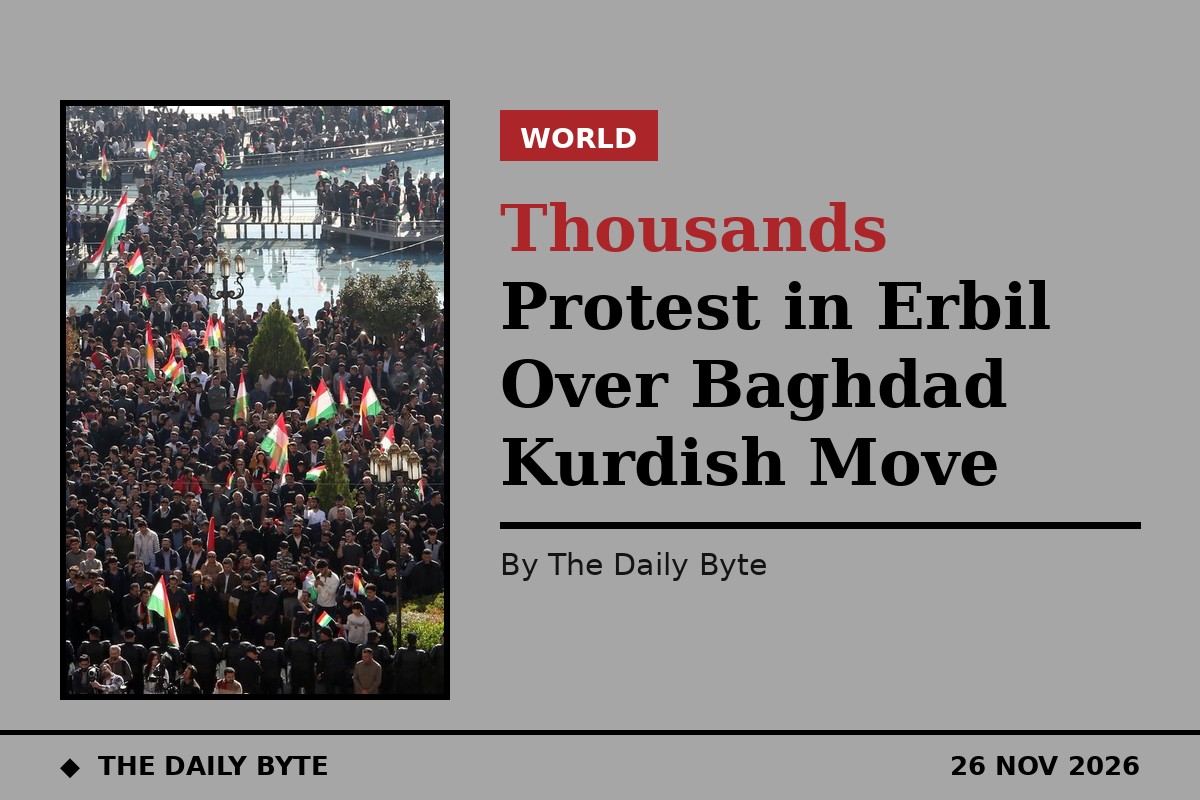
Thousands of Kurds protested in Erbil and Duhok on Thursday against Iraqi Prime Minister Ali al-Zaidi’s campaign to take over oilfields controlled by Kurdish security forces and deploy federal troops at the Kurdistan region’s international borders.
In Erbil, the regional capital, a banner bearing the image of a Kurdish leader and the Kurdish flag read: “Kurdistan Region will not submit to an unconstitutional decision or to the imposition of the will of any person or party.” In Duhok, university student Kenjo Khalaf told Reuters: “We do not accept an attack on Kurdistan’s land and will not allow anyone to interfere in our land. We are a peaceful people and we want security for everyone.” Erbil-based broadcaster Kurdistan24 reported that tens of thousands of people joined the Erbil protest, calling for Kurdish political unity, a higher figure than Reuters’ account of thousands.
Court backs Baghdad
Iraq’s Federal Supreme Court ruled on Wednesday that Baghdad can deploy federal forces along all international borders, including those in territory administered by the Kurdistan region. It said federal authorities could oversee the agencies operating at all border crossings, though they must coordinate with regional and provincial governments on customs administration.
The ruling followed orders issued by al-Zaidi on Tuesday: the Border Ports Authority was told to take over all crossings in the Kurdish region, unofficial crossings were to be closed, and the federal Oil Ministry was ordered to manage oilfields under Kurdish security control in Kirkuk, Nineveh, Diyala and Salahuddin provinces. The orders followed an investigation into smuggling at the state-run North Oil Company, and al-Zaidi dismissed eight security and administrative officials, including the head of the Border Ports Authority.
Baghdad says smuggling is draining national wealth on a large scale. The government estimates that 200,000 to 230,000 barrels of oil a day are smuggled, worth about $200 million a month, according to Al Jazeera.
Erbil rejects “military language”
The Kurdistan Regional Government (KRG) rejected what it called “military language and threats” in a statement from the spokesman for the Iraqi military announcing the new steps. The region’s two main political parties, the Kurdistan Democratic Party and the Patriotic Union of Kurdistan, issued a joint statement calling Baghdad’s decisions “unexpected and deeply surprising” and warning that undermining the power of the Kurdish political entity is a “red line”.
Erbil has said it supports efforts to fight corruption and smuggling, and has called for the dispute to be settled through dialogue and full implementation of the constitution.
Baghdad has denied reports that army units were moving towards the region. Government spokesman Haidar al-Aboudi told state broadcaster Al-Iraqiya on Wednesday that there was “no truth” to the reports, and said al-Zaidi was committed to “protecting the people of the region, not threatening them”. He added that the salaries of the Kurdistan region’s public employees would be secured in the 2027 budget. Baghdad has also sent Popular Mobilisation Forces chief Faleh al-Fayyad to press the Kurdish authorities for cooperation.
Sharpest confrontation in years
The dispute is the sharpest confrontation between Baghdad and Erbil in years over who controls the country’s oil, its border crossings and the revenues that flow from them. Ties have often been strained over oil, money, territory and trade: the central government responded with force when Kurdistan held an independence referendum in 2017, though relations have lately grown calmer.
Al-Zaidi, a 41-year-old multimillionaire businessman and political novice who came to power in a compromise just six months ago, is also in a second major standoff. Last week he ordered the army to prepare to enter Jurf al-Sakhar, south of Baghdad, where the government accuses the Iran-aligned militia Kataib Hezbollah of running a smuggling operation. The group was initially defiant but agreed to let soldiers enter the town.
Analysts say Washington is heavily focused on supporting al-Zaidi, particularly his agenda to consolidate state authority and rein in Iran-backed Shia armed groups, and that the Kurds should not expect American backing in the dispute. Tehran is also seen as satisfied with the pressure on Erbil, angered as it is by the presence of Iranian Kurdish opposition groups in the region, though analysts stress there is no hard evidence that Baghdad’s timing is part of a direct quid pro quo with Iran over Jurf al-Sakhar.
In an effort to defuse the crisis, Iraq’s four presidencies have agreed to a proposal by Supreme Judicial Council head Faiq Zaidan to hold a national dialogue on 1 December. One analyst called the dialogue a face-saving opportunity rather than a permanent fix, saying it could lead to a temporary compromise such as a joint oversight mechanism for official crossings.


