Timmy the whale starved to death, autopsy report finds
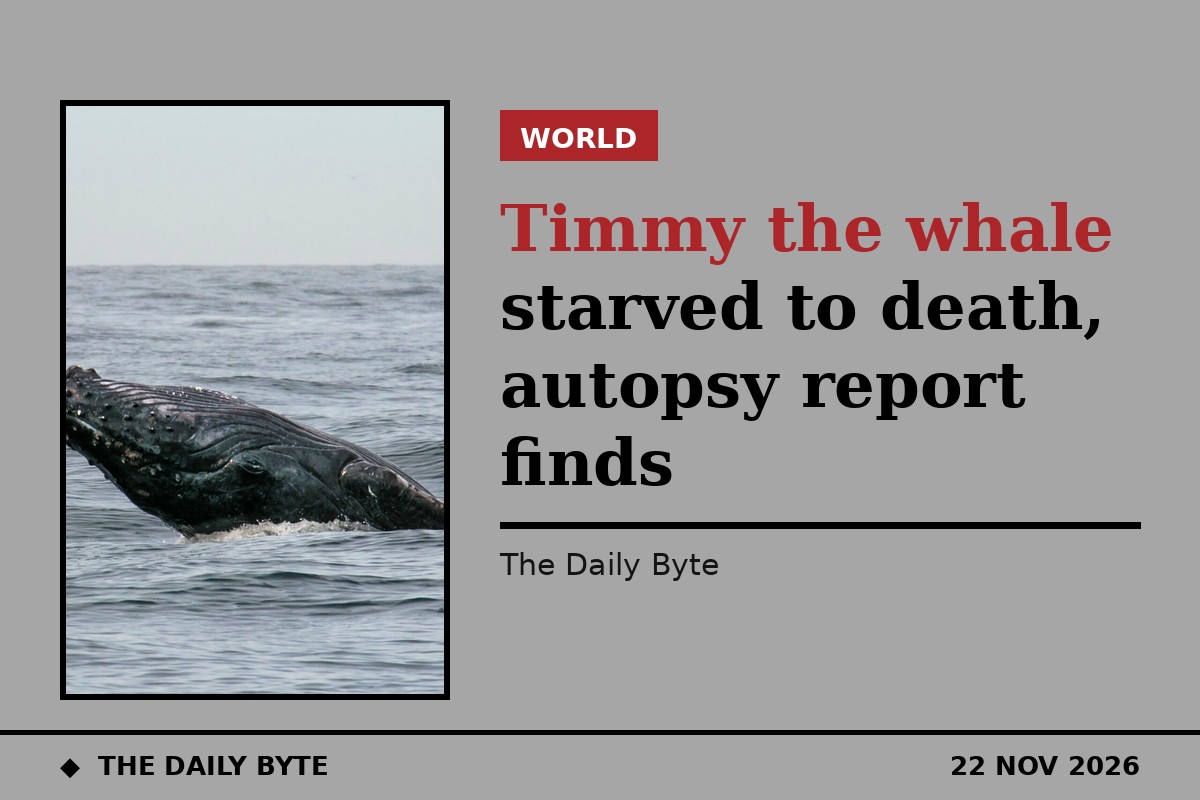
Timmy, the humpback whale that became stranded on Germany's Baltic Sea coast last spring, died of starvation after a fishing net trapped in her mouth made it impossible for her to eat. A Danish autopsy report published on Sunday 22 November 2026 found the whale's stomach was completely empty, and the lead pathologist said the animal had not eaten in months.
The findings come from an investigation by the German weekly newspaper Die Zeit, reported by Euronews. Timmy had become entangled in a gillnet of the type legally used for cod fishing at depths of around 50 metres between Denmark and Sweden. Fisheries biologist Daniel Stepputtis told Die Zeit that the whale had probably torn the net from its anchors, dragging a section about 150 metres long and three metres wide behind her.
Fishing-net dealer Eike Peters said the obstruction in the whale's mouth had likely made feeding impossible. The report found no underlying illness that could have caused the death.
A rescue that divided experts
Timmy was first spotted in the Baltic Sea near Wismar in early March 2026, an unusual place for a humpback whale. The Baltic's low-salinity water is unsuitable for the species, and the whale became stranded at the German coast several times. On 23 March she beached herself on a sandbar near Timmendorfer Strand, the beach she was named after, and rescue efforts began.
Most established whale researchers opposed the rescue operation, warning that the animal was severely weakened and unlikely to survive. The German Oceanographic Museum and the International Whaling Commission recommended palliative care, keeping the animal calm and wet until it died. Instead, after weeks of public pressure, a privately funded operation loaded the roughly 12-tonne whale into a water-filled barge and towed her towards the North Sea. She was released on 2 May 2026.
Tracking data showed Timmy swimming about 215 kilometres south in the Kattegat before drifting for a week and grounding near the Danish island of Anholt. A carcass matching her measurements was sighted there on 14 May, and Danish officials confirmed the identity on 16 May from the serial number of a tracking device attached to the whale's back. A necropsy in early June confirmed she was female.
Serious mistakes in the rescue
Die Zeit also reported serious mistakes in the rescue operation, and indications that Timmy endured considerable suffering during it. Drone footage showed the whale thrashing against the sides of the barge, and experts said the metal walls would have reflected her sonar, causing extreme stress. The whale was released about 70 kilometres north of Skagen, Denmark, directly into a busy shipping lane.
The rescue had already become a test case for how far people should go to save a single animal. Critics, including the director of the German Oceanographic Museum, described the operation as cruel, while supporters argued that doing nothing was unacceptable. The new autopsy findings are likely to revive that argument, since the net in Timmy's mouth predated the rescue and had already left her unable to feed.
Some of Timmy's bones are to be displayed in the University of Copenhagen Zoological Museum, while the blubber and other remains are being processed into biodiesel and biogas.
Frequently asked questions
How did Timmy the whale die? According to the Danish autopsy report, Timmy died of starvation. A fishing net trapped in her mouth made eating impossible, and her stomach was completely empty.
When was Timmy found dead? A carcass matching Timmy was sighted near the Danish island of Anholt on 14 May 2026, and Danish officials confirmed the identity on 16 May from the tracking device's serial number.
Why was Timmy's rescue controversial? Most whale experts opposed the barge rescue, warning the severely weakened whale was unlikely to survive and that the operation would prolong her suffering. The whale died about two weeks after being released into the North Sea.
Sources: Euronews; Oceanographic Magazine.


