Timor-Leste Starts $12m Survey for Greater Sunrise Gas
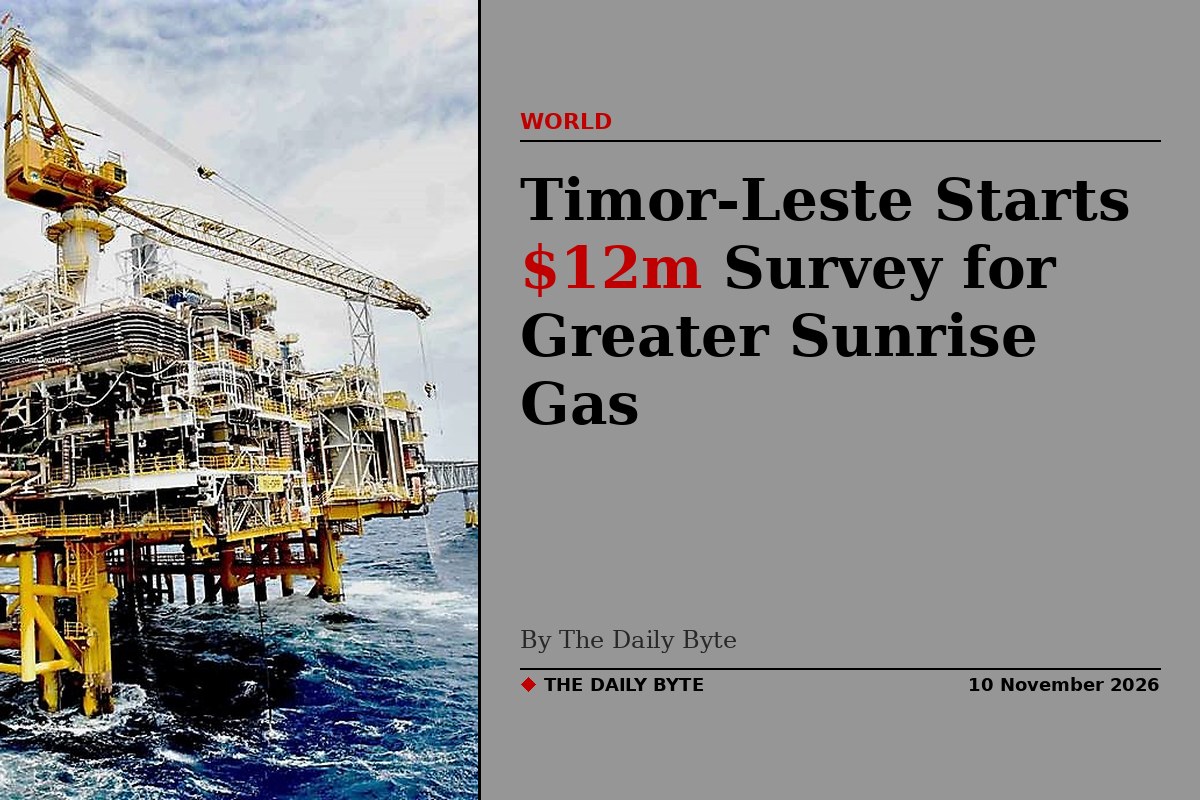
Timor-Leste has launched a US$12 million seabed survey for a proposed pipeline that would carry gas from the Greater Sunrise field to a planned liquefied natural gas plant at Natarbora, on the country's southern coast. Petroleum and Mineral Resources Minister Francisco da Costa Monteiro announced the launch on Tuesday, saying the high-resolution geophysical survey would take four months.
The work will be carried out by Fugro Singapore Marine as the opening stage of a wider marine investigation. Its job is to find a suitable route for the pipeline and identify hazards before engineers complete the design. Monteiro said earlier feasibility studies had found the project technically possible, while the new investigations would provide the detailed information needed for infrastructure intended to operate for 30 years or longer.
Surveying some of the world's deepest pipeline routes
The proposed route crosses the Timor Trough, where Fugro describes survey depths reaching 3,000 metres and exceeding that depth in parts of the wider survey area. At such depths, specialist vessels, underwater equipment and careful measurements are needed to understand where a pipeline could safely rest. Monteiro specifically identified the possibility of ground collapse as something the investigations would examine.
Fugro's programme covers geophysical, seismic, autonomous underwater vehicle and environmental surveys across the Greater Sunrise and Bayu-Undan development areas. Together, those activities will map conditions along the proposed pipeline corridors so engineers can choose a route, design for local conditions and avoid unstable slopes or areas where the ground could move.
The government is also investigating connections from Bayu-Undan and Chuditch to Natarbora. For Natarbora, the work advances planning for a proposed liquefied natural gas development, known as TLNG. Liquefied natural gas is natural gas cooled into a liquid so that ships can carry it to customers, and the pipeline would be the connection between the offshore resource and the planned facilities on land.
More surveys to follow in 2027
Fugro has also won two further awards from Timor-Leste's ministry, announced in September: a heavy geotechnical survey planned to take six months and a metocean survey planned to take 12 months, with fieldwork scheduled to begin in the first quarter of 2027. Geotechnical work tests the physical properties of the seabed, while metocean work measures weather and ocean conditions. The company plans to deploy its Seafloor Drill and SeaScout 35 MKII cone penetration testing systems, with its remote operations centre in Kuala Lumpur supporting the offshore teams.
A separate light geotechnical investigation along the same routes is being carried out by Indonesia's PT Taka Hydrocore, which signed an agreement with the ministry on 24 September. Monteiro said that assignment was funded with more than US$10 million and would take six months.
The surveys are advancing alongside changes in the ownership of the Greater Sunrise field. Timor GAP, the national petroleum company, signed an agreement on 27 October to buy Woodside Energy's entire 33.44 per cent interest in Greater Sunrise for up to US$200 million. Combined with a separate agreement to acquire Osaka Gas's 10 per cent interest, that would bring the resource entirely under Timor GAP's control once both transactions are completed, with completion targeted for the first half of 2027.
Timor-Leste and Australia have also reached technical agreement on three documents governing Greater Sunrise: the Petroleum Mining Code, the Production Sharing Contract and the Fiscal Regime. The documents must still pass through approval procedures in both countries, a process expected to take about three months.
Greater Sunrise was discovered in 1974 and has spent more than five decades awaiting production. An independent assessment in 2018 put development costs at US$15.6 billion, a historical estimate that illustrates the size of the undertaking. No date for pipeline construction or first gas was given in the launch announcement.
Frequently asked questions
What is the Greater Sunrise survey for? It will map the seabed along a proposed pipeline route from the Greater Sunrise gas field to Natarbora, so engineers can choose a safe route and design the pipeline.
When will the pipeline be built? No construction date has been announced. The surveys run into 2027, and route selection and engineering will use their findings.


