Tokyo Core Inflation Hits 16-Month High of 2.9%
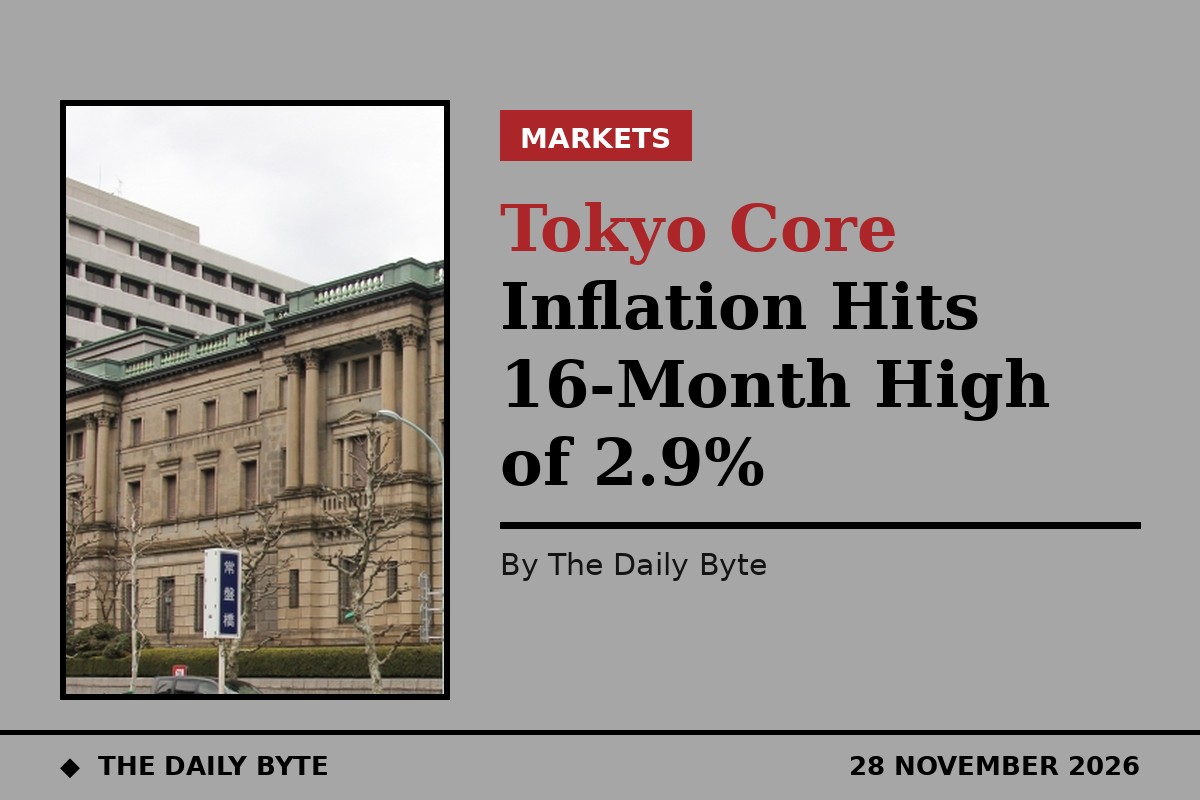
Core inflation in Tokyo rose to 2.9 per cent in November, its fastest pace in 16 months, data released on Friday showed, strengthening the case for the Bank of Japan to raise interest rates at its December meeting.
The core consumer price index for the capital, which includes fuel but excludes fresh food, rose 2.9 per cent from a year earlier, according to data from the Ministry of Internal Affairs and Communications. That compared with a 2.6 per cent rise in October and a median market forecast of 3.0 per cent, and marked the fastest year-on-year increase since July 2025.
The numbers behind the rise
Overall consumer price inflation in Tokyo increased marginally to 2.8 per cent from 2.7 per cent in October. A separate index stripping out both fresh food and energy, which the Bank of Japan watches closely as a gauge of trend inflation, eased slightly to 2.5 per cent from 2.6 per cent. Core inflation in the capital has now stayed above the central bank's 2 per cent target for three straight months.
Tokyo prices are widely regarded as a leading indicator of nationwide trends, so the figures will feed directly into the Bank of Japan's decision at its next two-day policy meeting, which ends on 18 December.
What is driving prices higher
The increase was driven partly by the end of government utility subsidies, but prices rose across a broad range of goods and services, including food, daily necessities and hotel charges. Inflation also rose for services such as public transport and medical care.
"Core consumer inflation is expected to accelerate due to rising energy prices from the Middle East conflict and ensuing second-round effects," said Masato Koike, senior economist at Sompo Institute Plus. He added that if market instability stemming from concern over the AI and chip outlook persisted, there was a chance the Bank of Japan might forgo a rate rise in December, but that his baseline projection was for it to proceed.
Ayako Fujita, chief Japan economist at JPMorgan Securities, said the figures suggested the shift in Japan's inflation dynamics was no longer driven only by temporary supply shocks. "We expect the momentum in price increases to remain broad-based" toward the first quarter of 2027, she said, adding that inflationary pressures were expected to broaden further across food and services even as momentum in core goods inflation gradually eased.
The Bank of Japan decision ahead
The Bank of Japan raised its policy rate to 1.25 per cent in September after delivering a rise in June, a shorter interval than the roughly twice-a-year increases seen in 2024 and 2025. It held rates steady in October, while saying underlying inflation had roughly hit its 2 per cent target and signalling readiness to keep raising rates to prevent price growth from accelerating too much.
A majority of analysts polled by Reuters expect the central bank to raise rates in December and follow up with another increase by the end of March. Many see the terminal rate at around 1.75 per cent or 2.0 per cent, and markets widely expect the rate to rise to 1.5 per cent from 1.25 per cent at the December meeting.
Hawkish board member Naoki Tamura said on Thursday that the central bank must respond swiftly to signs of an inflation overshoot, including by accelerating the pace of rate rises. Investors are watching for hints from Governor Kazuo Ueda on the likelihood of a December rise in a speech scheduled for Monday. Short-term Japanese government bond yields edged higher on Friday as the inflation data reinforced expectations of a move next month.
There is less agreement on how far the Bank of Japan can tighten beyond that. Shigeto Nagai, head of Japan economics at Oxford Economics, projects headline inflation will slow to 2 per cent in late 2027, which he said would allow the central bank to complete its multi-year rate normalisation process by mid-2027 with a terminal policy rate of 1.75 per cent.


