Treasury yields fall below 5% on safe-haven rush
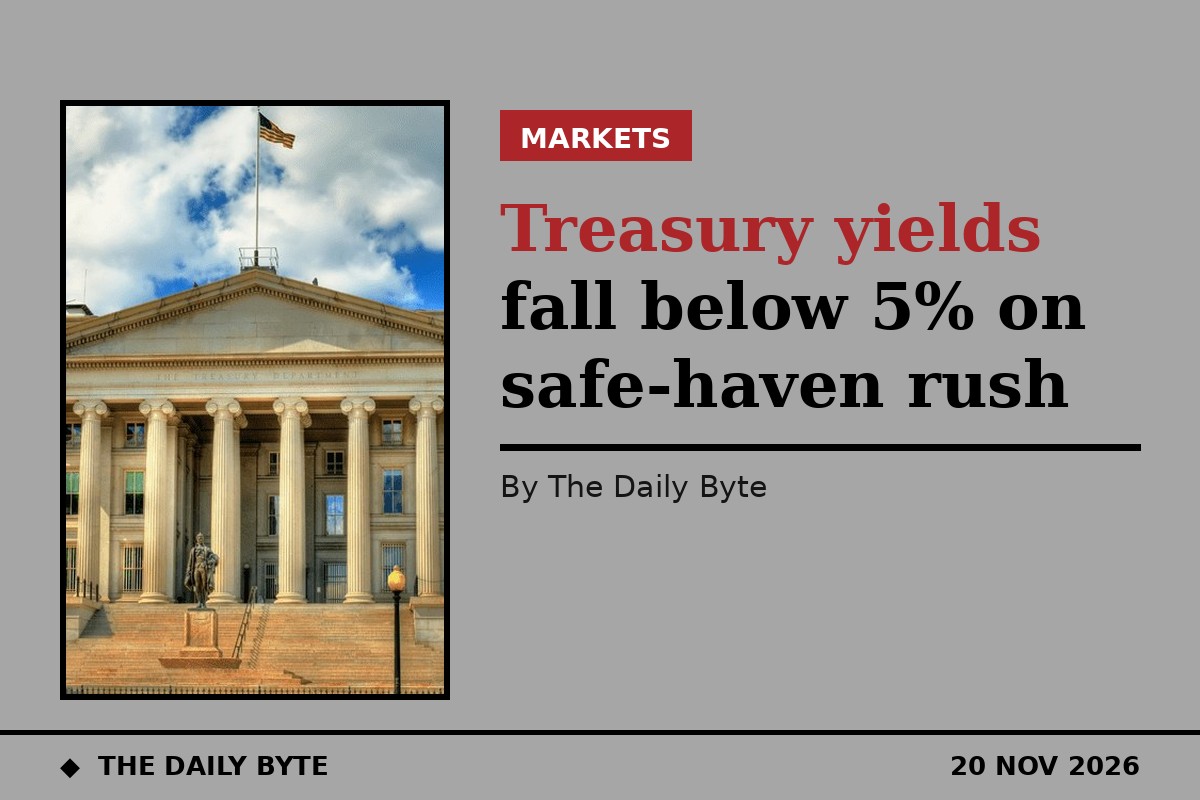
US government bond yields fell sharply on Friday, pushing the benchmark 10-year Treasury yield below 5% as a deepening sell-off in technology shares sent investors hunting for safety.
The 10-year yield dropped 4.4 basis points to 5.008% in Asian trading, according to Tradeweb data cited by Dow Jones, while the two-year yield fell 5.5 basis points to 4.724% and the 20-year yield declined 3.2 basis points to 5.419%. By later in the US session the 10-year yield had fallen further, down 10.3 basis points to 4.939%, its biggest one-day decline since 22 October, according to MarketWatch.
Yields fall when bond prices rise, so the move means investors were buying government debt in size. It was the fifth straight session of declines for the 10-year yield, and Reuters reported that the benchmark was on track for its biggest weekly fall since April 2025, down 17 basis points over the week.
The trigger was a violent rotation out of equities. Anthropic, the AI developer whose listing raised more than $81 billion in a record-breaking initial public offering this week, failed to revive appetite for artificial intelligence stocks. Instead, its debut exposed the doubts building beneath the rally: uncertain returns on the technology, unease about the volume of debt being raised to finance chips and data centres, and regulatory risk after the Democrats' sweeping midterm election victory.
A global flight to safety
The rush into bonds was not confined to the United States. Ten-year gilt yields in Britain and 10-year Bund yields in Germany both fell to one-week lows of 5.24% and 3.317% respectively, according to Tradeweb data. Australia's 10-year yield dropped to 4.951%, its lowest since August, after its biggest one-day decline since late March, and Japan's 10-year yield fell to a more than one-week low of 2.787%.
"The blockbuster debut couldn't sweep those worries under the rug," Ipek Ozkardeskaya, senior analyst at Swissquote, said in a note. David Groman, global equity strategist at Citi, said the concerns about the tech and AI sector were driving the flight to safety and causing government bond yields to drop.
The bond rally is striking because it comes despite expectations that the Federal Reserve is about to tighten policy further. Minutes from the central bank's October meeting, released on Wednesday, showed nearly all policymakers considered additional interest rate increases necessary, and futures markets put a 93.9% probability on a quarter-point rise at the December meeting, with a 6.1% chance of a half-point move, according to Kitco's assessment of futures pricing.
Yields fall even as a hike looms
Normally, the prospect of higher rates pushes yields up. That yields fell anyway shows how forcefully investors are seeking shelter from the equity rout, and how the market is starting to price in a weaker growth outlook even as inflation stays sticky. The US dollar index held near 103.8, around its strongest level since April 2025, adding to the pressure on risk assets.
Strategists at UBS said in a note that the anxiety was now spilling into credit markets, but argued that additional Fed hikes were largely priced in and a prolonged tightening cycle looked unlikely. The bank expects quarter-point moves next month and again in March 2027, and said Treasury yields had room to fall further as markets reassessed their expectations for Fed policy.
For borrowers, the drop in yields offers a small measure of relief after weeks of climbing borrowing costs. For investors, the question is whether the bond rally has room to run. If the equity sell-off deepens, demand for the safety of government debt is likely to keep yields under pressure. But if the Fed follows through with the hikes the market expects, yields could snap back just as quickly. Friday's move, for now, is a clear signal of where the fear sits: not in inflation, but in the market's faith in the AI boom.