Trinidad Murders Down 46% as PM Hails Crime Fall
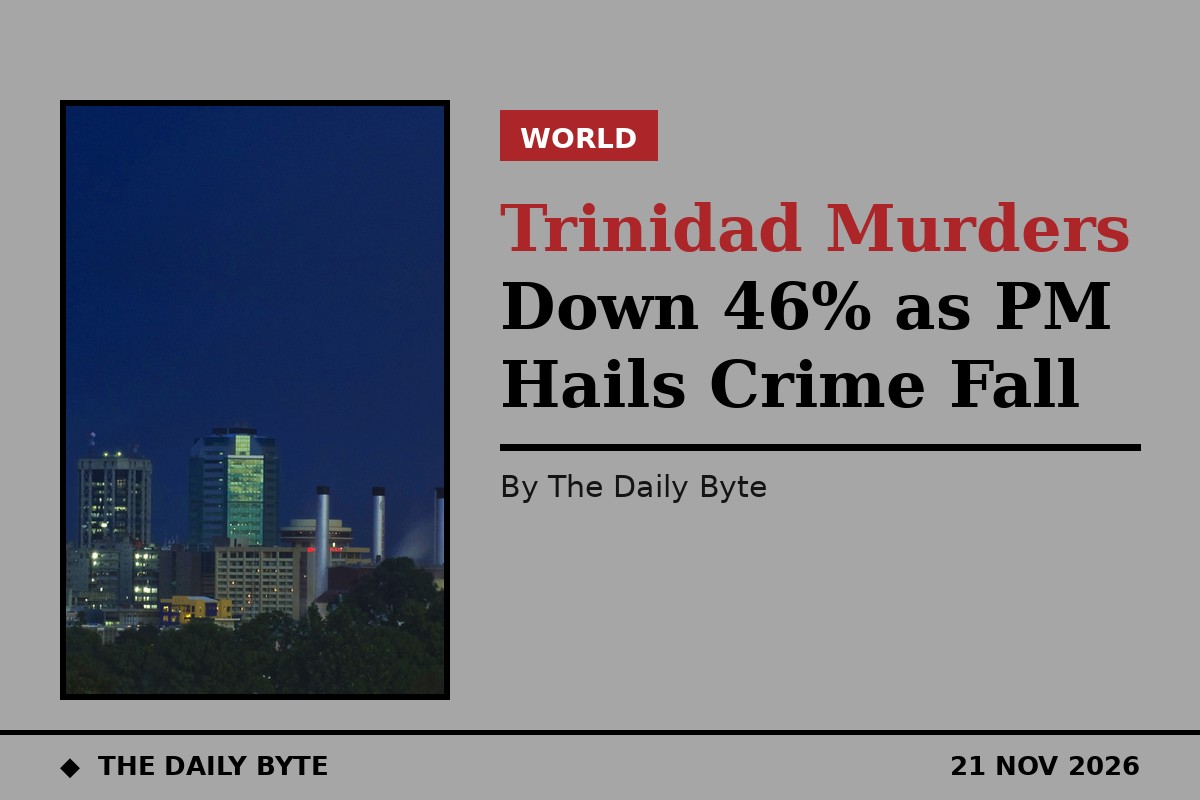
Trinidad and Tobago recorded 296 murders between 1 January and 16 November 2026, down 46.2 per cent from 550 during the corresponding period in 2024, according to a Trinidad and Tobago Police Service media release dated 18 November. Prime Minister Kamla Persad-Bissessar welcomed the figures on Thursday, describing them as evidence of progress in the government's efforts to restore safety and security.
The police figures also showed substantial reductions in other serious offences compared with 2024. Robberies were down 44.5 per cent, woundings and shootings by 42.5 per cent, motor vehicle theft by 38.7 per cent, burglaries and breakings by 23.3 per cent, and firearms and ammunition offences by 22.3 per cent.
Persad-Bissessar attributed the reductions to intelligence-led operations, increased police visibility, targeted interventions in crime hotspots, the removal of illegal firearms and sustained enforcement efforts. She commended the Commissioner of Police and members of the police service, while acknowledging that more work remained to be done.
The opposition's challenge
Opposition MP Marvin Gonzales, of Arouca-Lopinot, has called on the Police Service Commission to pursue an independent audit of the crime statistics, questioning the use of 2024 as the benchmark for reporting a reduction in murders. He said the police service's November 18 statistics raised concerns about selective comparisons and the classification of deaths.
Gonzales pointed out that 325 murders were recorded during the corresponding period in 2025, meaning the reduction to 296 in 2026 amounted to 29 murders, or 8.9 per cent. He said 225 of the 254 fewer murders recorded between 2024 and 2026 had already been accounted for by the reduction between 2024 and 2025, and questioned whether the choice of 2024, the final full calendar year of the previous People's National Movement administration, as the headline benchmark was coincidental or intended to support the current government's political narrative.
He also raised concerns about 39 deaths which the police service has listed as unclassified, noting that the figure exceeded the 29-murder reduction recorded between 2025 and 2026. Gonzales said that if 29 of those deaths were eventually classified as murders committed in 2026, the reported year-on-year reduction would disappear, and if 30 were classified as murders, the figures would instead show an increase, assuming the 2025 total remained unchanged.
Gonzales also questioned the murder detection rate, which he said had declined from 24 per cent in 2025 to 22 per cent in 2026, with only 65 of the 296 murders recorded this year detected. He further noted that substantial portions of 2025 and almost all of 2026 were spent under states of emergency, during which the police had extraordinary powers of arrest, search and detention, and said policing conditions during those periods were fundamentally different from those prevailing during most of 2024.
Audit call
In calling for the audit, Gonzales said he welcomed any genuine reduction in crime and recognised the work of police officers, but insisted that improvements had to be demonstrated through credible, consistent and independently verifiable statistics. He wants the Police Service Commission to pursue an independent examination of the accuracy and consistency of murder statistics for 2024, 2025 and 2026, the methodology used to select comparison periods, the 39 unclassified deaths and how they compare with previous years, the procedures and timelines for classifying and reclassifying suspicious deaths, and the accuracy of murder detection statistics, with the findings made public.
The Trinidad Express, in its own running tally, put the murder toll at 300 up to last night, compared with 357 at the same time last year. An earlier police update, covering the period to 10 November, had put the toll at 292 murders against 542 in 2024, a reduction of 250, and 9 per cent lower than the 322 recorded during the corresponding period in 2025.
The figures land in a country that has spent much of the past two years under emergency powers, and the argument now is as much about how the numbers are counted as about the numbers themselves. The prime minister says the trend shows the country is becoming safer; the opposition says only an independent audit can show whether the headline fall stands up.


