Trump Backs Iraq Crackdown on Kurdish Oil Smuggling
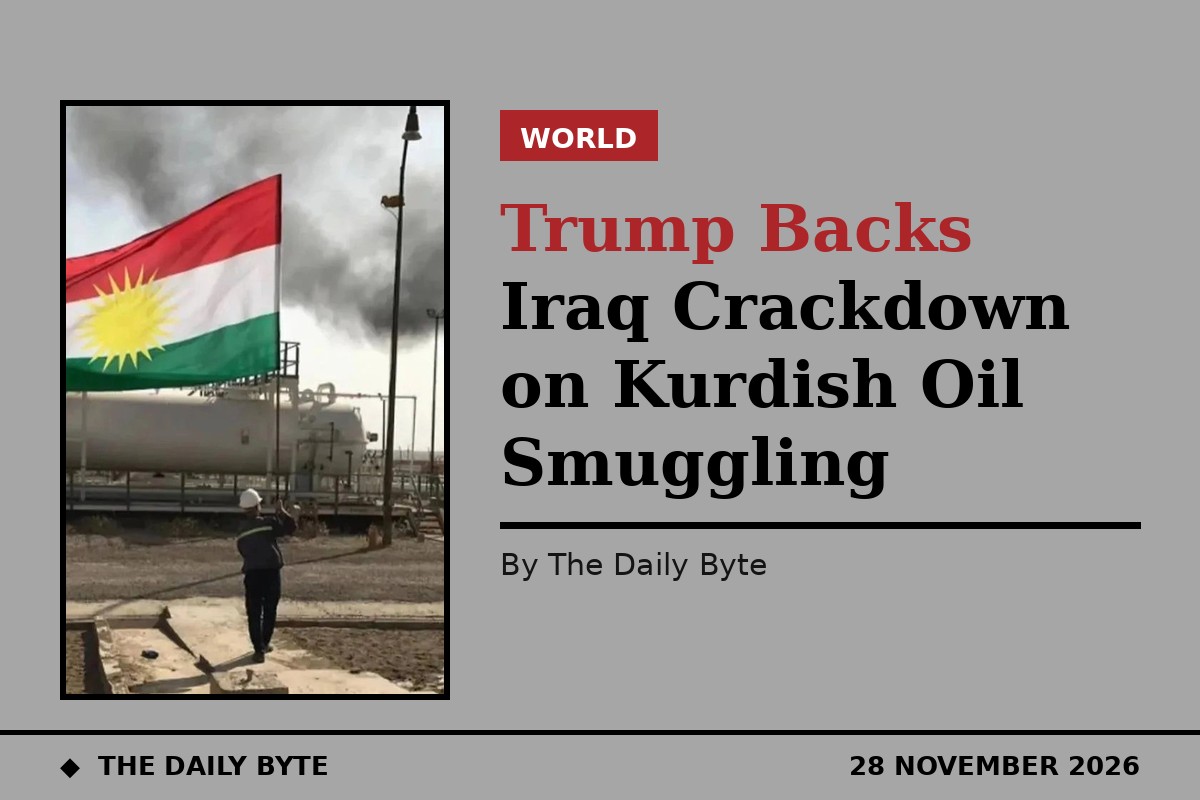
US President Donald Trump on Friday backed Iraqi Prime Minister Ali al-Zaidi's drive to impose Baghdad's control over the Kurdistan region's oil trade and borders, as Iraq's government put the cost of oil smuggling through the region at $100 billion over 17 years.
"We support Iraqi Prime Minister Ali al-Zaidi's efforts to assert state authority throughout Iraq, stop the smuggling of Iraqi oil, end corruption, and bring all weapons under the exclusive control of the state," Trump said in a post on Truth Social, according to Reuters.
The post appeared shortly after Iraqi government spokesman Haider al-Aboudi told the state news agency that Baghdad regards crude oil exports that bypass the state oil marketer SOMO as smuggling, because the proceeds do not reach the state treasury.
The $100 billion figure
Speaking to the Iraqi News Agency, Aboudi said Iraq lost an estimated $100 billion to oil smuggling through its Kurdistan region between 2008 and 2025. He attributed the figure to the Federal Board of Supreme Audit, Iraq's audit body, which he said had established that the damage from Kurdistan oil exported outside SOMO exceeded $100 billion.
Reuters noted that it was unclear how the government calculated the figure, and no audit report was released with the statement. The Insight International, reporting the same announcement, noted that the period cited covers years in which the Kurdistan Regional Government sold oil independently through Turkey, as well as periods when Erbil and Baghdad had export arrangements in place.
Aboudi said the border closures and the takeover of crossings were aimed at smugglers, and that legal action would reach anyone involved in wasting the state's sovereign wealth. He added that the prime minister was "concerned with protecting the people of Kurdistan" and made no distinction between one province and another.
Court ruling and border closures
The row escalated through the week. On Wednesday, Iraq's highest court ruled that Baghdad can deploy federal forces along all international borders, including those in the Kurdistan region, backing al-Zaidi's drive to bring Kurdish-run crossings and oilfields under federal control.
A day earlier, al-Zaidi had ordered the federal Oil Ministry to manage oilfields held by Kurdish security forces and directed the Border Ports Authority to take over every crossing in the region. The Kurdistan Regional Government was told not to approve crude or fuel exports except through the federal Oil Ministry.
On Thursday, Iraqi border forces closed two crossings administered by the Kurdistan Regional Government, one with Syria and one with Iran, after the prime minister ordered federal authorities to take control of crossings run by the semi-autonomous regional administration.
Iraqi Oil Minister Basim Mohammed told a news conference: "We are in contact with the Kurdistan region to ensure the optimal management and preservation of our oil wealth. The oilfields in the region and Basra belong to all Iraqis and remain under the Iraqi flag."
Kurdish response
Thousands of Kurds protested on Thursday against the moves to put oilfields under federal control and deploy federal troops along the region's international borders. The Kurdistan Regional Government rejected what it called the "military language and threats" in a statement from the Iraqi military spokesman announcing the new steps, while saying it was working with federal authorities to combat corruption and calling for an end to oil smuggling across Iraq.
The ruling Kurdistan Democratic Party and the Patriotic Union of Kurdistan said in a rare joint response that undermining the region's autonomy was a red line. Kurdish leaders are expected to hold talks with federal officials on 1 December.
Ties between Baghdad and the Kurds have often been strained over control of oil, money, territory and trade. The central government responded with force when Kurdistan held an independence referendum in 2017, though relations have lately grown calmer.
A wider crackdown
The moves against the Kurds came just a week after al-Zaidi ordered a showdown against the heavily armed Shi'ite militia Kataib Hezbollah, which is aligned with Iran. The prime minister ordered the army to prepare to enter Jurf al-Sakhar, south of Baghdad, where the government accuses the group of running a smuggling operation. The group was initially defiant but agreed to let soldiers enter the city.
Both crackdowns have been linked to alleged oil-smuggling rings, and both put Baghdad in direct confrontation with powerful armed factions. The court decision appears to be a victory for al-Zaidi, a 41-year-old multimillionaire businessman and political novice who came to power in a compromise just six months ago.
Iraq, one of the world's leading oil producers and an ally of both the United States and Iran, is hoping to attract wide-scale foreign investment into its often struggling economy. Whether Baghdad can enforce federal control without a wider confrontation is now the central question, with talks due within days.


