Trump Delays Iran Strike Decision Until After 1 January
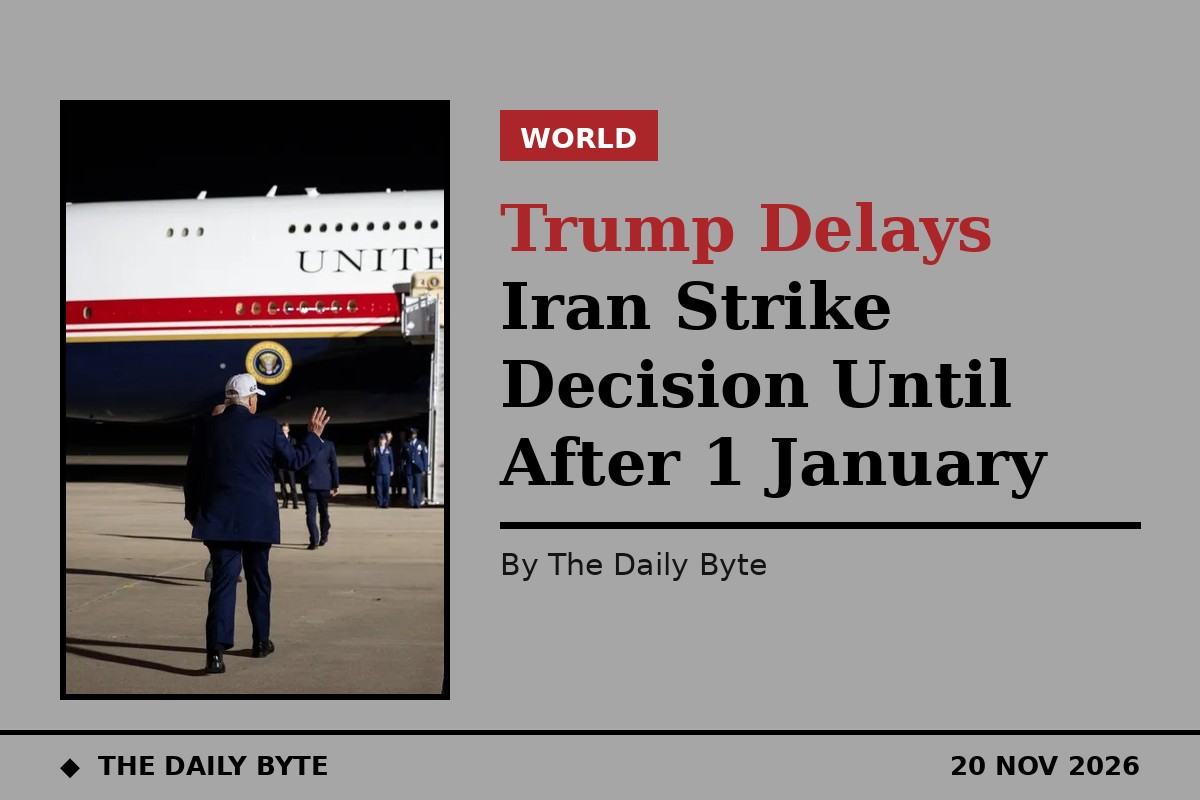
President Donald Trump has pushed a decision on renewed major strikes against Iran into next year, telling reporters aboard Air Force One that he is in no hurry to decide. The remarks, made on Thursday as he flew home from China, extend a timetable he had previously suggested could come to a head after this month's midterm elections.
"Well, I'll talk to you about it after the beginning of the year," Mr Trump said when Reuters asked about the possibility of new strikes. "We've got time." He gave the same message in two other interviews the same day, telling Fox News "we'll see what happens after January 1" and telling Axios and Israel's News 12: "I am not rushing into any decision [on Iran]."
Why the timetable has moved
In the weeks before the 3 November congressional elections, Mr Trump repeatedly suggested that Iran would be more willing to strike a deal once the voting was over. Instead, his fellow Republicans lost both chambers of Congress, and the administration said last week that it believes its naval blockade and economic sanctions against Iran are working. On Thursday, the Senate, which Republicans control until 3 January, voted 51 to 48 to reject a measure aimed at curbing the war, according to Reuters.
The president has acknowledged that the war played a part in the election losses, but has said he would not have changed course. Vice President JD Vance, a possible 2028 presidential candidate, publicly blamed the conflict for the party's defeat, writing that "the reason we lost is the war". Mr Trump told Reuters that Mr Vance's remarks were fine. "What he said was right," he said. "And the big thing is if you had to do it again, would you do it? And the answer is yes. Because you can't let Iran have a nuclear weapon." He has since directed Mr Vance away from Iran diplomacy and towards domestic matters.
Israel presses for action, Gulf states urge restraint
The delay comes despite intense pressure from Israel. The New York Times reported that Prime Minister Benjamin Netanyahu is urging Washington to join a joint operation lasting four to seven days, citing concerns that Iran is rebuilding its missile and drone capabilities. Israel's Channel 13 reported that Mr Netanyahu told Israeli security officials on Wednesday evening that an operation against Iran was "unavoidable". A senior Israeli official told Ynet News that Mr Netanyahu was "putting enormous pressure on the Americans, hoping to get to Trump and extract a green light from him".
The White House has nevertheless asked the Pentagon and intelligence agencies to assess how Iran might retaliate against various strike scenarios, according to Axios, cited by Breitbart. Officials are said to be particularly concerned about whether another operation could trigger devastating Iranian attacks on oil and gas infrastructure in Gulf states, which have urged Washington to avoid a new round of strikes. Among the targets reported to be under consideration is Iran's heavily fortified Pickaxe Mountain nuclear complex, as well as military installations, bridges, power plants and Iranian leaders. Mr Trump has not authorised another major operation.
What the delay does not settle
Secretary of State Marco Rubio has argued that Washington is already achieving its objectives through economic pressure, without the need for major combat operations. The administration's position is that the blockade, which has halted Iranian oil exports, and sanctions are squeezing Tehran. Iran's President Masoud Pezeshkian warned on Thursday that disruption to domestic production could bring rising unemployment and spreading poverty.
Mr Trump also used the Fox News interview to address a CNN report that Iran was planning to detonate a "dirty bomb" in Washington, saying "I don't think so" when asked whether people in the capital should be alarmed. He added that there were indications Iran was "looking at" biological or chemical weapons, without elaborating. Iran's Foreign Ministry rejected the claim, calling it an attempt to create fear and justify military action, and Tehran denies seeking nuclear weapons. The chemical and biological claim has not been independently verified.
Nothing in the president's remarks amounts to a promise that there will be no strike before January. Axios noted that he could change his mind at any time, and that he would not telegraph an attack in advance. With Democrats due to take control of Congress on 3 January having pledged to make ending the war a priority, the window Mr Trump has given himself is narrow: a decision deferred, not a decision made.


