Appeals Court Gives Trump New Path in Hush Money Case
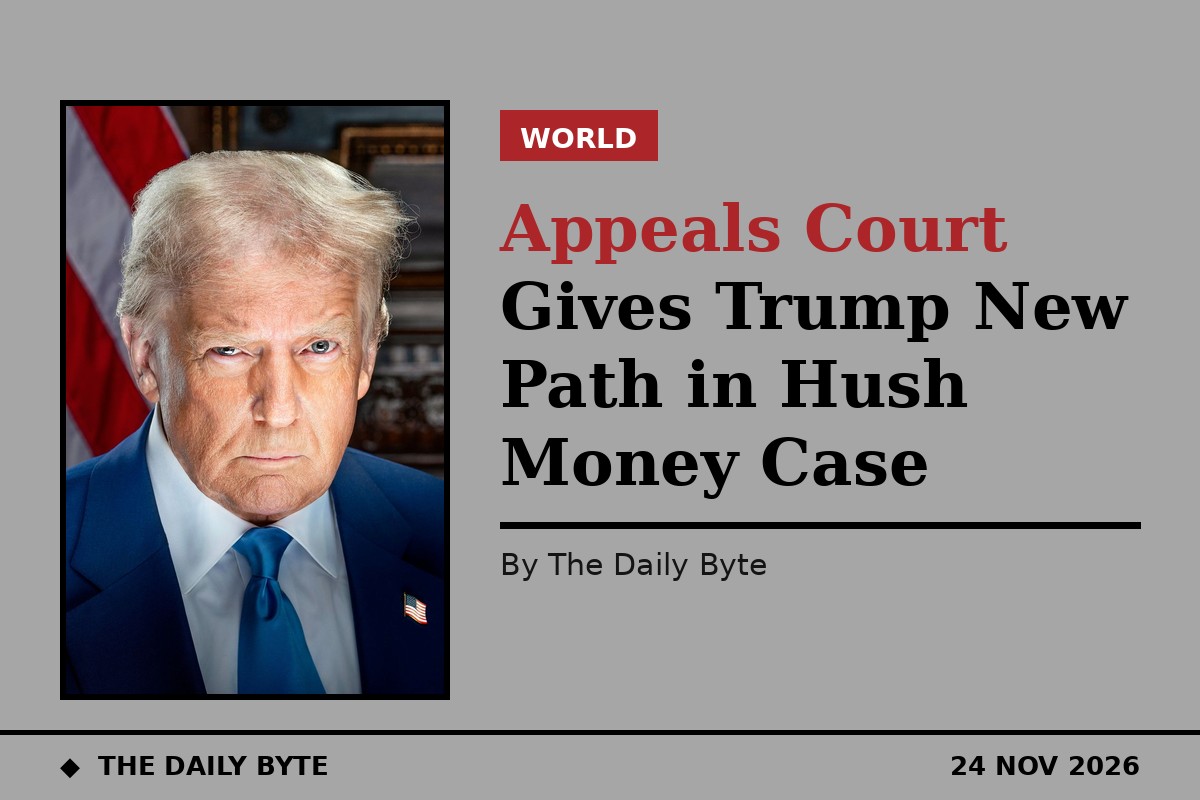
A federal appeals court has given President Donald Trump a new pathway to try to erase his hush money criminal conviction, reviving his long-running effort to move the case from a New York state court into the federal system. The ruling, handed down on Monday, 23 November, does not overturn the conviction, but it opens a route through which Trump could ask a federal judge to dismiss the case on presidential immunity grounds.
A three-judge panel of the 2nd US Circuit Court of Appeals reversed a lower court decision that had kept the case in state court in New York, where Trump was tried and convicted on 34 felony counts of falsifying business records. The counts related to a 130,000 dollar payment to adult film performer Stormy Daniels, made to silence claims about an alleged affair before the 2016 presidential election. Trump denies wrongdoing and was given no punishment in the case, which made him the first US president convicted of a crime.
What the appeals court decided
In a two-page order, the panel said the late US District Judge Alvin Hellerstein had erred when he ruled that moving a state criminal case to federal court, a process known as removal, was categorically unavailable after a federal officer defendant had been convicted. The judges also said Hellerstein had erred in finding that Trump's lawyers had failed to show good cause to make two attempts at moving the case, once after his indictment and again after his trial.
The panel ordered a federal judge to promptly decide whether the US District Court in Manhattan should retain control of the case. If the case stays in federal court, Trump could then argue that the verdict should be discarded because of presidential immunity. The decision also set in motion a halt to proceedings in Trump's simultaneous state court appeal, which will pause while the federal question is addressed.
Why the timing matters
Trump's lawyers have argued that the appeal should be heard by federal judges because it involves questions of federal election law and the Supreme Court's presidential immunity decision, which came down weeks after his conviction in May 2024. They said they had good cause to seek removal again because they did not know how much the district attorney's office would rely on federal election law at trial, or how the immunity ruling would limit the use of evidence about official conduct.
Hellerstein had rejected Trump's argument for moving the case into federal court three times. He died last month at the age of 92, and the case has not yet been assigned to another judge. Whoever takes it over will bring fresh eyes to legal questions that began in 2023 and escalated after the conviction and the Supreme Court's immunity ruling two months later. The panel that ruled on Monday consisted of Judge Raymond Lohier Jr., Judge John M. Walker Jr. and Judge Jose A. Cabranes, two nominated by Democrats and one by a Republican.
What happens next
If the new district court judge decides the case should move to federal court, the Second Circuit would probably then evaluate the case on its merits. Any further appeals would go to the Supreme Court, allowing it to interpret its own ruling on immunity. That route could also bring the case to the Supreme Court more quickly than the state process, which might otherwise take years to exhaust.
Earlier this month, Trump's lawyer argued before a state appellate court panel that it should overturn the verdict. That court has not yet ruled. At a hearing last week, Steven Wu, chief of appeals for the Manhattan District Attorney's office, argued that the case was not about Trump's social media posts or his conversations with former White House communications adviser Hope Hicks, who testified at trial. He said the case was about falsifying business records to commit or conceal another crime, which could have involved state or federal election law, tax law or falsifying bank records.
A spokesman for Trump's legal team celebrated the decision, saying Trump appreciated the Second Circuit's prompt ruling and would keep challenging what he called the weaponisation of the justice system. A representative for the Manhattan District Attorney's Office could not be reached for comment on Monday afternoon. For now, the conviction stands, but the appeals court's order has given Trump a second chance to move the fight into federal court, where the immunity argument would take centre stage.


