Trump Israel Aid Is Not Ending, It Is Changing Shape
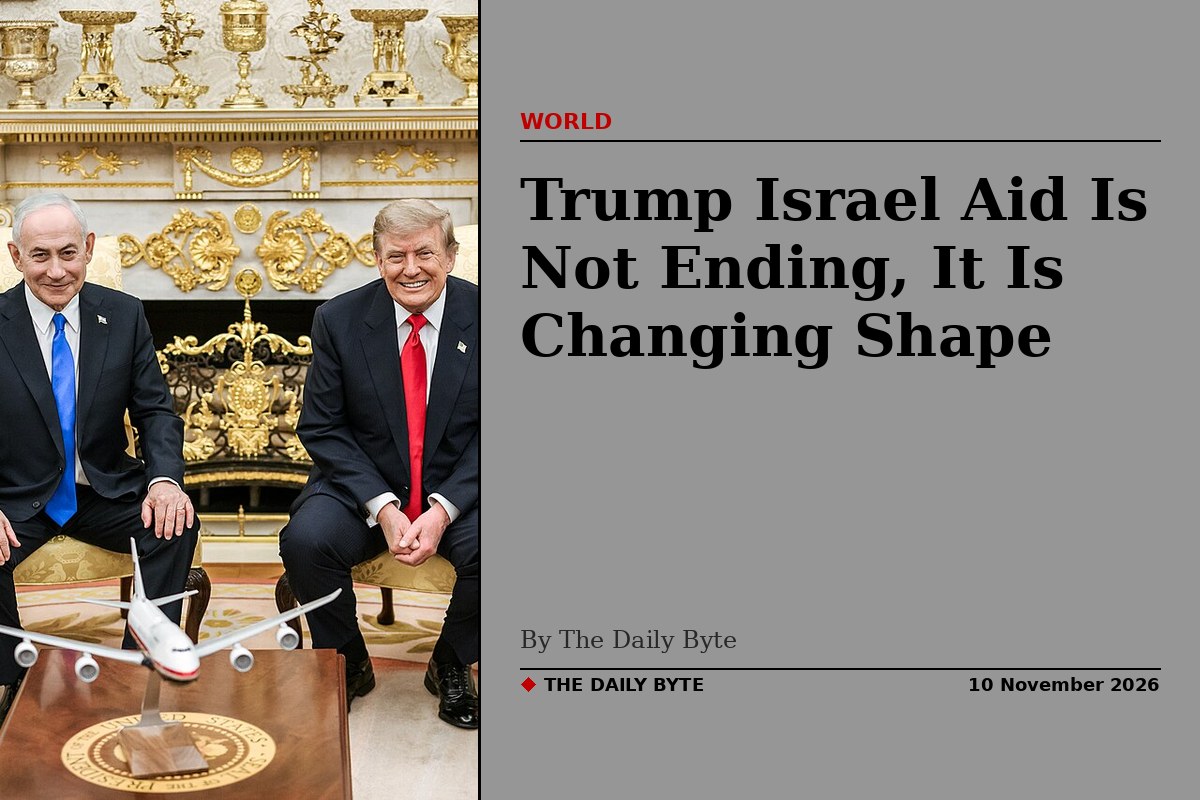
President Donald Trump’s announcement that the United States will stop about $4 billion a year in aid to Israel has alarmed many in Israel and delighted critics of the funding in the US. But defence experts and former officials say the money is not going away. It is changing shape, moving from the State Department to the Pentagon and from grants to a defence-industry partnership.
Trump made the announcement on 3 November 2026, on election day for the US midterm elections, in an interview on Fox News’ Fox & Friends programme. He said he and Israeli Prime Minister Benjamin Netanyahu had agreed months earlier that the funding would stop by the end of this year, while weapons sales to Israel would continue.
“We give Israel $4 billion a year, and we made a deal months ago that we’re stopping,” Trump said. “We’ve already agreed that by the end of this year we won’t be paying Israel. Now we’ll help Israel if they need it.” He added that Israel no longer needed the money and had become a very successful country.
The $3.8 billion framework
The figure at the centre of the announcement is a familiar one. The US provides about $3.8 billion a year in military assistance to Israel under a ten-year memorandum of understanding signed in 2016, covering the US fiscal years 2019 to 2028. Of that, $3.3 billion is foreign military financing and $500 million supports cooperative missile defence.
That agreement does not expire until September 2028, and Trump gave no details of how the funding would be halted at the end of this year, or which accounts and deliveries would change.
The idea of ending the funding did not begin with Trump. In May 2026, Netanyahu told CBS’ 60 Minutes that he wanted to draw the financial support down to zero. “I want to draw down to zero the American financial support, the financial component of the military cooperation we have, because we receive $3.8 billion dollars a year,” he said. “I think it’s time we weaned ourselves.”
From aid to partnership
For months, US and Israeli officials have been negotiating a plan to shift the relationship from the State Department to the Pentagon. It would integrate parts of the Israeli and American defence industries and make it easier to run joint projects on missile defence, cybersecurity, biotechnology and drones.
“The way Israel defines it, we’re going from aid to partnership,” Avishay Ben-Sasson-Gordis, head of US-Israel research at the Institute for National Security Studies in Tel Aviv, told NPR.
The new framework is set out in the National Defense Authorization Act for fiscal year 2027. In the House version of the bill, Section 219 says the US defence secretary would designate an “executive agent” inside the Pentagon, responsible for synchronising cooperative efforts between the US and Israeli militaries.
“It doesn’t mean that the US and Israel are going to stop working together. It doesn’t mean the US is going to stop funding things,” Mairav Zonszein, senior Israel analyst at the International Crisis Group, told NPR. “It’s just going to be repackaged, reframed — and possibly not include the same kind of congressional oversight.”
Supporters and critics disagree
The American Israel Public Affairs Committee, which supports the new arrangement, says it includes a $50 million increase in US funding for Israel compared with fiscal year 2026. Amnesty International, by contrast, calls it a troubling proposal that risks expanding the US government’s legal liability for potential violations of international law committed by Israel’s military.
Critics also warn that funding routed through the Pentagon could face less scrutiny and less transparency, at a time when American public support for Israel has fallen to a record low. Annelle Sheline, a former State Department official now at the Quincy Institute, told NPR the change would let the money be protected inside the Pentagon budget.
What happens next
The House passed its version of the defence bill in July, but the Senate has not yet passed its version. Congress needs to pass and reconcile both before a government funding deadline on 11 December. That means it will be the outgoing lame-duck Congress, rather than newly elected members who include more critics of Israel, that may ultimately decide the new framework.
For now, the careful description is an announced intention with important questions still open, rather than an established end to American support. The annual grant may end, but the US-Israeli defence relationship, on the evidence of the plan now before Congress, is being rewritten rather than wound up.
Sources
NPR: What Trump meant when he said the US is cutting aid to Israel
Reuters via TBS News: Trump says US will stop $4 billion in funding to Israel at end of 2026


