Trump launches Americas anti-cartel coalition at Doral
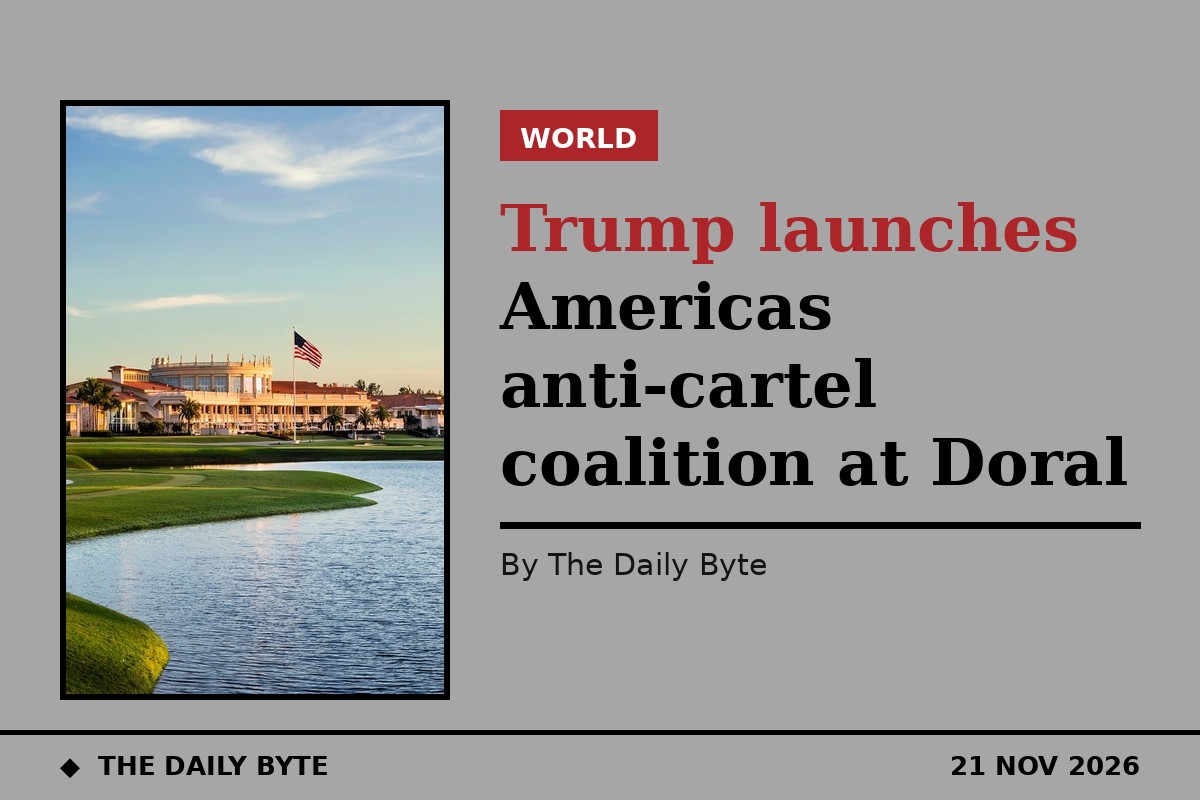
President Donald Trump opened the first Shield of the Americas summit on Saturday at his Trump National Doral resort in Florida, launching a new military coalition aimed at drug cartels and telling a dozen Latin American and Caribbean leaders that only military force can defeat them.
The gathering brought together the leaders of Argentina, Bolivia, Chile, Costa Rica, the Dominican Republic, Ecuador, El Salvador, Guyana, Honduras, Panama, Paraguay and Trinidad and Tobago. Trump signed a proclamation formally launching the Americas Counter Cartel Coalition, which he said would use lethal military force to destroy cartels and what he called terrorist networks operating across the hemisphere.
“The only way to defeat these enemies is by unleashing the power of our militaries,” Trump told the leaders. “We have to use our military. You have to use your military.” He compared the effort to the United States-led coalition that confronted the Islamic State group in the Middle East, saying the same approach should now be used against the cartels at home.
Seventeen nations signed up this week
Trump said representatives of 17 nations had formally entered the new alliance earlier in the week in Miami, in meetings led by Secretary of War Pete Hegseth. The heart of the agreement, he said, is a commitment to use lethal military force against cartels, with the United States offering intelligence, weapons and, where invited, direct help. He told leaders the United States would do whatever they needed, including missile strikes, while accepting that some countries would prefer to handle the problem themselves.
Secretary of State Marco Rubio hosted the leaders for a working lunch after Trump left the summit. The lunch gave Kristi Noem her first outing as special envoy for the Shield of the Americas, a new role she took up after Trump dismissed her as homeland security secretary on Thursday, according to the Associated Press. Noem told the leaders the aim was a hemisphere that was safer, more sovereign and more prosperous.
Notably absent from the summit were the region’s two largest powers, Brazil and Mexico, as well as Colombia, long the linchpin of United States anti-narcotics strategy in the region. Trump nonetheless singled out Mexico in his remarks, calling it the epicentre of cartel violence and saying drug kingpins there were orchestrating much of the bloodshed in the hemisphere. “The cartels are running Mexico,” he said. “We can’t have that. Too close to us.”
Venezuela recognised, Cuba “at the end of the line”
Trump used the summit to confirm that the United States had formally recognised the interim government of Delcy Rodriguez in Venezuela this week, restoring diplomatic and consular ties. He said Washington had also reached what he called a historic gold deal with Venezuela to work together on sales of Venezuelan gold and other minerals, and said the country was making more money from oil than ever before under the new arrangement.
He then turned to Cuba, saying the island’s government was in its final phase. “Great change will soon be coming to Cuba,” he said, adding that Havana had no money and no oil, and that it wanted to negotiate. He said a deal with Cuba would be easy to reach once the war with Iran was over, and that several leaders at the summit had asked him to deal with Cuba. Cuban officials have said they are open to dialogue based on respect for Cuban sovereignty, but have never confirmed that talks are taking place.
Joint operations already under way
The summit followed joint action this week. Ecuadorian and United States security forces attacked a refuge belonging to the Colombian armed group Comandos de la Frontera in the Ecuadorian Amazon on Friday, authorities reported, and Ecuador’s president, Daniel Noboa, said the joint fight against drug traffickers was only the beginning. Trump also pointed to his administration’s campaign against drug boats, saying drugs arriving by sea had fallen sharply, and said fentanyl crossing the United States border had fallen by 67 percent in his first year.
Trump’s time with the leaders was brief. After the summit he flew to Dover Air Force Base in Delaware for the dignified transfer of six United States troops killed in a drone strike on a command centre in Kuwait, a day after the United States and Israel launched their military campaign against Iran. The summit was designed to show that the White House still regards Latin America as a strategic priority even as the war with Iran dominates its foreign policy, and Trump warned the leaders against what he called hostile foreign influence in the hemisphere, an implicit reference to China’s footprint in the region. Trump National Doral is also set to host the Group of 20 summit later this year.