Trump pardons late baseball legend Pete Rose
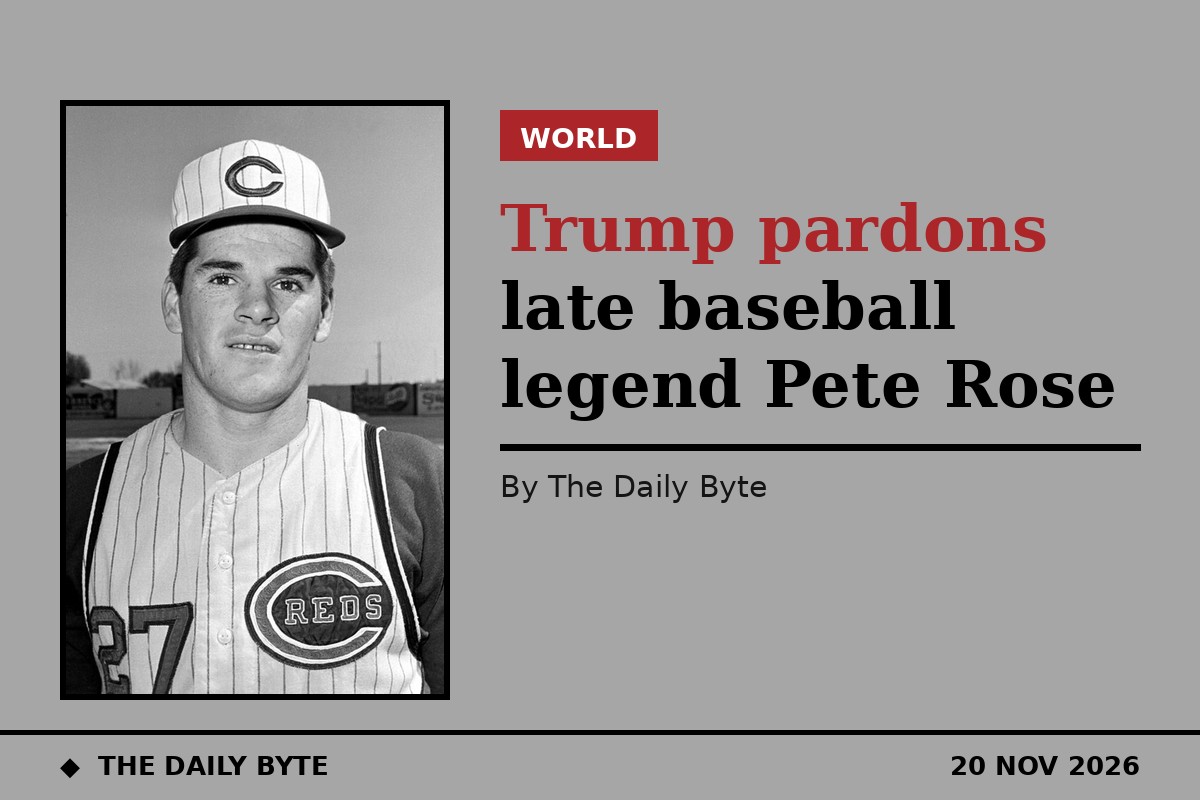
President Donald Trump has posthumously pardoned baseball's all-time hits leader Pete Rose for tax crimes, more than two years after the player's death and a year after Major League Baseball lifted his lifetime ban.
Trump announced the pardon on Thursday, 19 November, in a social media post written as he flew home from a trip to Asia aboard Air Force One. "I have just given a Complete and Total Pardon to the Late, Great Pete Rose, a true Baseball SUPERSTAR & LEGEND, whose record of 4,256 Hits ... will never be broken," he wrote.
Rose, who died on 30 September 2024 at the age of 83, pleaded guilty in 1990 to two felony counts of filing false tax returns. Trump had said earlier in November that he would consider a pardon for Rose.
The hits king and the ban
Rose amassed 4,256 hits over a 24-year career from 1963 to 1986, most of it with the Cincinnati Reds. Nicknamed "Charlie Hustle" for his relentless style of play, he won three World Series titles and was one of the most popular players of his era.
But he was banished from the game after he was found to have wagered on baseball, including games in which he took part as a manager of the Reds. The lifetime ban meant he could not play or coach in the major leagues, and he was not eligible for admission to the National Baseball Hall of Fame.
After the ban, Rose blamed his exclusion from the game for financial struggles, saying he relied on memorabilia signings and public appearances to make a living.
The tax case
The tax charges arose from income Rose did not declare, including money from those signings and winnings from horse-racing wagers. He served a five-month sentence in a minimum-security prison, followed by three months in a halfway house, paid a $50,000 fine and was ordered to complete 1,000 hours of community service.
The pardon wipes away those federal tax convictions. It does not by itself put Rose into the Hall of Fame, which is decided separately by baseball's own bodies.
Hall of Fame still not settled
MLB Commissioner Rob Manfred posthumously removed Rose from the permanently ineligible list in May 2025, and later acknowledged that Trump urging him to do so in a meeting at the White House in April had influenced his decision. Rose is now eligible for Hall of Fame consideration.
As a player whose contributions came largely before 1980, Rose will be considered by the Classic Baseball Era Committee. The group will next vote in December 2027, for induction in July 2028. He would need 12 votes from the 16-person committee, and his chances appear limited: the committee has tended to respect the precedent set by baseball writers, who did not elect Barry Bonds or Roger Clemens, both strongly linked to performance-enhancing drugs.
Jeffrey Lenkov, the attorney who has represented the Rose family in its attempt to win reinstatement, called the pardon a "benevolent gesture" by Trump, "but it would have been better to have occurred when he was alive". He added: "Pete is very polarizing."
A pardon, not a plaque
In the same social media post, Trump also advocated for retired pitcher Roger Clemens, the only seven-time winner of the Cy Young Award for the top pitcher in each league. Allegations of steroid use have kept Clemens out of the Hall of Fame, although he has denied using performance-enhancing drugs and was acquitted at trial on charges of lying to Congress about the subject.
"Politics, I guess!" Trump wrote in his post.
For Rose's supporters, the pardon is the latest step in a long campaign to rehabilitate the reputation of baseball's hits leader. Whether the Hall of Fame's voters follow remains an open question until December 2027.
Sources: Reuters; USA Today.


