Trump Pauses Project Freedom Hormuz Mission
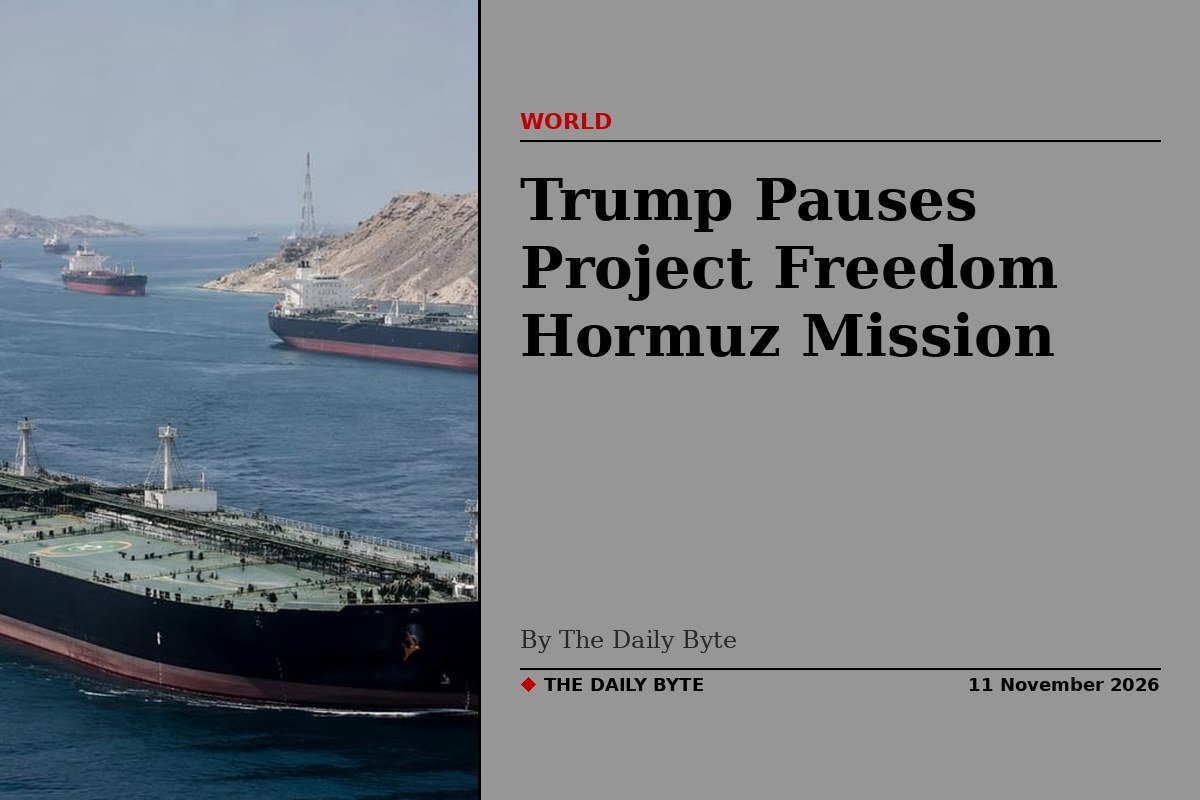
US President Donald Trump has paused Project Freedom, the American naval mission to guide stranded ships through the Strait of Hormuz, saying the move will give talks with Iran a chance to produce a deal.
Trump announced the pause on his Truth Social platform on Tuesday, a day after the operation began. He said the decision was made following a request from Pakistan and other countries and because, in his words, great progress had been made towards a complete and final agreement with representatives of Iran.
“We have mutually agreed that, while the Blockade will remain in full force and effect, Project Freedom (The Movement of Ships through the Strait of Hormuz) will be paused for a short period of time to see whether or not the Agreement can be finalized and signed,” he wrote.
There was no immediate comment from Iran on the announcement.
What Project Freedom was meant to do
Trump announced the mission on Sunday, describing it as a humanitarian gesture to free ships and crews trapped in the Gulf since the war between the United States, Israel and Iran began on 28 February. He said the United States would guide the vessels safely out of the restricted waterways so they could resume their business.
US Central Command said it would support merchant vessels seeking to transit the strait. According to the command, the deployment could include guided-missile destroyers, more than 100 land and sea-based aircraft, unmanned platforms and about 15,000 service members.
The International Maritime Organization estimates that up to 20,000 seafarers are stranded on board roughly 2,000 vessels in the Gulf near the strait, which normally carries about one-fifth of the world’s oil and liquefied natural gas supplies. Iran has effectively sealed the waterway since the war began, while the United States has imposed its own blockade on Iranian ports.
Warnings and clashes in the strait
The mission began against a tense backdrop. Iran’s military warned that any foreign armed force entering the strait would be attacked, and Iran’s Islamic Revolutionary Guard Corps issued a new map of the waterway with an expanded area of Iranian control, warning vessels to keep to the corridors it has set or face a decisive response.
Iranian media claimed a US warship trying to cross the strait near the port of Jask had been hit with two missiles and forced to withdraw. The US military denied the claim, saying no US Navy ships had been struck, and no independent evidence has confirmed it.
The US military said it destroyed several Iranian boats in the strait, as well as cruise missiles and drones. The United Arab Emirates said its air defences dealt with missile and drone attacks from Iran for a second day, while another commercial ship in the strait reported being hit by an unknown projectile.
Washington says offensive operations are over
On Tuesday, US Secretary of State Marco Rubio told reporters that the United States had completed its offensive operations against Iran, known as Operation Epic Fury, and that there would be no shooting unless US forces were shot at first. He added, however, that Iran must pay a price for its efforts to control the strait.
“The Straits of Hormuz do not belong to Iran. They don’t have a right to shut it down and blow up ships and lay mines,” Rubio said.
US Defence Secretary Pete Hegseth said the renewed violence in the strait did not amount to a breach of the four-week-old truce. “Right now, the ceasefire certainly holds, but we’re going to be watching very, very closely,” he said at the Pentagon.
Earlier on Tuesday, Trump told reporters at the White House that Iran wanted a deal, despite its defiant public stance. “Iran wants to make a deal,” he said. “They want to make a deal. And who wouldn’t?”
The pause does not end the pressure on Tehran. The US naval blockade of Iranian ports remains in full force, and the strait remains closed to normal shipping. Whether the pause leads to a signed agreement, or simply delays a return to confrontation, is now the question facing mediators in the days ahead.
Frequently asked questions
What is Project Freedom? It is the name given by President Donald Trump to a US naval mission to escort ships stranded in the Gulf through the Strait of Hormuz, which Iran has effectively closed since the war began on 28 February.
Why was Project Freedom paused? Trump said it was paused for a short period at the request of Pakistan and other countries, because of what he described as great progress towards a complete and final agreement with Iran.
Is the US blockade of Iran still in place? Yes. Trump said the blockade of Iranian ports will remain in full force while Project Freedom is paused.


