Trump Vows Tax on Firms Building Data Centres Abroad
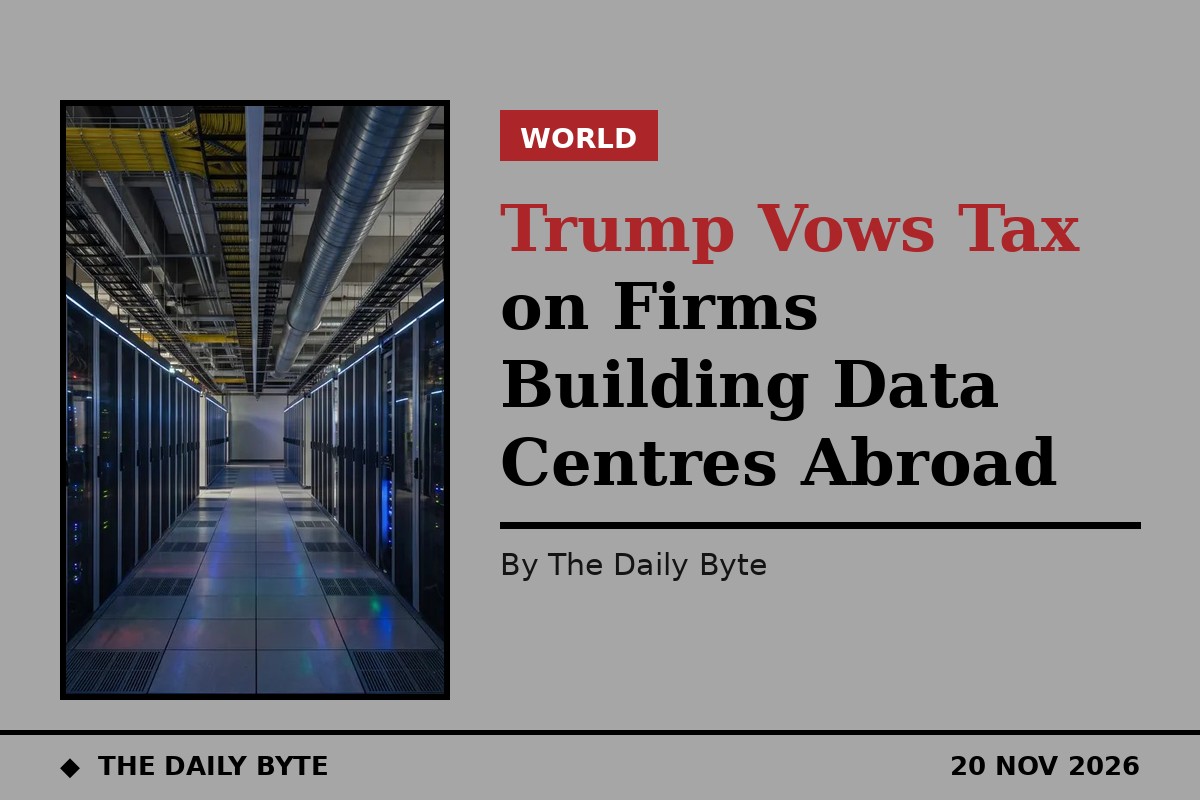
President Donald Trump said on Friday that the United States would penalise American companies that build data centres overseas, threatening a “tremendous tax” on firms that site the facilities abroad rather than at home.
“We’re not going to allow our companies to build data centers outside of our country,” Trump said at a White House news conference following his trip to Asia. He said companies that build data centres abroad would face “a tremendous tax”.
Trump framed the move as part of the contest with China over artificial intelligence. “We’re not allowing data centers to go into other countries because China will take all of them, and we’re not allowing that to happen,” he told reporters, adding that his administration would “fight very hard” to encourage companies to build in the United States.
No details yet on how the penalty would work
No detail was given on Friday about how such a tax would be designed, which companies it would cover, or when it might take effect. Trump said he had not yet told his own officials about the plan, according to the Associated Press, and no legislation or executive action was announced alongside the remarks.
That matters because a new tax on overseas construction would need Congress, a trade measure, or some other legal route to take effect. For now the announcement is a threat and a statement of intent, not a policy with a timetable. Companies with overseas data centre plans have been given no formal instruction to change course.
Trump also urged Americans to welcome data centre construction in their own communities, while pressing developers for concessions. “You ought to take advantage of the data centers. Make them pay you, make them pay your community, but don’t shut them off,” he said.
Part of a wider clampdown on AI computing abroad
The remarks follow a week in which Washington tightened the rules around advanced computing overseas. On Monday, the Commerce Department announced interim licensing requirements for advanced AI chips headed to data centres anywhere in the world that supply significant computing power to companies in China and other countries of concern, with added case-by-case licensing for shipments to Indonesia, Malaysia, Singapore, Thailand and Brazil.
Reuters reported on Thursday that Taiwan’s TSMC had suspended some previously permitted advanced chip manufacturing orders from Chinese customers following the new licensing requirements. Chinese technology stocks have fallen this week as investors weigh whether the curbs will slow Beijing’s AI ambitions or accelerate its push for technological self-sufficiency.
Data centres are central to the AI boom because they provide the computing power needed to train and run increasingly complex AI systems. Developers often locate facilities close to users to reduce delays for time-sensitive work such as payment processing, and moving large volumes of data over long distances can add significant costs, so a penalty on overseas builds could complicate the global buildout.
What it could mean for the big tech firms
The threat lands on an industry that has been expanding abroad at pace. Google committed about €13 billion (roughly $15 billion) to AI infrastructure in Finland in September, its largest single investment in Europe, covering data centres in Hamina, Kajaani, Muhos and Vaala. Projects of that kind are exactly the sort of overseas construction Trump’s remarks would cover, although no company was named on Friday.
Whether the threat becomes policy will be watched closely in Washington and in the countries courting American investment. Until a mechanism is set out, the practical effect is uncertainty for firms planning where to put their next wave of AI computing capacity.


