Trump says 'fair' Canada trade deal is in the works
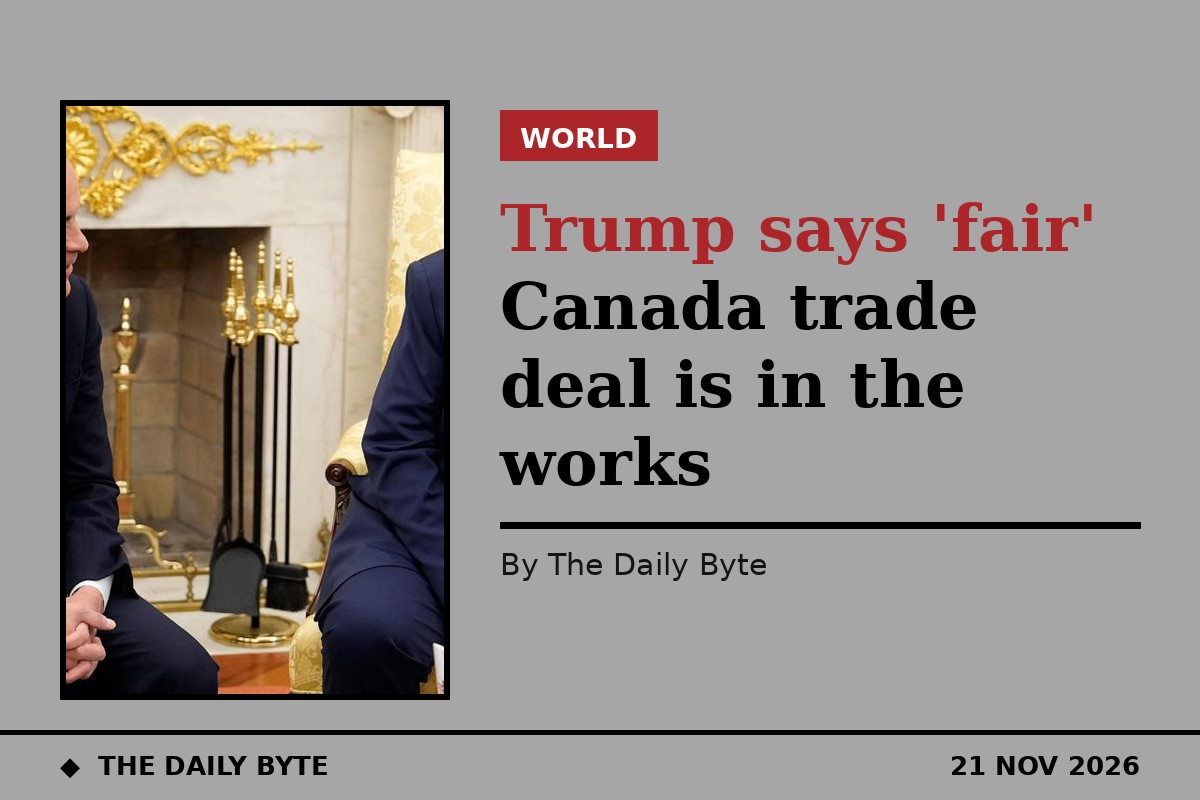
President Donald Trump has said the United States is working on a “fair” trade deal with Canada, but that more work remains before anything is agreed. His comments on Friday came a day after Canada’s trade minister said Ottawa is aiming for an interim arrangement by the end of the year that would lower American tariffs and open formal talks on reviewing the three-country trade pact.
Speaking at a White House news conference after returning from a trip to Asia, Trump said Prime Minister Mark Carney “was very nice” and that a deal was in the works. He also repeated his complaint that Canada has been “ripping us off” for years, and said he would be ready to talk once Canada’s trade surplus with the United States falls to zero.
Canada’s trade minister, Dominic LeBlanc, told CBC’s Power & Politics on Thursday that Ottawa is seeking an interim arrangement rather than a full trade agreement. Such a deal would probably keep some tariffs imposed under Section 232 of a 1962 American trade law — covering steel, aluminium, cars and lumber — but at lower rates. Canada also wants the 50 per cent tariffs imposed in August on hundreds of Canadian goods removed entirely.
Autos are the sticking point
The biggest obstacle is the tariff on Canadian vehicles. The United States charges 25 per cent on Canadian cars, and Trump said in August that the rate would rise to 50 per cent on 1 January. A deal reached in December would stop that increase before it starts, while a deal that slips into January or February would come too late for carmakers already planning around the higher rate.
LeBlanc was candid that Canada will not get everything it wants. “We have to be realistic with Canadians,” he said. “In those particular sectors, an element of those tariffs is going to remain.” His measure of success, he said, is a “better comparative position” than the countries that have already struck deals with Washington. The European Union, Japan and South Korea each accepted 15 per cent on cars, while Britain accepted 10 per cent on a fixed number of vehicles.
An interim deal would also unlock the formal review of the Canada-United States-Mexico Agreement, known as CUSMA. Washington declined to renew the pact in July, and LeBlanc said the Americans have made clear that an arrangement on tariffs would let the review process begin. Canada’s chief trade negotiator has told MPs the aim is the lowest tariff on the narrowest range of goods, with the best access for Canadian businesses and workers.
New Congress may not help
LeBlanc warned Canadians not to see the new Congress, which takes office on 3 January with Democratic majorities in both chambers, as a “magic bullet”. Some Democrats have pledged to try to end the tariffs, and the Senate has already passed resolutions against them, but the president can veto such measures and an override needs two-thirds of both chambers.
Reuters has reported, citing two people familiar with LeBlanc’s briefing, that the United States has shown little movement since the last round of talks broke down in August, and that the midterm elections have not changed the course of the negotiations. Carney, speaking by video from China on Wednesday, said: “We’d like to do a deal. If the U.S. doesn’t want to do a deal, we’re busy.”
Tensions flared this week when Peter Navarro, one of Trump’s top trade advisers, criticised Carney for seeking closer trade ties with China, calling the move “offensive in the extreme”. Carney met Trump on the sidelines of the Asia-Pacific Economic Cooperation summit in China, a conversation he described as “reasonably direct” but one that produced no breakthrough.


