Trump Says Iran War 'Effectively Over' After Qatar Talks
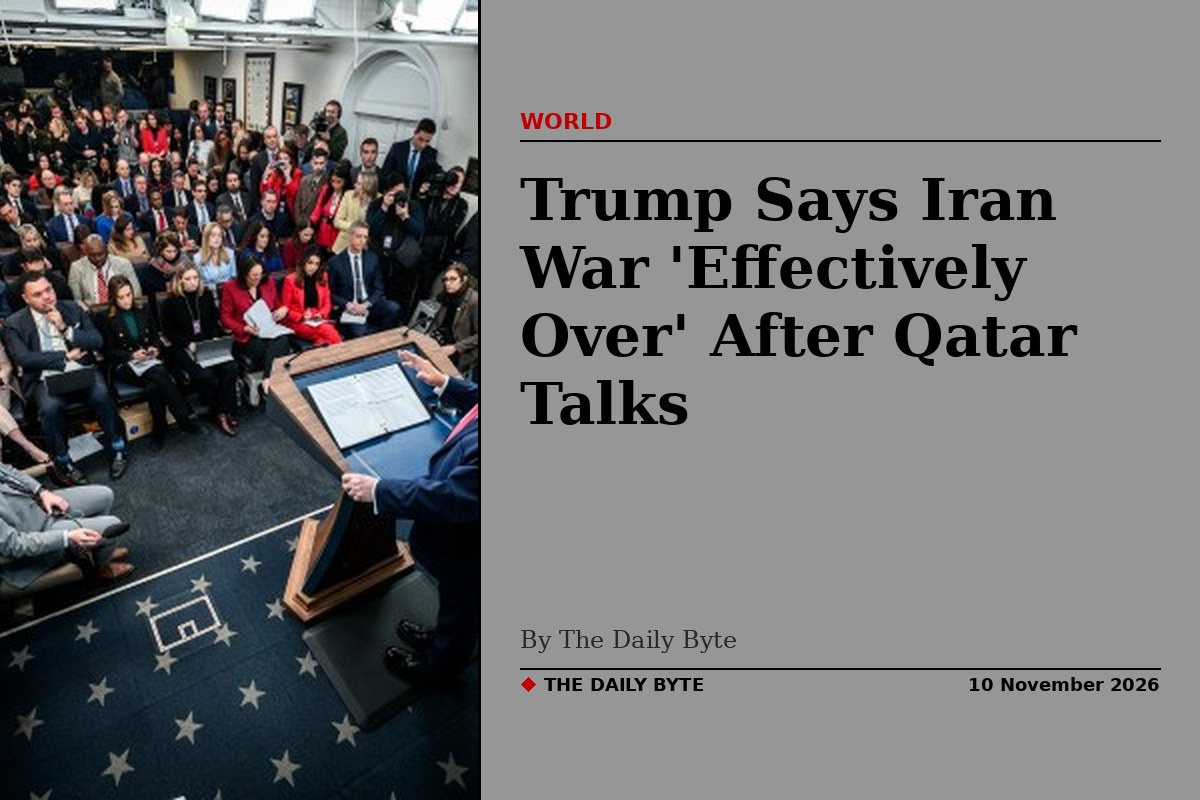
US President Donald Trump has said the war in Iran is “effectively over” in military terms, signalling that he does not plan to order new American strikes for now while keeping US forces ready to act if circumstances change.
Mr Trump made the remarks on Monday, 9 November, during a surprise visit to the White House briefing room, shortly after meeting Qatar’s Prime Minister, Sheikh Mohammed bin Abdulrahman Al Thani, at the White House. The Qatari leader has been acting as a key mediator between Washington and Tehran.
“Iran militarily is effectively over,” Mr Trump told reporters. “We’re just keeping it the status quo.”
No new strikes “at this point”
Asked about the possibility of renewed military action, the president said it did not currently seem necessary. “At this point ... taking the military action doesn’t seem to be a very necessary thing. But we’re locked and loaded, ready to go for any reason that changes,” he said, according to Reuters.
He added that he believed the conflict was “going to be ending fairly soon”. Mr Trump also told Reuters that Qatar and Saudi Arabia would both prefer a peaceful solution to the conflict, while stressing that the United States remained ready to resume strikes if needed.
The president said he had decided to maintain the current position — including the US naval blockade of Iran — after his conversation with the Qatari prime minister. He also announced a new effort, named Operation Iron Gate, aimed at cutting Iran’s overland trading routes, alongside the existing naval blockade.
Mr Trump said the US military had identified infrastructure targets, including 38 bridges, that it could strike if military action resumed. He did not say when, or under what circumstances, such strikes would be ordered.
Talks remain stalled
The comments came a day after Mr Trump told CNN in a telephone interview that it was “highly unlikely” new strikes would be necessary if negotiations with Tehran made progress and produced a strong agreement.
US Secretary of State Marco Rubio said on Sunday that negotiations had made little progress and that he did not see an imminent breakthrough. He rejected the terms put forward by Tehran.
Iran has proposed ending the war within a two-day framework. Under its plan, the United States would end its blockade of Iranian ports, lift some sanctions and halt bombing, in return for Tehran ending its own blockade of the Strait of Hormuz. Talks on Iran’s nuclear programme and other sanctions would follow. Washington has repeatedly rejected that plan, although Iranian officials have defended it as the most reasonable offer available.
Iranian President Masoud Pezeshkian said on Monday that Tehran was prepared to negotiate an end to what he described as a prolonged state of neither war nor peace. He said Supreme Leader Mojtaba Khamenei had instructed officials to resolve the uncertainty, but insisted Iran would not surrender to coercion.
A war in its ninth month
The conflict began on 28 February, when the United States and Israel launched attacks on Iran. More than eight months later, neither side has achieved a decisive victory, and mutual attacks have continued.
US forces have carried out limited strikes on Iran in the past week, including against air defences, and Iranian state media reported strikes on Qeshm Island in the Strait of Hormuz. Iran has continued to attack tankers in the Gulf and the Strait of Hormuz, through which about a fifth of global petroleum liquids consumption passed before the war.
For now, Mr Trump’s message is one of pause rather than peace. The blockade stays, the forces stay in place, and the diplomacy continues — but the president has made clear that a return to large-scale strikes is not his current plan.


