Trump Says US Does Not Need Iran Deal, Redirects Vance
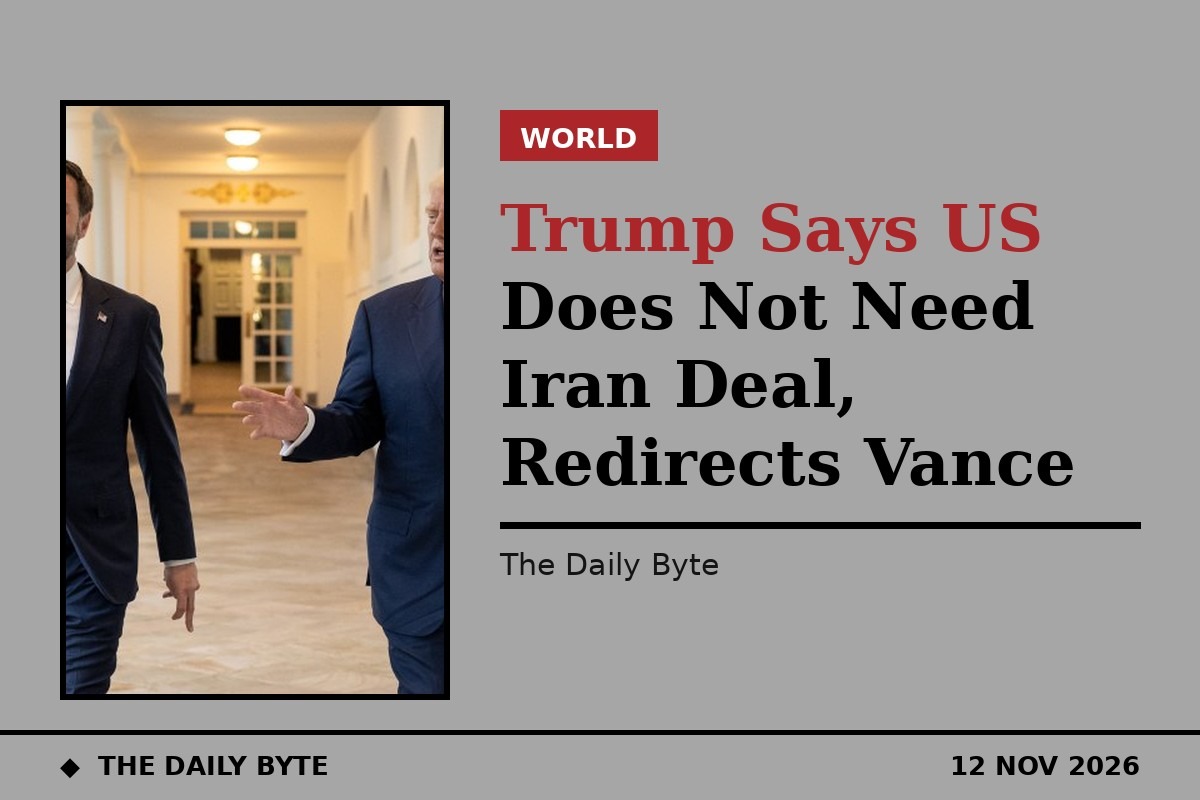
President Donald Trump has said the United States does not need a deal with Iran and has told Vice President JD Vance to turn his attention away from the negotiations with Tehran, in the latest sharp turn in Washington's handling of the eight-month war.
Writing on social media on Thursday, Mr Trump said: "We don't need a deal with Iran. Those days have long since passed! We've got their money, Hundreds of Billions of Dollars, and we've got their Strait!"
He said he had asked Mr Vance to focus "his complete and total attention" on alleged corruption and crime in Democratic-run cities and states across the US, arguing that tackling it could save more money than any agreement with Tehran.
Vance had led the Iran diplomacy
Mr Vance had been the leading figure in American efforts to resolve the conflict with Iran, which began in February when the US and Israel attacked Iranian targets. His removal from the brief, even temporarily, marks a significant change of direction.
The move came a day after the Wall Street Journal reported that Mr Vance was considering face-to-face peace talks with Mohsen Rezaei, the hardline secretary of Iran's Supreme National Security Council. Tehran has denied that any such meeting was planned, and Mr Rezaei has said there are currently no negotiations taking place between Iran and the United States.
Mr Vance joined an Oval Office meeting to discuss the war on Thursday morning, after Mr Trump posted his statement. Sources told the New York Post that the vice president was not entirely off the Iran portfolio and would probably return to the negotiating role if there was progress in the stalled talks, leaving special envoys Steve Witkoff and Jared Kushner as the primary negotiators in the meantime.
Midterms cast a long shadow
The president's comments also come a week after Mr Vance publicly blamed the costly war with Iran for the Republicans' heavy defeat in last week's midterm elections. Mr Trump has himself admitted that the war was largely responsible for the result, while insisting he would not have acted differently.
The shift in tone is striking. In recent weeks Mr Trump had suggested that Iran would be more willing to strike a deal after the US elections. He told CBS's 60 Minutes on Sunday that he was "not looking" to escalate the war, and on Monday he told reporters in the White House briefing room that further military action would not be necessary "at this point".
On Tuesday he said the war was "effectively over" but that he would keep in place the naval blockade of Iranian ports.
Talks had accelerated behind the scenes
Behind the public statements, diplomatic talks between Washington and Tehran have accelerated in recent days, with both sides quietly negotiating an agreement that could avert a return to all-out war and open the door to broader discussions.
Iran has sent the United States a nuclear proposal through Qatar, to be discussed only after Washington meets seven demands presented by Tehran, a senior Iranian official told Reuters last week. Mr Rezaei has also said Iran will not allow any enriched nuclear material to leave the country, and has warned that US bases in Europe could be targeted if they are used to launch attacks on Iran.
Mr Vance was a key figure in negotiating a 14-point memorandum of understanding between the US and Iran in June, which opened a 60-day window for talks to finalise an end to the war. That window passed without a deal.
For now, the direction of American policy is unclear: the president says no deal is needed, while his envoys continue to talk and the blockade of Iran's ports remains in force.