Trump Targets Newsom in Justice Dept Speech
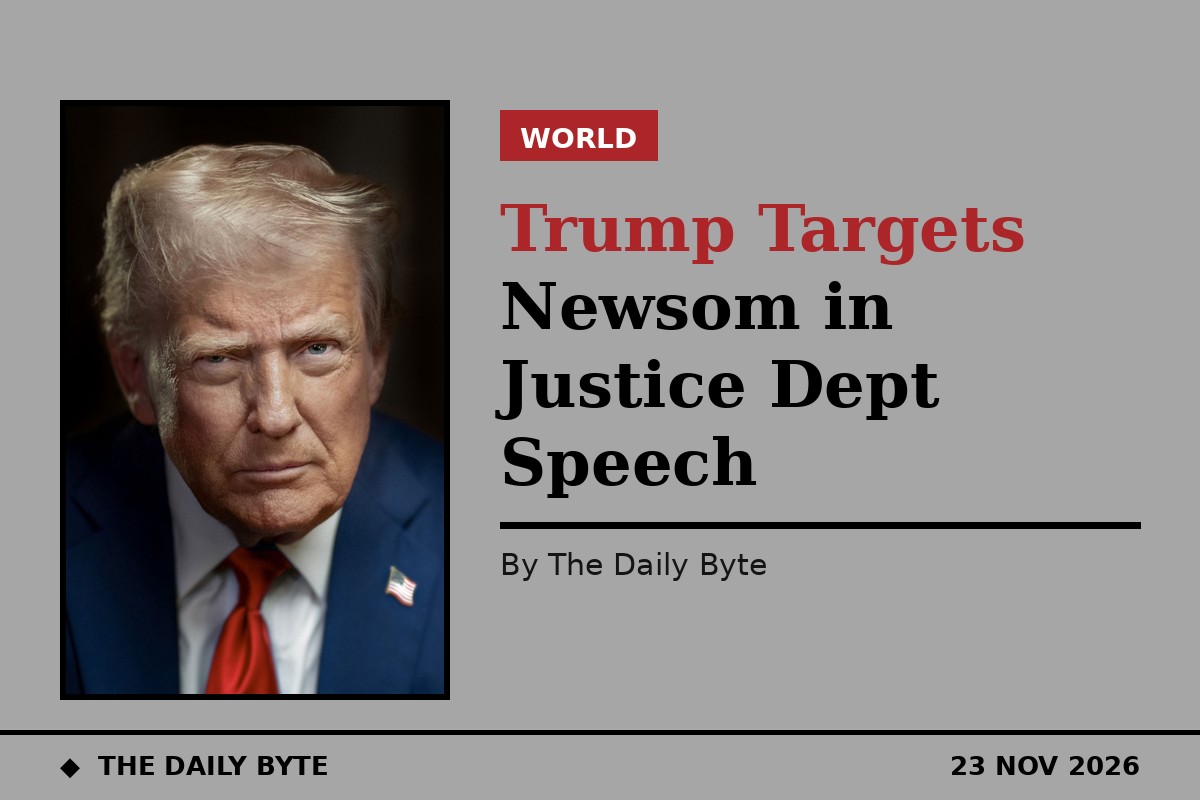
President Donald Trump took his confrontation with California Governor Gavin Newsom into the heart of federal law enforcement on Monday, using a speech at the Justice Department to condemn the governor's decision to commute the death sentences of 548 prisoners.
The address, delivered in the department's ceremonial Great Hall, was scheduled for 4:30 p.m. EST and was framed by the White House as a speech about protecting American families. Trump was joined by Attorney General Todd Blanche and FBI Director Kash Patel, and families of murder victims were expected to attend, with the president planning to highlight their stories.
Victims' families at the centre
The White House left little doubt about the tone of the speech before it began. White House spokeswoman Lauren Bis said Newsom was failing victims and their families, accusing the governor of playing politics with public safety.
"Governor Newsom is failing these innocent victims and their families by refusing to carry out justice against these heinous murderers," Bis said. The White House said in a statement ahead of the event that the commutation decision was "playing politics with public safety."
For the families in the audience, the event was a chance to be heard at the highest level of the Justice Department. The White House said Trump planned to highlight their stories as he made the case that the commutations denied them justice.
What Newsom did
Earlier this month, Newsom announced plans to commute all 548 death sentences in California to life imprisonment without the possibility of parole. Many of the commutations require approval from the California Supreme Court before they can take final effect.
Newsom has argued that capital punishment is morally wrong and inconsistent with California's values. His office said in a post on X that every one of the inmates whose sentences had been commuted would die in prison.
The governor has described the decision as among the most difficult choices of his career, saying it would surface painful memories for the families of crime victims. California has not carried out an execution since 2006, although voters rejected proposals to abolish the death penalty in 2012 and 2016.
A department under scrutiny
Monday's speech was Trump's second address to the Justice Department in less than two years. His previous speech there, in March 2025, focused on crime and immigration but was also used to air grievances about his own criminal prosecutions and to promise to expose what he called misconduct by the officials who had investigated him.
The latest speech unfolded against a difficult political backdrop for the president. Republicans suffered sweeping losses in this month's midterm elections, giving Democrats control of Congress and opening the way to possible House and Senate investigations of the administration.
Those inquiries could examine the mass firings of agents and prosecutors who investigated Trump, as well as a series of politically charged investigations by the Justice Department that have been rejected by grand juries and judges. The department has pursued cases against several of the president's perceived enemies since he returned to office, although some have not survived in court.
A 2028 undercurrent
The choice of target was also political. Newsom is a potential Democratic presidential candidate in 2028 and one of Trump's most frequent sparring partners, and the White House made no secret that it saw the commutations as an opening to revive a familiar line of attack: that Democrats are weak on crime.
Newsom's move has drawn criticism from prosecutors and some victims' families, while supporters of the commutations argue that capital punishment is costly, unevenly applied and vulnerable to wrongful convictions.
Whatever the politics, the legal process around the commutations continues. Many of them still need approval from the California Supreme Court, and the debate over the future of the death penalty in the country's most populous state is far from over.


