Trump Vows Vetoes, Urges Democrats to Deal
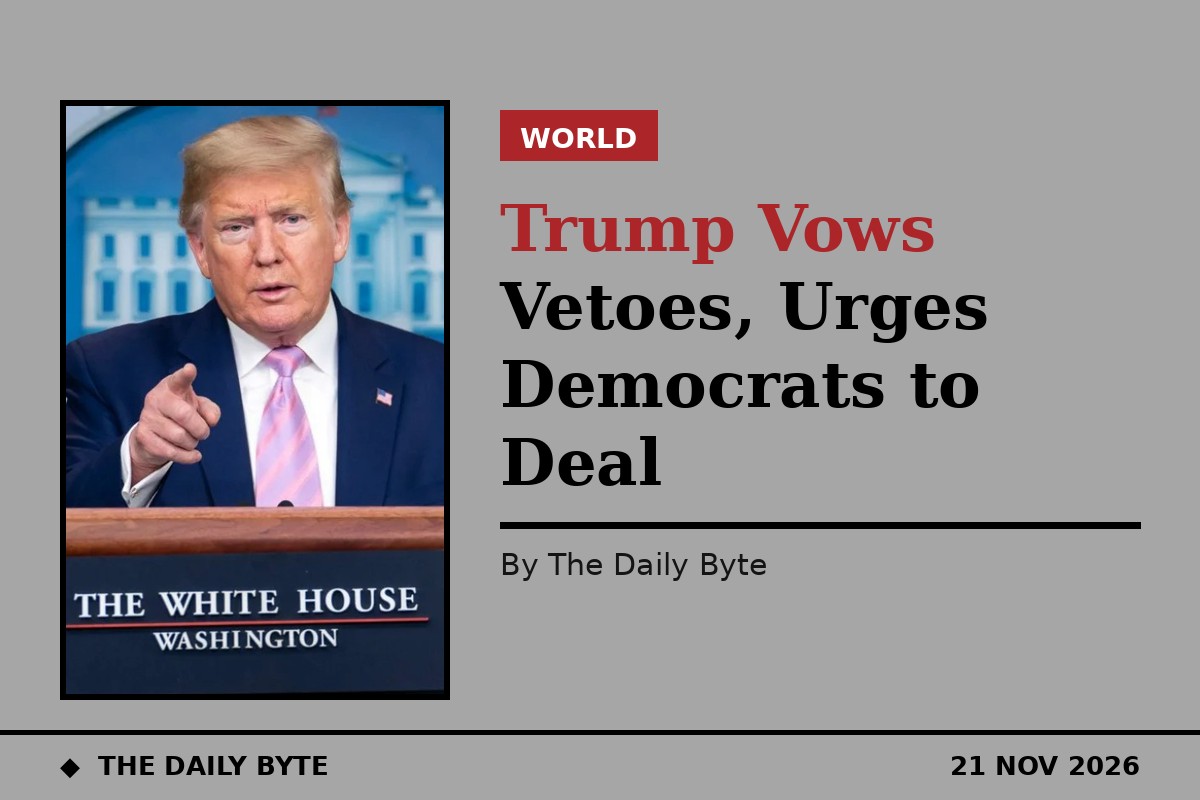
President Donald Trump has pledged to veto legislation passed by Democrats when they take control of Congress in 2027, while telling reporters at the White House that the threat of his veto could force both sides into deals on health care, immigration and other issues.
Speaking at a news conference on Friday 20 November, after returning from a trip to Asia, Trump described the presidential veto as “extreme powers” and said repeated vetoes would push Democrats to moderate their plans.
“They’re going to send things my way, and I’m going to veto them. And then they’re going to send more things, and I’m going to veto them,” Trump said, according to Reuters. “And they could go two years and one month, because that’s what we have, and I’m going to veto them.”
He added that Democrats might conclude that working with him was the only way to get legislation signed. “Because of the power of the veto, there’s a real possibility that we get a lot of great things done,” he said.
Health care and immigration named as possible deals
Trump said many Democrats had called him to discuss health care and immigration reform, and pointed to health care as an area where lawmakers from different perspectives might meet in the middle.
“I’m open to great health care,” he said. “Can it be what they want? No, but it can be a combination of what we all want, and we could end up with great health care in our country.”
Reducing health care costs is the first priority named by the incoming Democratic House leadership. The Democrats aim to restore tax credits for participants in the Affordable Care Act and reverse cuts to Medicaid funding, provisions that were part of Trump’s tax-cut bill approved by Republicans in 2025. Trump did not specify where common ground might lie.
On immigration, Trump said he had a productive conversation on 18 November with Gina Hinojosa, the Democratic governor-elect of Texas, about keeping a strong southern border. “She wants to have a strong border,” he said. “I think we’ll be able to work something out.”
He also voiced sympathy for immigrants who have lived and worked in the United States for years. “What are we going to do? They work well and they work hard,” he said, while repeating that his deportation crackdown targets “the worst of the worst”.
Another Democratic priority is legislation offering permanent residence to undocumented immigrants who arrived as children, or to people who held protected status because of chaos in their home countries. Under a bill from Representative Sylvia Garcia of Texas, applicants would have to have been in the country since 2021 and pass a background check, qualifying through education, military service or employment. Many Republicans oppose the measure, describing it as amnesty.
Trump praises Schumer and Jeffries
With the new Congress due to choose its leadership soon, Trump described Senator Chuck Schumer of New York, who is vying to become Senate majority leader, and Representative Hakeem Jeffries, who is on course to become the next House speaker, as “smart” and said he was willing to work with both men. Democrats take control of the House on 3 January.
“If they want to get things done, I want to get things done too,” Trump said.
His confidence came after Jeffries said Democrats could not work with White House chief of staff Stephen Miller, the architect of the president’s immigration crackdown. Trump praised Miller lavishly during the news conference. Miller has been an aide since Trump’s first-term campaign.
Movies and college sports also on the table
Trump said returning film production to the United States was a “very bipartisan” priority. He has threatened 100 per cent tariffs on movies made abroad, where locations in Canada or Australia are cheaper, but said he has been working with Senator Adam Schiff of California, who led the first impeachment against him, on tax incentives to bring moviemakers back.
“We’re actively in negotiations on that and I can tell you it’s going to be very bipartisan,” Trump said. “It’s a very important industry.”
College sports was another area he raised, calling for limits on payments to athletes for the use of their name, image and likeness. The College Sports Commission reported in May that 75 million dollars in such deals were signed during a two-month period. Trump said colleges would go bankrupt without a bill capping the payments, citing quarterbacks paid 12 million dollars a year, and noted that the Senate approved legislation on the issue in September.
“We have to pass that bill,” he said. “I am finding tremendous bipartisan support and hopefully they get that done fast.”
Whether the veto threat produces compromise or stalemate will become clear once the new Congress sits in January.


