Trump Would Do Iran War Again, Vance Sidesteps
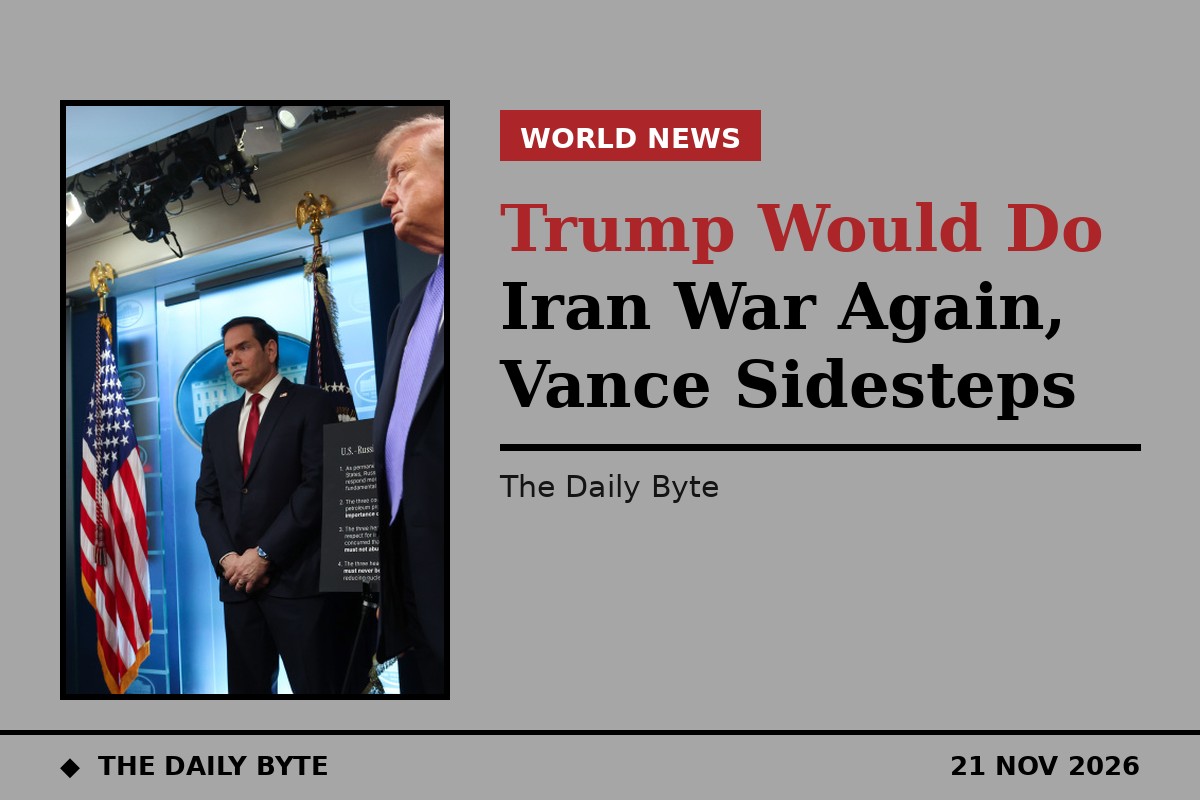
President Donald Trump said on Friday that he would launch the war against Iran again, while Vice President JD Vance declined to say whether the conflict had been worth the midterm election losses it cost Republicans.
The exchange came during a roughly 90-minute press briefing at the White House on Friday 20 November, with Trump flanked by Vance and Secretary of State Marco Rubio. Also present were Secretary of War Pete Hegseth, Treasury Secretary Scott Bessent and White House Chief of Staff Stephen Miller.
Trump was asked about Vance's post-election assessment that the Iran war was the reason Republicans lost the midterm elections on 3 November, when Democrats won majorities in both houses of Congress, six governors' offices and hundreds of seats in state legislatures.
“I didn't say I was unhappy with it,” Trump said of Vance's statement. “I thought the statement was fine, except I would have had one other thing that, if I were asked, I would have said that, ‘Would you do it again?’ Absolutely. The answer is yes, because we cannot allow Iran to have a nuclear weapon.”
Vance defers to the president
Vance, pressed on the same question, affirmed the administration's position that Iran must not be allowed to obtain a nuclear weapon, but stopped short of endorsing the decision to go to war himself.
“What I've said is the goal of keeping Iran from getting a nuclear weapon is absolutely what we should be doing,” he said. “It's the biggest state sponsor of terrorism. If they had a nuclear weapon, they would use it as leverage, or, God forbid, they would attack and kill thousands, hundreds of thousands, potentially, of innocent people.”
“The president is the one who makes the decision, and the president has said he would do it again,” Vance added. “My view is that my goal is and my job is to support the president of the United States.”
In a lengthy post-election analysis on 4 November, Vance had claimed that many former Trump supporters voted for Democrats to punish the party over the Iran war, and that its consequences were clearly responsible for the party losing both houses of Congress. “The reason we lost is the war. The president himself said so last night. If you'd like to argue it was worth it, that losing the Senate for the next six years was worth it, then do so,” he wrote.
Vance also pointed to the affordability crisis, the nature of the United States' relationship with Israel and a failure to prioritise American interests as factors driving disaffection among Trump's fractured political base.
A vice-president pulled from the Iran file
The briefing exposed a rift that has been widening for weeks. Trump had earlier pulled Vance from the Iran negotiations and said he wanted the vice-president to focus his complete attention on benefit fraud in Democrat-run states instead of international diplomacy. Special envoys Steve Witkoff and Jared Kushner are now the president's primary negotiators with Iran.
Trump also dismissed the memorandum of understanding that Vance had negotiated with Iran in June as a waste of time, in an interview during his trip to China this week, although he added that signing it had not been a mistake. The pact fell apart in July when Iran attacked several commercial ships in a dispute over postwar control of the Strait of Hormuz.
Trump has said the war is effectively over, but that he will keep the naval blockade of Iranian ports in place. He has also said he is in no rush to decide on further military action, suggesting any new strikes could wait until after the beginning of the new year.
The president has declined to rebuke Vance directly, but when pressed on whether he will endorse his deputy to succeed him in the White House, he has repeatedly pivoted to praise for Rubio, who is viewed as a possible rival to Vance for the Republican nomination in 2028.
The same day as the briefing, the Israeli ambassador to the United States, Yechiel Leiter, walked back remarks he had made on Newsmax earlier in the week about the potential duration of the Iran war, issuing a statement clarifying that only the president of the United States decides when and where American troops are deployed. The war is now approaching its ninth month.


