Trump, Xi Agree Humans Must Control Military AI
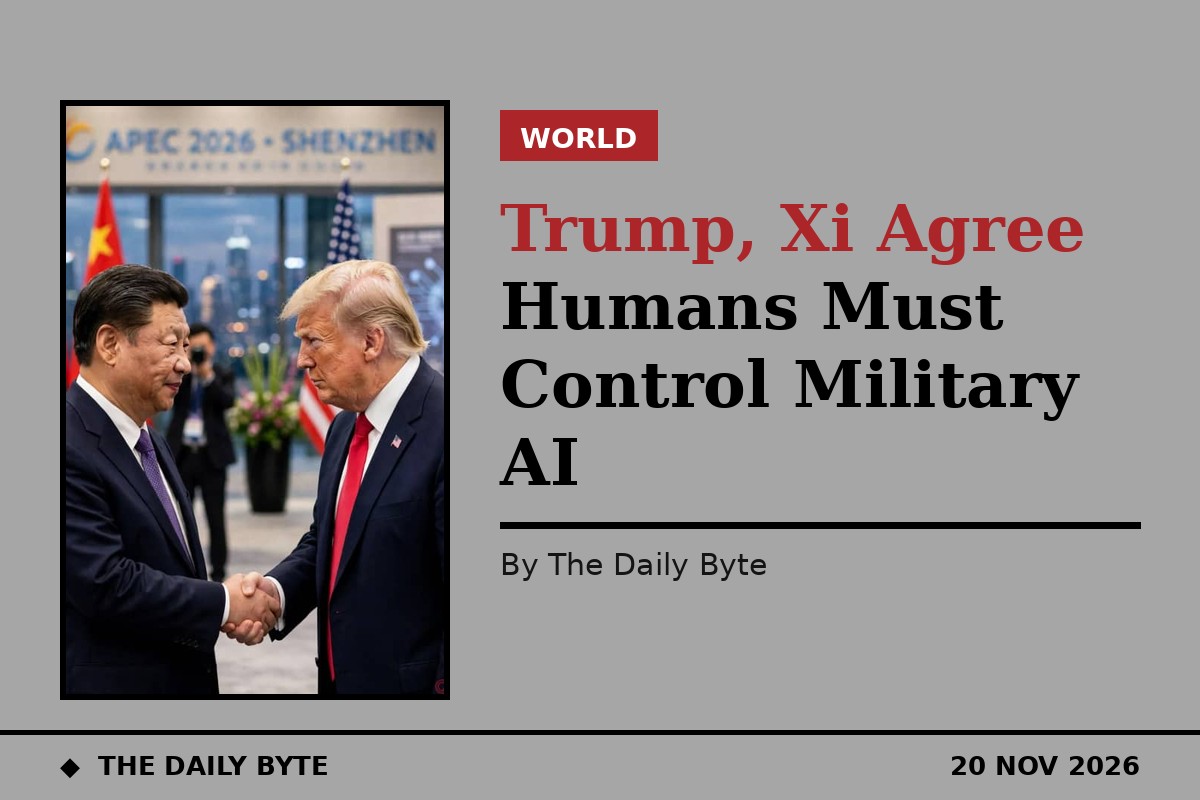
United States President Donald Trump and Chinese President Xi Jinping have agreed that human beings must always be involved in military decisions that use artificial intelligence, Treasury Secretary Scott Bessent said on Friday. Bessent said the understanding was one of the major achievements of Mr Trump's trip to Asia, which included a meeting with Mr Xi in Shenzhen, China.
"I think it was very important that President Trump and President Xi agreed that humans should always be involved in any military decisions that SI makes, and the SI should not be allowed to be autonomous for major military actions," Mr Bessent told the business news channel CNBC after returning from the trip. SI is the Trump administration's preferred term for the technology, short for "super intelligence".
Mr Bessent said the agreement also covered other safeguards around the military use of artificial intelligence. He added that it would not be affected by the two countries' competition for supremacy in the technology. "But there's nothing to do with competition when it says that both sides agree that no major military operation should be launched without a human being involved," he said.
A rare point of agreement in an AI race
The two countries are racing to build superior AI models, which both governments view as strategically important for military and technological leadership. Washington has spent years trying to limit Beijing's access to advanced American chips, in particular those made by Nvidia, because it does not want the Chinese military to benefit from them.
Against that background, a shared commitment to keep people in charge of military AI stands out as a point of agreement rather than another front in the rivalry. Mr Trump said separately in an interview with Fox News on Thursday that he and Mr Xi both wanted AI regulations for safety purposes and would work together on reasonable rules for the technology.
The Chinese embassy in Washington said in a statement on Thursday that the two countries should strengthen communication and coordination, prevent the security risks of AI and ensure that AI is always under human control. That language lines up closely with the account Mr Bessent gave on Friday.
Chips stay on a separate track
The understanding on military AI does not soften the dispute over advanced chips. Mr Bessent said Nvidia's second-tier AI chip, the H200, remained the most advanced chip that China could buy under licence, after Mr Trump took what he called a "very firm line". He said there had been few Chinese orders for the H200 as Beijing tries to build out its own chip industry, adding that China was "probably many years behind".
Mr Bessent also played down differences he had voiced with Commerce Secretary Howard Lutnick over chip restrictions, saying administration officials were "all committed to following President Trump's instructions". The Commerce Department took steps on Monday to restrict China's access to advanced AI chips further, including chips used by overseas data centres where Chinese entities can rent computing power.
"I think we are going to see that the proper chip restrictions are in place, and the remote access has been curtailed," Mr Bessent said. He added that American AI laboratories needed to maintain their technological lead as the best defence against what he called "dangerous" Chinese AI models being used in cyberattacks.
Mr Bessent said the spying allegations involving former Nvidia chief executive Jensen Huang and a Chinese national did not come up in the bilateral meeting between Mr Trump and Mr Xi.
What is not yet clear
No published text of the understanding has been released, and the public record so far rests on Mr Bessent's account of the conversation. There is no detail yet on how either side would check compliance, or on what exactly would count as a "major" military action under the agreement.
The test will come in the months ahead. If the understanding holds through the next dispute over chip controls or trade, it will count as a genuine guardrail in a rivalry that otherwise keeps intensifying. For now, it is a stated commitment from both leaders that no machine should be left to decide on war by itself.


