TSMC AI Design Kit Lets Agents Design A14 Chips
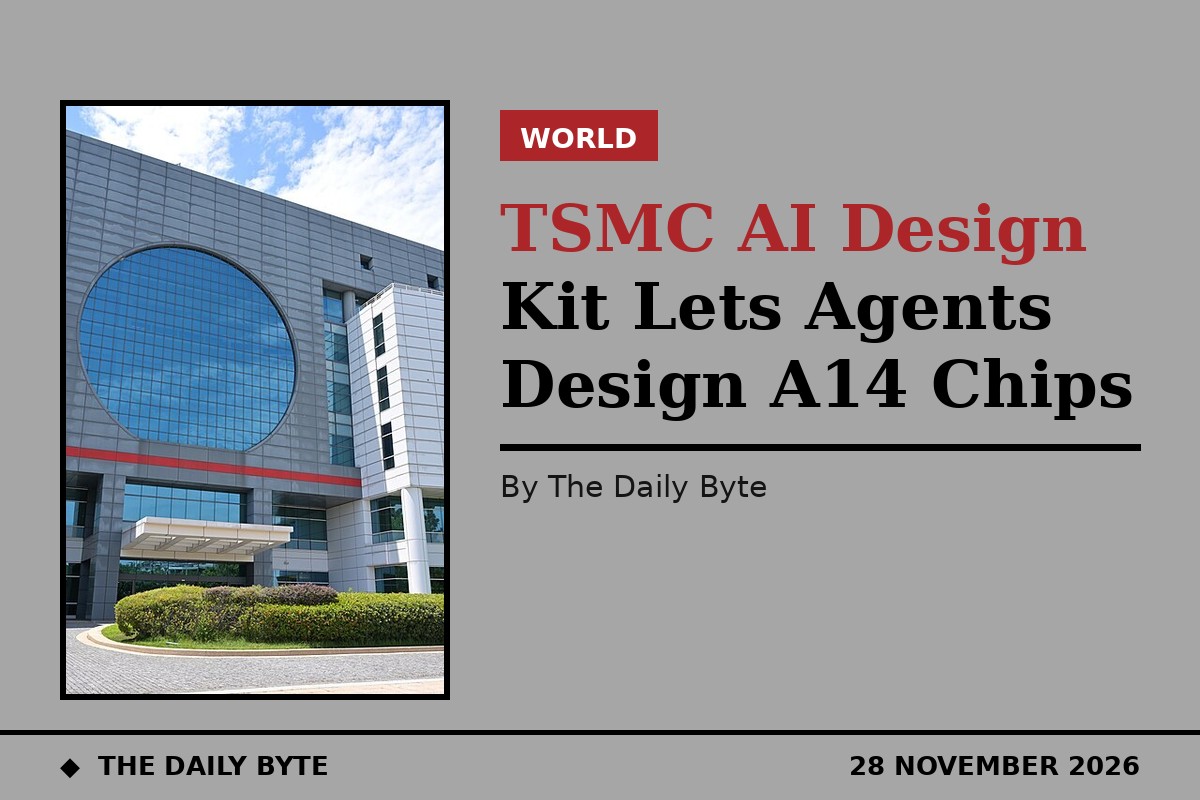
Taiwan Semiconductor Manufacturing Company has unveiled an AI Design Kit that lets artificial intelligence agents generate chip design flows for its most advanced process, the A14 node. The kit was shown at the company's 2026 Europe Open Innovation Platform Ecosystem Workshop in Munich, and reported by Tom's Hardware on 27 November 2026.
The kit, known as the ADK, is a package of process-specific technical information, implementation guidelines and design methods. It is designed to give AI agents the foundry knowledge they need to automate the physical implementation of chips, the stage where a circuit design is turned into a layout that can be manufactured.
What the kit does
The ADK complements TSMC's traditional process design kits rather than replacing them. Aveek Sarkar, TSMC's head of ecosystem and alliance management, said the kit brings in capabilities to augment electronic design automation flows and layers the company's technology-specific learning onto customers' own design expertise.
Early contents listed in TSMC's workshop slides include metal pitches, standard cell heights, routing track patterns, library cell naming conventions and implementation guidelines. Electronic design automation agents such as Cadence's InnoStack and Synopsys's Implementation Agent can take a plain-language prompt, a language model and the ADK, and produce a qualified automatic placement and routing reference flow for A14. That flow covers project setup, library cell use, placement and routing optimisation, routing track and power grid creation, and wide-wire configuration.
Engineers traditionally spend weeks preparing such scripts. TSMC said on stage that agents can instead take a simple prompt from users and the ADK and use a generative model to deliver a qualified reference flow. For larger projects, TSMC proposes an orchestration agent running at the customer's site, combining the customer's in-house know-how, specialised design agents and the ADK, then adjusting tool settings from one iteration to the next.
Why chip design needs AI help
TSMC's case for the kit is the rising complexity of each new process. Compared with its N5 family of processes, the number of design rules rises 2.3 times at N3P, 3.1 times at N2P and 3.6 times at A14, the first node the ADK supports. Available standard library cells grow 2.8 times, 5 times and 4.6 times across the same nodes. Sarkar said some customers want to cut chip development cycles from 18 months to 12 months.
TSMC has previously put a productivity figure on the approach. In an interview published by EE Times in September, Sarkar said the ADK lifts digital design productivity by three to five times and analogue and radio-frequency design productivity by up to six times, although no baseline was given for those figures. They are TSMC's own claims, not independently measured results.
What it does not do
The kit covers physical implementation only. It does not handle chip architecture or logic design, and TSMC has not shown a flow that takes a chip from architectural specification to tape-out without engineers. The company disclosed no quantified power, performance and area gains, no measured cut in development time and no commercial availability date at the Munich event.
Developers also cannot use the ADK on its own. It still needs conventional electronic design automation software from vendors such as Cadence, Synopsys or Siemens, and TSMC has not said when the kit will be generally available, what it will cost or how it will be licensed.
There is a strategic angle too. A faster route onto A14 helps TSMC fill a node that has just opened to design work, with version 0.9 of its process design kit now available. The ADK is exclusive to TSMC for now, and the company has indicated it will remain so for a while, which could make moving a design to another foundry harder.


