TSMC pauses China chip shipments under US rules
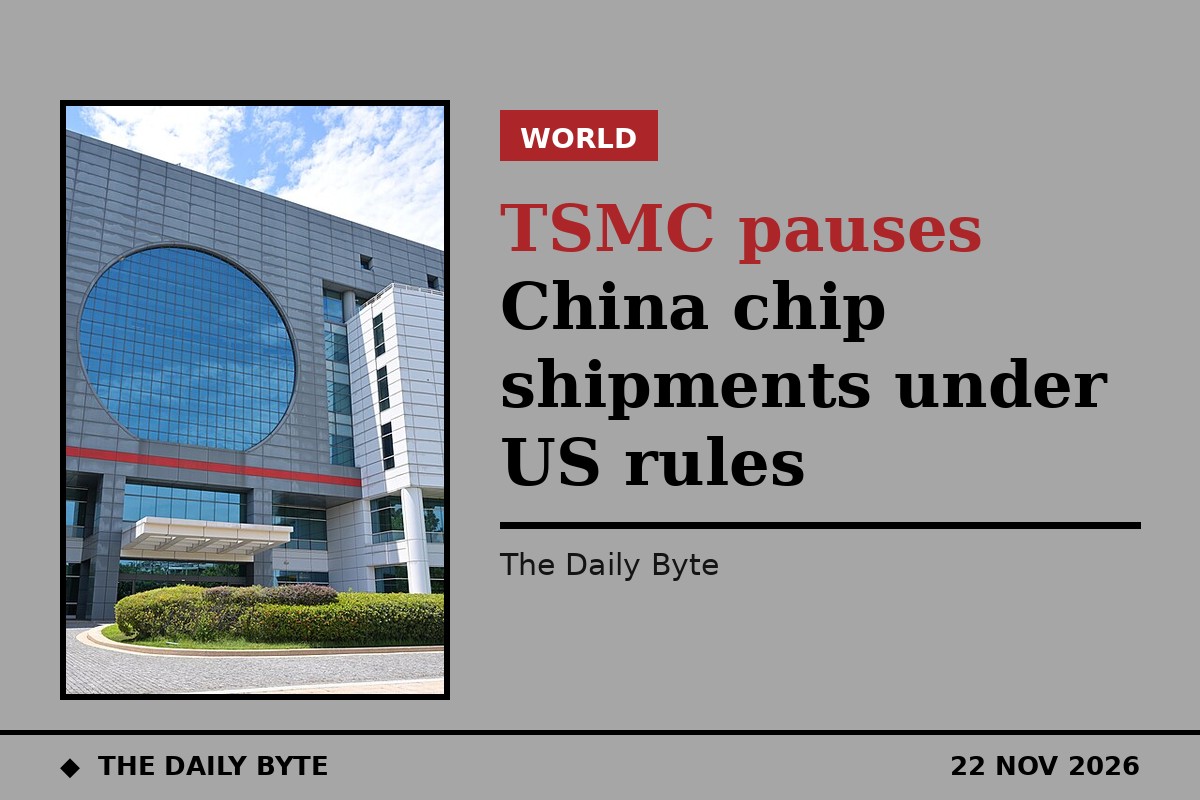
TSMC and Samsung have paused some chip shipments to Chinese customers after new United States export controls took effect on 19 November 2026. The two chipmakers told Chinese clients in recent days that they would halt sales of certain processors while they seek licences from the US Commerce Department, the Financial Times reported on 19 November. Reuters reported the same pause, citing people familiar with the matter.
The trigger is a Bureau of Industry and Security interim final rule titled Addressing Remote Access to Advanced Semiconductors. The rule was published in the Federal Register on 19 November 2026 and took effect the same day. It narrows the ways a foundry can show that an advanced logic chip falls outside US controls.
What the new rule changes
Under the existing control, a fabricator must presume that a logic chip made at the 16 or 14 nanometre node or below is a controlled data-centre AI chip unless it can show otherwise. There were three ways to overcome that presumption: an attestation from an approved designer, the fabricator's own attestation that the packaged chip falls below transistor-count thresholds, or an attestation from an approved packaging company. The new rule removes the second and third routes for designers located in, or with a parent in, countries facing licence requirements.
TSMC has told affected Chinese customers that orders using manufacturing processes of 16 nanometres and below are halted unless they obtain US export licences, Reuters reported, citing two people familiar with the matter. Those designers will generally be limited to older 28 nanometre and 40 nanometre processes, provided their chips use no high-bandwidth memory and need no advanced packaging.
The disruption reaches beyond AI chips
The surprise in the days since the rule took effect is how widely it bites. Nikkei Asia reported from Taipei that TSMC has put shipments to several Chinese and non-Chinese chip developers on hold while it reviews compliance, and that the rules are reaching everyday mobile and consumer applications, not just advanced AI accelerators. Chinese designers are effectively pushed back to older 28nm and 40nm nodes.
The Financial Times reported that the new rules remove exemptions that applied to non-AI chips, including smartphone processors. TSMC supplies smartphone chips to Xiaomi, Oppo and Vivo, according to the same report, while Seoul Economic Daily named Baidu's Kunlun AI unit and ByteDance among Samsung's Chinese customers.
TSMC has said it is aware of the new regulations and will comply with all applicable laws and rules, while declining to comment on specific customer communications. Shipments already moving on 19 November under a real order can finish under the old terms if completed by 21 December 2026, according to the Federal Register notice.
Frequently asked questions
Why has TSMC paused chip shipments? A new US Commerce Department rule took effect on 19 November 2026. It requires licences for advanced chips made at 16 nanometres and below for affected Chinese designers, so TSMC has halted those orders until licences are obtained.
Does the pause affect only AI chips? No. Reporting by Nikkei Asia and the Financial Times says the rules also reach consumer chips, including smartphone processors, because the exemptions for non-AI chips were removed.
Is this a ban on selling chips to China? No. It is a pause while licences are sought. Affected designers can generally still use older 28nm and 40nm processes, provided their chips use no high-bandwidth memory and need no advanced packaging.
Sources: AI Weekly, summarising the Nikkei Asia report, and CASRAI, summarising the Financial Times report of 19 November 2026 and the Reuters reporting of the shipment pause.


