Tunisia jails rights defender Ben Sedrine for five years
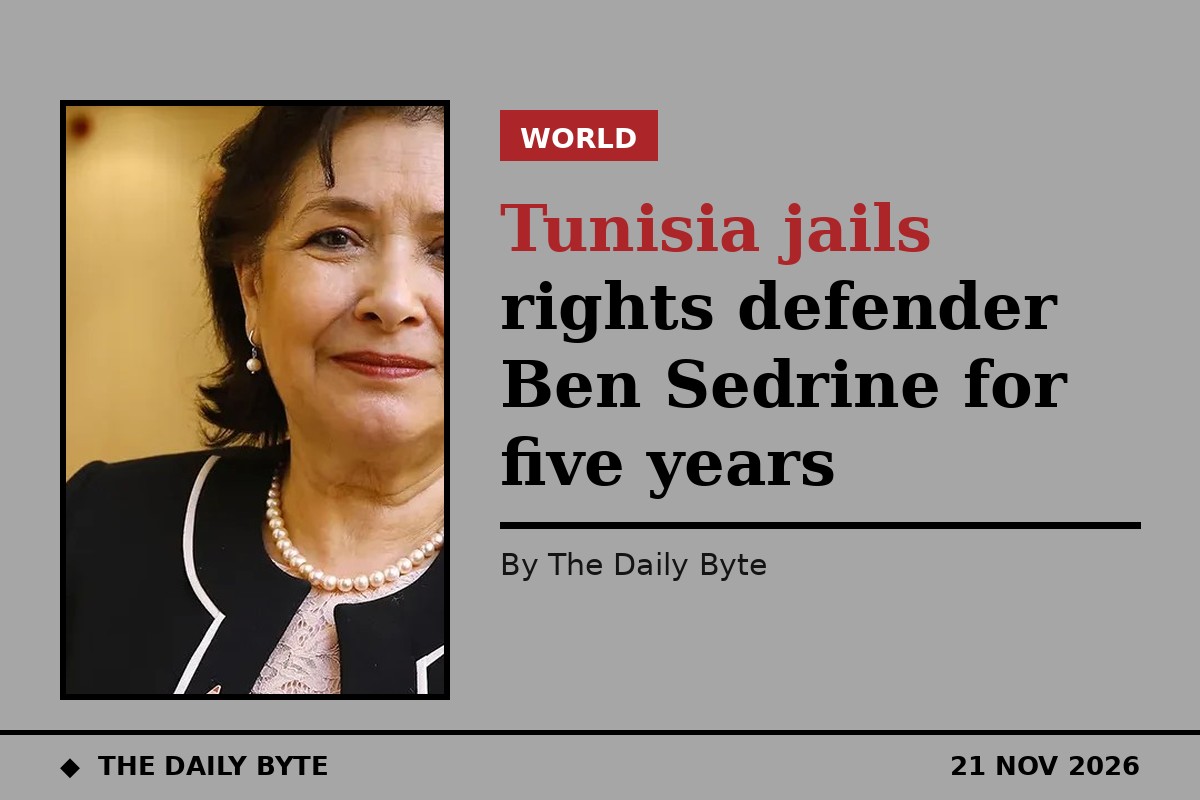
A court in Tunis has sentenced prominent Tunisian human rights defender Sihem Ben Sedrine to five years in prison, in a further case linked to her leadership of the country's post-revolution Truth and Dignity Commission.
The Criminal Chamber of the Economic and Financial Judicial Division of the Tunis Court of First Instance handed down the sentence on charges of financial corruption, her lawyer said. The case concerns an arbitration and reconciliation decision adopted by the commission through its transitional justice mechanism, in a matter involving businessman Lazhar Sta.
Amnesty International condemned the verdict, which was announced on Friday, 20 November. Heba Morayef, the organisation's regional director for the Middle East and North Africa, said the new sentence compounded what she called an outrageous injustice against Ben Sedrine, who she said was being punished for her historic work as head of the transitional justice commission and for her years of human rights work.
The latest sentence comes on top of a combined 25 years in prison imposed on Ben Sedrine on 26 June 2026, in two separate cases, one attracting five years and the other 20 years. Amnesty said she faces seven criminal cases in all linked to her time as president of the commission. She remains free while she appeals against her convictions, and her lawyer said she will appeal the latest verdict.
Ben Sedrine, who is 76, was detained in August 2024 and released in February 2025. The Committee for the Respect of Freedoms and Human Rights in Tunisia also condemned the latest conviction, saying the judicial persecution of Ben Sedrine must end and solidarity with her must be strengthened.
A commission created to confront the past
Ben Sedrine chaired the Truth and Dignity Commission, known by its French initials as the IVD, which Tunisia created after the 2011 uprising to investigate gross human rights violations and state corruption under previous governments. The commission heard testimony from victims, documented decades of abuse and issued a final report setting out its findings.
Her supporters say the prosecutions against her are a direct consequence of that work. Amnesty said the charges against her were bogus and that she was being punished for exposing decades of state abuses. The organisation said the latest verdict concerned a decision taken by the commission itself, through the arbitration and reconciliation mechanism it was set up to operate.
The cases have drawn sustained attention from international rights groups, which have followed Ben Sedrine's trials closely since her first detention. They argue that the sentences handed down this year, which now total 30 years across three cases in the space of five months, are designed to punish a figure who became a symbol of Tunisia's attempt to reckon with its past.
For now, Ben Sedrine remains at liberty while her appeals are heard. Her lawyer has said the defence will challenge the latest five-year sentence, as it has the earlier convictions. The outcome of those appeals will determine whether one of Tunisia's best-known rights defenders, who spent years documenting the abuses of the old regime, ends up serving a prison term for the work she did in the commission she once led.


