Turkey Defence Chief to Visit US in F-35 Push
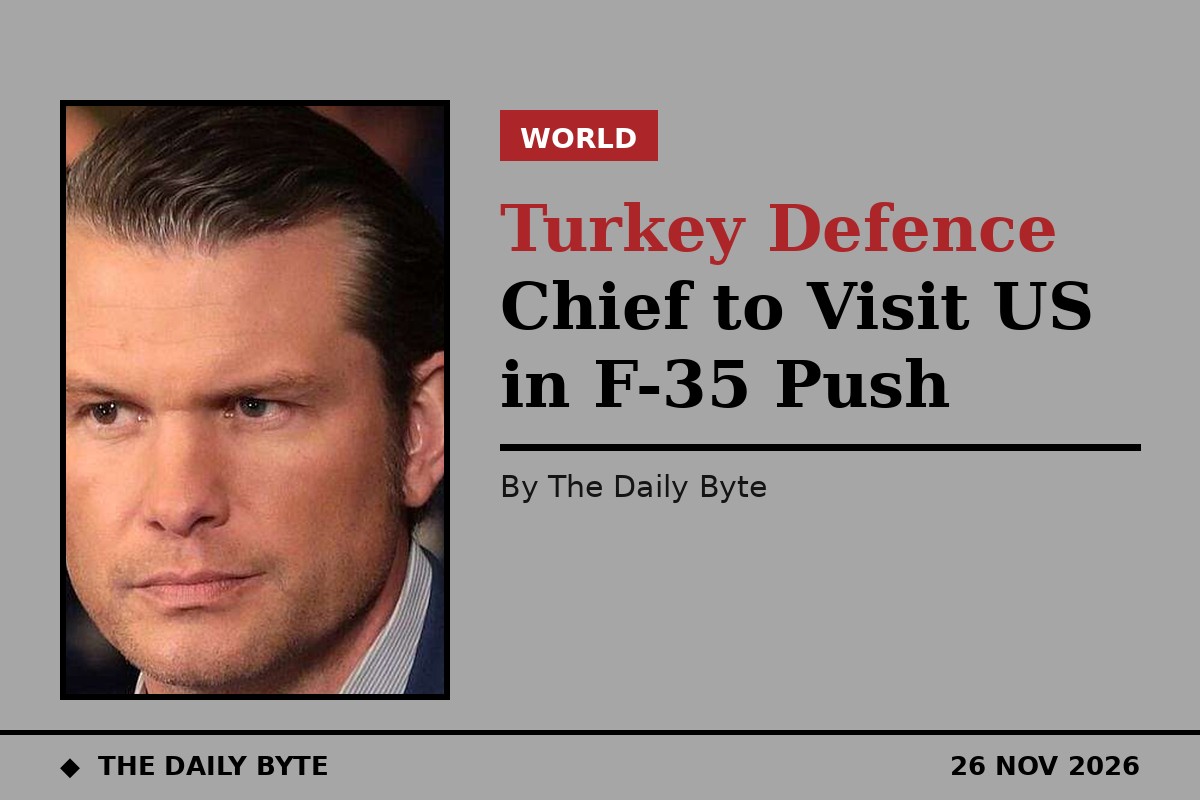
Turkey's Defence Minister Yaşar Güler will travel to Washington next week for talks with US Defence Secretary Pete Hegseth, Ankara said on Thursday, as Turkey pushes to have American sanctions on its defence industry lifted and to rejoin the F-35 fighter jet programme.
Güler is due to meet Hegseth in Washington during an official visit from 30 November to 3 December, a Turkish defence ministry spokesman said on Thursday. The talks are expected to focus on bilateral security ties and defence industry cooperation, with the removal of the sanctions at the top of Ankara's agenda.
The United States removed Turkey from the F-35 programme in 2019 after Ankara took delivery of Russian-made S-400 air defence systems. Washington said the presence of the S-400 could enable Russia to gather intelligence on the aircraft's capabilities. Sanctions followed in 2020 under the Countering America's Adversaries Through Sanctions Act, known as CAATSA, over the purchase.
Addressing the Turkish parliament's Planning and Budget Commission on Thursday, Güler said the United States had begun to shift its position on Turkey's request to buy F-35 jets after seeing progress on Turkey's home-grown KAAN fighter programme. "When the Americans saw that we could build and fly the KAAN, they changed their minds a bit about the F-35," he said, according to Turkish media reports. He also gave the commission updates on Turkey's F-16 and Eurofighter acquisitions.
Ankara is also seeking to finalise a deal to purchase US-made F-16 fighter jets. Turkish officials have continued to press for the delivery of six F-35 jets that were built for Turkey but never handed over after its removal from the programme.
A legal obstacle remains. Under US law, F-35 transfers to Turkey are barred unless the administration certifies that Ankara has relinquished possession of the S-400 systems and given credible assurances that it will not reacquire them. Fuat Oktay, chairman of the Turkish parliament's Foreign Affairs Committee, said talks involving Turkey, the United States and Russia over the S-400 systems had advanced recently, without giving details. He said Ankara was not seeking to sell or transfer the Russian systems to a third country.
Oktay also said there was a chance to resolve the dispute before Democrats take control of Congress in January, arguing that Democratic lawmakers could be more resistant to allowing Turkey back into the F-35 programme. The talks come ahead of a possible meeting between President Recep Tayyip Erdoğan and US President Donald Trump at the Group of 20 summit in Miami in mid-December.
Mr Trump indicated during the NATO summit in July that his administration was prepared to lift the sanctions and would consider selling F-35s to Turkey. US Secretary of State Marco Rubio said in October that Mr Trump would like Turkey to receive the jets it has already paid for, but that US law does not permit the transfer until the S-400 matter is resolved.
Güler's talks are also expected to cover wider defence industry cooperation, including Turkey's efforts to secure American-made engines for its domestically developed KAAN jets. The outcome of next week's meeting will show whether the recent high-level exchanges between Mr Erdoğan and Mr Trump have moved the long-running dispute any closer to a settlement.
Why was Turkey removed from the F-35 programme?
Turkey was removed in 2019 after it took delivery of Russian S-400 air defence systems. The United States said the S-400 could allow Russia to gather intelligence on the stealth jet's capabilities.
What are the CAATSA sanctions?
They are US sanctions imposed in 2020 under the Countering America's Adversaries Through Sanctions Act over Turkey's purchase of the S-400 system. Ankara wants them lifted as part of any return to the F-35 programme.
What would it take for Turkey to rejoin?
Under US law, the administration must certify that Turkey has given up the S-400 systems and will not reacquire them before F-35 transfers can go ahead. Talks over the systems are continuing.


