UAE Used AI to Track False Posts During Attacks
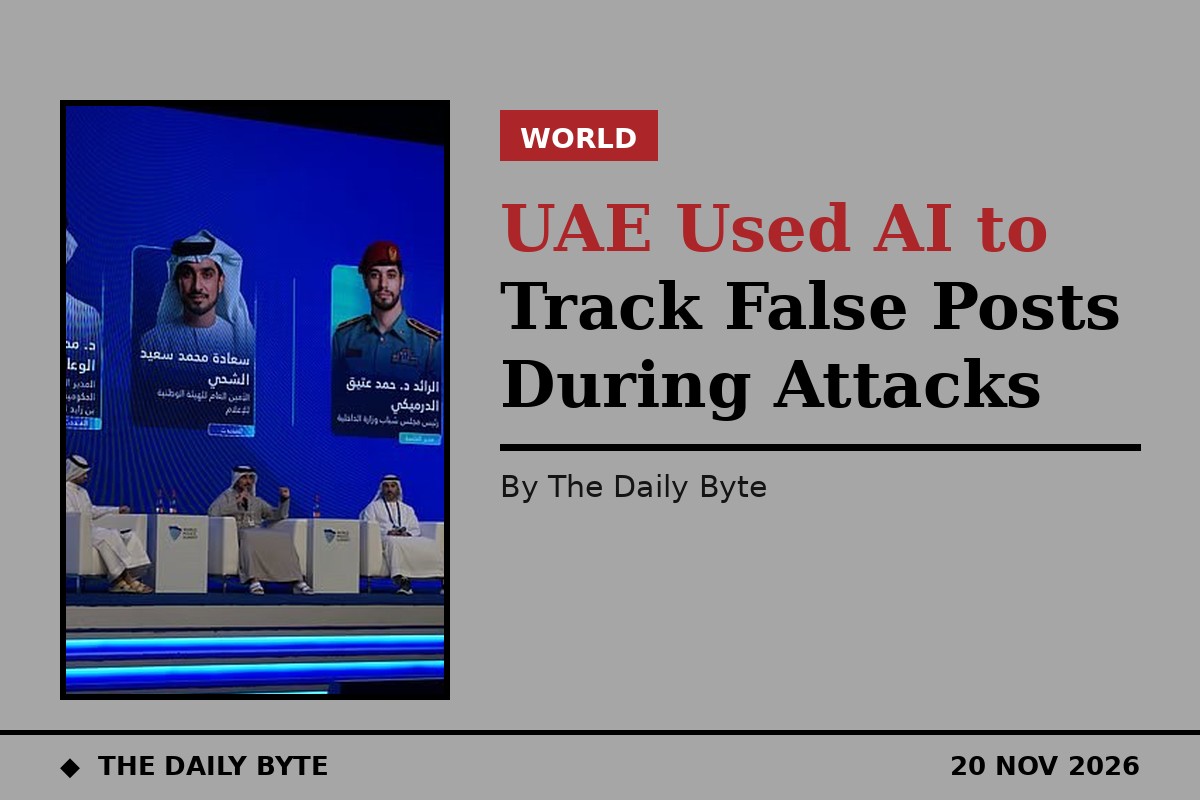
The United Arab Emirates used artificial intelligence to identify misleading social media posts targeting the country's reputation before, during and after the recent attacks on the country, the head of its National Media Authority has said.
Mohammed Saeed Al Shehhi, the authority's secretary-general, told a panel at the fifth World Police Summit in Dubai that AI tools helped officials analyse large volumes of online content, follow the spread of false claims and detect patterns pointing to coordinated disinformation campaigns.
Al Shehhi said the authority worked with government departments and social media platforms to challenge misleading content, while federal and local media teams published verified updates in several languages within minutes of incidents.
Speed matters most
He warned that when official sources are slow to respond, people fill the vacuum with speculation, allowing false claims to gain ground. He said the main challenge in today's information environment was no longer a shortage of information, but the speed and volume at which it spreads.
Accuracy, speed and clarity were the key elements of effective communication, he said, stressing that verified information must reach the public quickly to preserve its relevance and credibility. AI, he added, should complement rather than replace human judgement, with people remaining responsible for verifying information and taking decisions.
A growing global risk
Misinformation and disinformation rank as the world's second most severe global risk over the next two years, Al Shehhi said, citing the World Economic Forum's Global Risks Report 2026, with consequences for national security, social stability, economic prosperity and investment.
He described disinformation as an organised industry, supported by specialised tools, networks and actors, that can circulate false claims and shape public opinion before verified information reaches audiences.
The authority has set up a dedicated National Narrative Department to communicate a clear account of the UAE's values, positions and achievements. It is also developing a unified platform to monitor and analyse information, with early-warning capabilities to detect disinformation campaigns and help officials respond promptly, and it is training teams to use AI tools to monitor digital content.
The wider summit picture
The panel, on AI-powered policing and digital transformation, was organised by the Ministry of Interior with the UAE Cyber Security Council, the National Media Authority and Mohamed bin Zayed University of Artificial Intelligence, among others. Dr Mohammed Ahmed Al Loghani, of the university, spoke about the governance of AI agents and the ethical considerations involved in their use within government and security institutions.
Separately at the summit, the UAE's cybersecurity chief, Dr Mohamed Al Kuwaiti, said Iran's cyber attacks during the conflict had targeted power stations, desalination plants and healthcare systems, and had included attempts to erase data and compromise security cameras, The National reported.
The fifth edition of the World Police Summit took place at the Dubai World Trade Centre from 16 to 18 November. Al Shehhi's message from its stage was that technology alone is not the answer: it must go hand in hand with public awareness and media literacy, so that people can identify trustworthy sources, question suspicious claims and verify information before sharing it.


