CVE-2026-132802: UniFi Access flaw gives root access
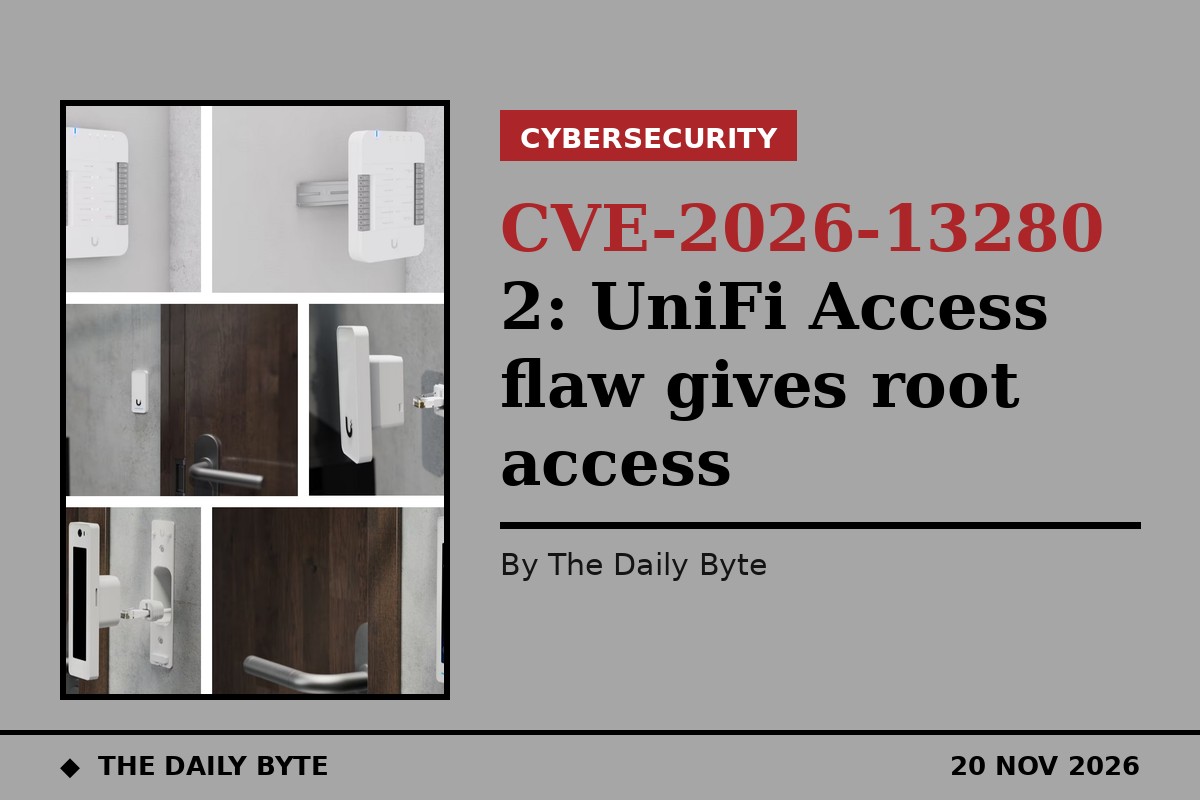
Ubiquiti has disclosed seven security flaws in its UniFi Access application, the software that manages electronic door locks, badges and readers. Five of the flaws are rated critical, and four of them carry a CVSS score of 9.9 out of 10. The most serious, tracked as CVE-2026-132802, lets an attacker with low-level access to the application run arbitrary code with root privileges on the host device. Ubiquiti disclosed the flaws on 18 November in Security Advisory Bulletin 073 and fixed all seven in UniFi Access Application version 4.3.24. Versions 4.3.22 and earlier are affected.
UniFi Access is the management layer for Ubiquiti's door-access hardware: it controls who can open which door, stores badge and PIN data, and talks to readers and door hubs across a site. Ubiquiti says it has shipped more than 101 million devices worldwide, and a single Enterprise NVR console can serve up to 30,000 users and 300 door hubs. That scale is what makes this disclosure matter. A flaw in the door software does not only threaten the application itself. In the worst cases here, it threatens the host it runs on and the physical devices it manages.
The most serious flaws
CVE-2026-132802 is an improper link resolution flaw, classified as CWE-59, found by researcher Rafael Cardoso Lino. Ubiquiti states that a malicious actor with network access and low privileges could exploit it to execute arbitrary code with root privileges on the host device. Root is the highest privilege on the system, so a successful attack would hand over the machine the access software runs on, not just an account inside the application.
Three further flaws also score 9.9. CVE-2026-132803 groups authenticated SQL injection flaws that let a low-privileged user escalate privileges on the host. CVE-2026-132804 is a server-side request forgery flaw that lets an attacker escalate privileges within UniFi OS by abusing the application's ability to issue requests on their behalf. CVE-2026-132808 is an incorrect authorisation flaw that lets a low-privileged attacker execute arbitrary commands on certain adopted UniFi Access devices, the readers and hubs connected to the console.
The remaining three flaws are still serious. CVE-2026-132807, scored 9.0, comes from improper certificate validation on adopted devices and can expose information or permit unauthorised changes on a device under certain network conditions. CVE-2026-132806, scored 8.8, is an authenticated SQL injection flaw that can expose sensitive information and allow unauthorised changes inside the application. CVE-2026-132805, scored 8.3, is an unauthenticated server-side request forgery flaw that can expose information and allow unauthorised changes on the host. The last of these needs no login at all, which makes it the most important of the three for sites whose management interfaces are reachable from untrusted networks.
Why door software is a high-value target
Access-control software sits in an awkward place. It is often treated as building infrastructure rather than as a networked application, yet it holds privileged access to a database, to internal services and to connected hardware. The flaws disclosed here span all of those boundaries: file handling on the host, database queries, requests the server makes on an attacker's behalf, certificate checks on devices, and authorisation checks between the console and the hardware it manages.
An attacker who reaches the application with a low-privilege account does not need to find a way in from outside. With CVE-2026-132802, that foothold is enough to take over the host; with CVE-2026-132808, it is enough to run commands on the devices that open doors. Organisations that run UniFi Access on an internal network should not assume that placement alone protects them, since the critical flaws need only network access and low privileges rather than exposure to the internet.
What administrators should do
Ubiquiti lists no workarounds for these flaws, so the fix is the update. Administrators should upgrade to UniFi Access Application version 4.3.24 or later and check the version on every console running the application. The installed UniFi OS version is not a substitute for that check, because the two components have separate version numbers. Sites exposed to untrusted networks should be patched first, and management access should be restricted to trusted networks while updates are rolled out.
Ubiquiti has not reported any confirmed exploitation of the seven flaws, and it has not said the flaws can be chained together into a single attack. That is reassuring, but it is not a reason to delay. Four flaws at the maximum end of the severity scale, several of them reachable with low privileges, make this an update to install now rather than at the next maintenance window. Administrators should also review access logs for suspicious activity, since a low-privilege account that suddenly reaches for host-level functions would be the sign that something is wrong.
Sources: Ubiquiti Security Advisory Bulletin 073 | Security Online


