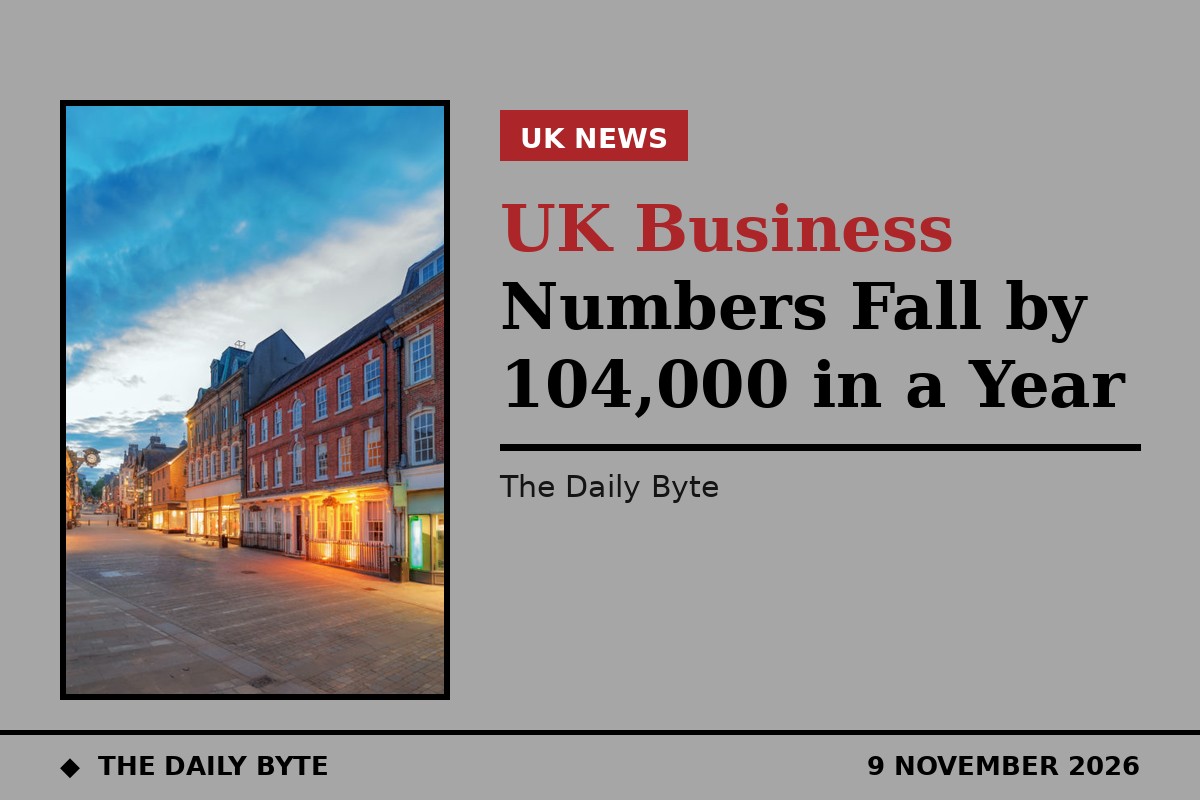
UK Business Numbers Fall by 104,000 in a Year
The number of private sector businesses in the UK fell by 104,000 in the year to the start of 2026, official figures show, taking the total to 5.6 million. The drop was driven by a sharp fall in the number of people working for themselves, even though the number of businesses with employees rose.
The Department for Business, Innovation, Science and Trade published its annual business population estimates on 5 November 2026. The figures, reported on 9 November, show the private sector business population fell by 1.8 per cent between the start of 2025 and the start of 2026.
Self-employed numbers drive the fall
The headline fall masks two very different trends. The number of businesses with employees rose by 54,000, or 3.8 per cent, to 1.47 million. But the number of businesses without employees fell by 157,000, or 3.7 per cent, to 4.12 million.
Almost all of that fall came from unregistered businesses, which dropped by 154,000, or 5.1 per cent. These are mainly self-employed people working alone or in partnership who are not registered for VAT or PAYE. The number of registered businesses, by contrast, rose by 51,000, or 1.9 per cent.
By legal form, sole proprietorships fell by 137,000, or 4 per cent, and ordinary partnerships fell by 25,000, or 7 per cent. The number of companies rose by 58,000, or 3 per cent.
Down since 2020, but up since 2010
The figures continue a longer decline since the pandemic. The business population peaked at around 6.0 million at the start of 2020 and has fallen by 394,000, or 6.6 per cent, since then. Over that period the number of employing businesses rose by 59,000, while non-employing businesses fell by 453,000.
Looked at over a longer period, the picture is different. There were 1.1 million more businesses at the start of 2026 than in 2010, a rise of 24.6 per cent, with most of that growth coming from non-employing businesses.
Small and medium-sized businesses still dominate the economy. They account for 99.85 per cent of the business population, employ 17.0 million people, or 60 per cent of private sector workers, and generate about half of private sector turnover. Total employment across all private sector businesses rose from 28.1 million to 28.3 million over the year.
Reaction and a note of caution
Tina McKenzie, national chair of the Federation of Small Businesses, said: "It's worrying to see that there are 100,000 fewer SMEs in the UK economy." A government spokesperson said: "We want to run the most pro-business country in the world and we are committed to making Britain one of the best places in the world to start and scale a business."
Readers should treat the headline fall with some care. The release is classed as official statistics in development, and the figures for unregistered businesses are estimates subject to sampling error. Reporting of the release notes that the 95 per cent confidence interval around the total is plus or minus 109,000, so the 104,000 fall is not statistically confirmed. The government also notes that the figures measure the net change in the business population and cannot be used to count business start-ups or closures.
The release comes after the Autumn Budget on 28 October, in which Chancellor John Healey raised the small business rate relief threshold for retail, hospitality and leisure firms from £12,000 to £18,000.