UK Cars Set for 'Made in Europe' Status in EU Deal
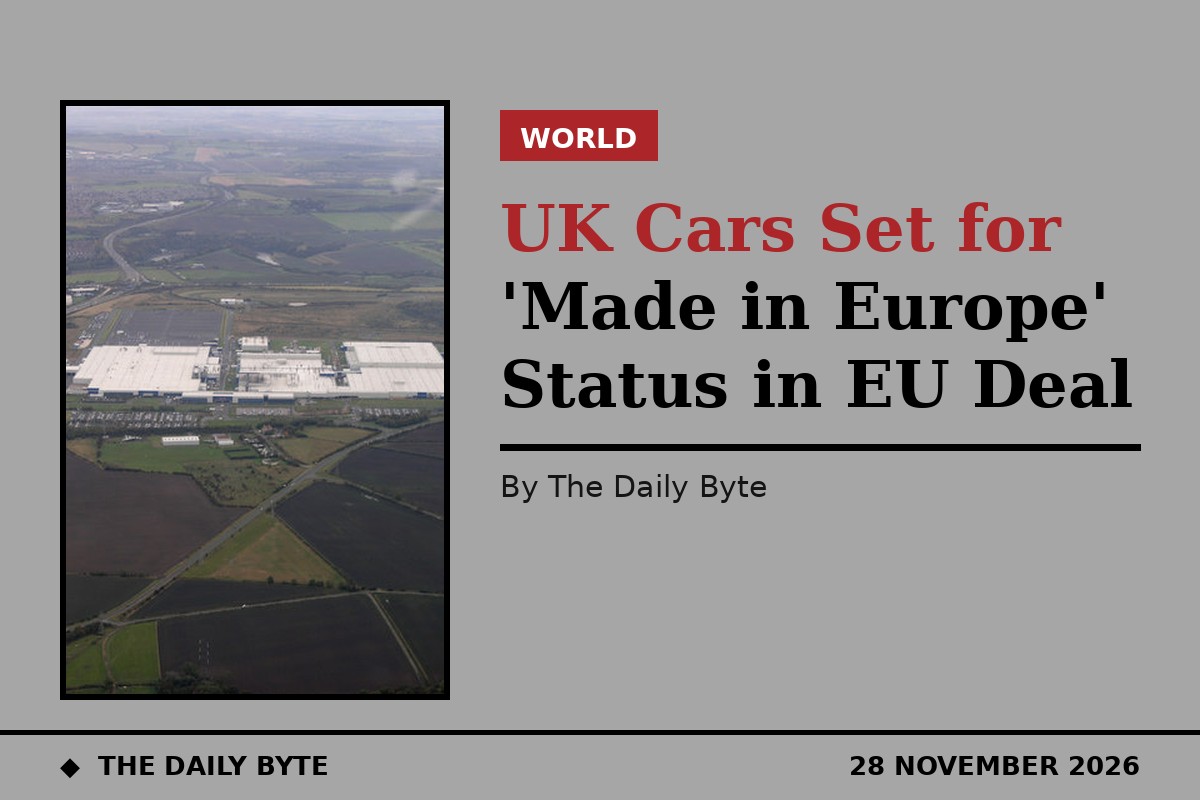
British-built cars are set to qualify as "Made in Europe" under the European Union's new industrial rules without the United Kingdom having to match EU tariffs on Chinese electric vehicles, under a compromise drawn up by Ireland's presidency of the EU.
The proposal, reported by Reuters on 24 November, would give Britain "partner" status for car assembly under the Industrial Accelerator Act, the EU's Made in Europe legislation.
Under the plan, cars assembled in the UK — including the Mini at BMW's Oxford plant and Nissans built at Sunderland — would qualify as European for EU subsidies and public contracts. The same treatment would extend to the European Economic Area countries of Iceland, Liechtenstein and Norway, and to Switzerland. Car parts from Japan and South Korea could also be covered.
The Irish compromise
Ireland, which holds the rotating presidency of the Council of the EU, put its latest proposal to member states on Monday, 23 November. EU diplomats told Reuters that member states were leaning towards accepting it, and that the text would be considered by EU competition ministers on 3 December.
The compromise drops a condition that had threatened to exclude Britain altogether. France and Germany had proposed last month that non-EU countries included in the scheme should align with EU trade protection measures, including tariffs on Chinese electric vehicles — something London has been reluctant to do.
Instead, a partner country would qualify by giving EU-made vehicles reciprocal access to its own subsidies and public procurement contracts for fleet cars. A spokesperson for the Irish presidency told the Guardian: "Having listened closely to all member states, the presidency has proposed a pragmatic and balanced way forward on the IAA to deliver for European competitiveness."
The UK's foreign secretary, Ed Miliband, told a parliamentary committee there had been "a transformation in the EU view" of Britain since Prime Minister Andy Burnham took office. Burnham last week took the biggest step towards deeper ties with the EU since Brexit, sealing deals to ease trade and create a youth mobility scheme.
Why carmakers wanted in
The stakes for the British car industry are high. The Society of Motor Manufacturers and Traders (SMMT) has warned that being left out of the Made in Europe rules would threaten the future of UK vehicle manufacturing, because cars built in Britain would be shut out of EU subsidies and public contracts in their biggest export market.
"It is essential that the final arrangements recognise the unique UK-EU automotive relationship as allies in adversity, and do not create new barriers to our shared supply chains," said Mike Hawes, the SMMT's chief executive. The trade body says the UK Government must now work urgently to agree concrete solutions that safeguard a trading relationship worth €80 billion a year.
The industry's case is that the two sides' car sectors are so intertwined that both would be damaged if Britain were excluded. At the SMMT's annual dinner in London, its president, Paul Philpott, warned: "Made in Europe could effectively lock us out of Europe and, together with tougher rules of origin and ongoing trade disruption, the competitiveness of UK production is under threat."
The tariff question had been the sticking point. France had dropped its opposition to British inclusion on condition that the UK align with the EU on tariffs on Chinese vehicles. But the business secretary, Jonathan Reynolds, ruled out imposing tariffs on Chinese vehicles in October, leaving the Irish compromise as the way through.
What is still to be decided
Nothing is final yet. EU members aim to agree a common position a few days after the industry ministers' meeting in Brussels on 3 December, and the European Parliament plans to set out its own position in mid-December. Negotiations between governments and MEPs are unlikely to start before January.
British carmakers would not get everything their EU counterparts enjoy. A scheme allowing manufacturers to meet fleet emissions targets more easily by selling small electric vehicles made in Europe — known as CO2 supercredits — would remain limited to cars produced in the EU's 27 member states, the Financial Times reported.
The proposals come as the EU prepares separate caps on imports of Chinese hybrid cars from 1 December. The quota, under World Trade Organization rules, will apply for 200 days during an investigation into imports of plug-in and battery-powered hybrids, limiting tariff-free Chinese imports to 350,000 in the first year, or about 191,000 over the 200 days. First-year quotas were also set at 310,000 for Japan, 230,000 for Turkey, 105,000 for South Korea and 190,000 for the UK, which exported 166,000 hybrids to the EU last year.


