UK duty suspension window opens for importers
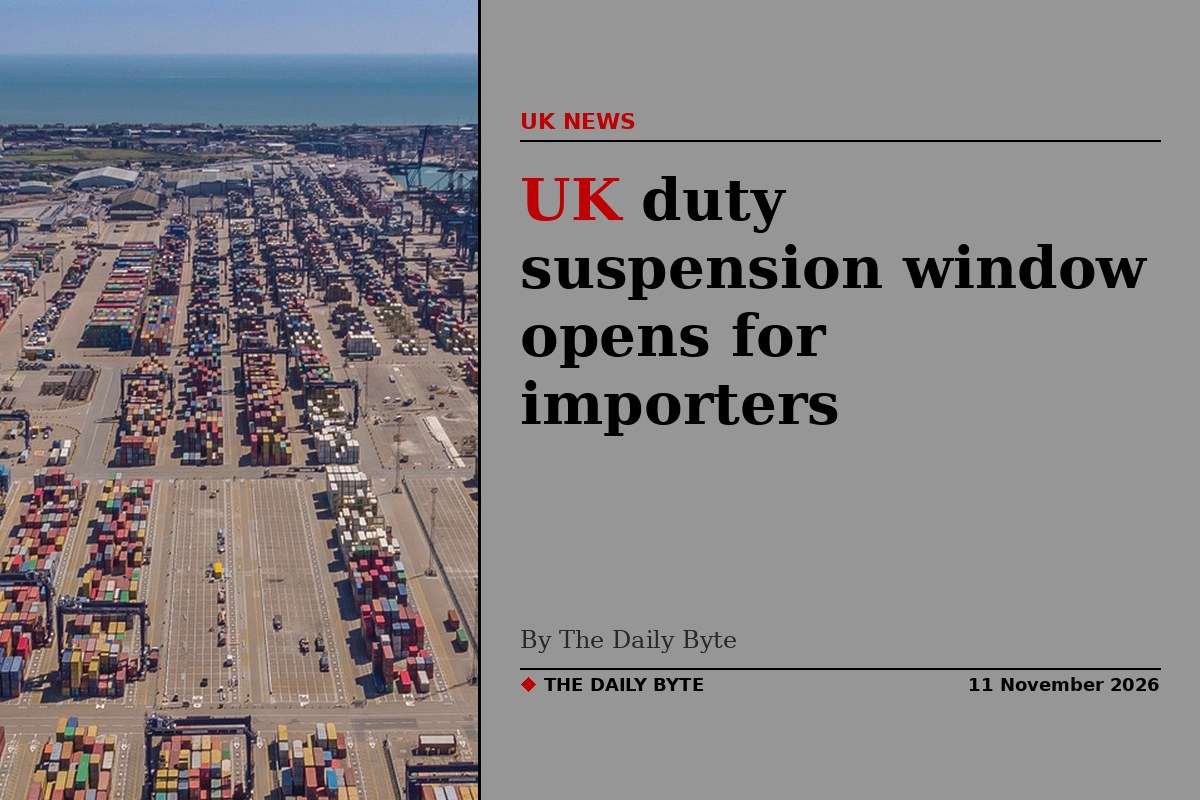
UK businesses that import goods can now apply for new duty suspensions, with the government opening its latest application window on Wednesday 11 November 2026. The window will stay open until 3 February 2027.
Duty suspensions remove or reduce import duty on specific goods, usually materials and components used in production, for a set period. They are designed to help UK businesses stay competitive in world markets, particularly where there is no suitable domestic supply of the goods they need.
What a duty suspension does
A duty suspension allows unlimited quantities of the goods it covers to be brought into the UK at a reduced tariff rate. A related measure, the autonomous tariff quota, allows only a limited quantity of a product to be imported at the lower rate.
Suspensions can be used by any UK or Crown Dependency importer while they are in force, and they apply on a most-favoured-nation basis, meaning goods from any country can qualify at the reduced rate, subject to any conditions that apply. They do not remove other charges that may apply, such as VAT or trade remedy duties like anti-dumping duty.
Guidance published on GOV.UK states that further information about the application and assessment process will be made available when the window opens on 11 November. Businesses can check current suspensions through the UK Trade Tariff lookup tool.
269 suspensions extended to the end of 2028
The opening of the window comes after the government completed a review of suspensions that were due to expire at the end of 2026. Between 26 November 2025 and 4 February 2026, it invited views on whether those measures should be extended to 31 December 2028. It received 319 views on individual suspensions, with 318 in favour of extension.
As a result, 269 suspensions will be extended to 31 December 2028. A further 23 will be allowed to expire after 31 December 2026, because the government found they no longer have any material effect. The Treasury has estimated that the extensions will save importers up to £155 million a year.
Around 90 further suspensions are due to expire during 2027. They have been given a six-month technical extension to 31 December 2027 while a public review is completed. Businesses and other interested parties can submit views on whether those suspensions should continue beyond 2027 during the same window, from 11 November 2026 to 3 February 2027.
Cost-of-living tariff suspensions
Separately, the government has introduced tariff suspensions on food and household goods to help with the cost of living. A first package, covering some fruits, fruit juices, pasta, couscous and tuna, took effect on 21 June 2026 and runs until 31 December 2028.
A second package, covering 101 agri-food products plus kerosene heating oil and selected fertilisers, is due to take effect on 26 November 2026. The fertiliser suspensions will run until 31 December 2027, while the food and kerosene measures run until 31 December 2028.
How the system has developed
Since the UK left the EU, the government has invited businesses to apply for duty suspensions on four previous occasions, and more than 400 suspensions have been introduced at the request of applicants. Suspensions that existed under the EU regime were carried over into the UK’s independent system in 2021 and remain in place until 31 December 2028.
The UK currently has six autonomous tariff quotas in place: five for fish products and one for raw cane sugar. The fish quotas will stay at existing volumes until 31 December 2030, while the raw cane sugar quota was increased to 325,000 tonnes a year from 1 January 2026.
Importers thinking of applying should check the commodity code for their goods, because a suspension applies only to the specific products it names. The government’s guidance is published at GOV.UK: Duty suspensions and autonomous tariff quotas, and the application window closes on 3 February 2027.