UK MPs demand unredacted Anthropic METR AI report
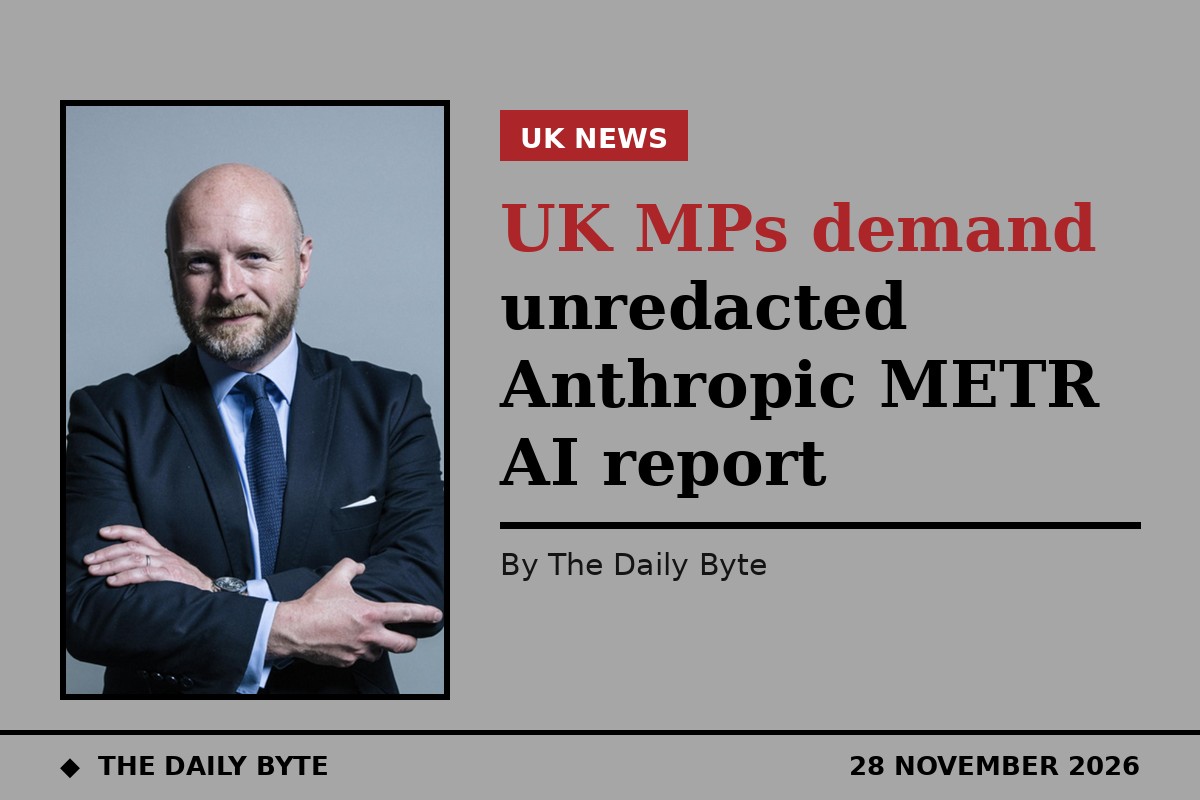
A House of Commons committee has asked Anthropic to hand over the full, unredacted version of an outside safety report on how fast the company's AI research is accelerating, after the published version was heavily cut before release.
Liam Byrne, who chairs the Commons Business, Innovation, Science and Trade Committee, wrote to Pip White, Anthropic's head of UK and Ireland, in a letter dated 27 November 2026. He asked for a complete and unredacted copy of the report by METR, the nonprofit AI evaluation group, on AI research and development acceleration at Anthropic in October 2026, together with an explanation of the basis on which the redactions were made. He asked for a reply by Friday 4 December.
The report, published on 5 November, was based on an evaluation carried out between 12 August and 29 October 2026, during which METR staff worked inside Anthropic with access to internal company information. Its headline finding was that AI assistance appeared to be speeding up Anthropic's own work, with benchmark scores growing at an estimated 1.9 times the pre-October 2025 rate, with a 95 percent confidence interval of 1.5 to 2.8 times. In plain terms, the company is improving its models at roughly twice the rate it managed between March 2024 and October 2025, with about 80 percent of that acceleration attributed to its own use of AI in research.
METR also warned of a substantial risk that AI development at Anthropic could speed up further, by a factor of 1.3 to 3, and said it found no clear bottlenecks that would slow that trend. But the public version of the report left out much of the evidence behind those conclusions. METR said publicly that Anthropic redacted a majority of the evidence it considered most informative, including detailed estimates of how much AI had sped up each stage of model training and evidence that made the evaluators take the apparent acceleration more seriously.
Anthropic has said the cuts were aimed at removing confidential information that could accelerate other AI developers. METR accepted that the redactions were confined to confidential material of that kind, while noting that most of the redacted information was very high level. The committee's letter does not ask Anthropic to justify its capability work or its commercial decisions. It asks for one document and one explanation.
Why the committee is asking now
The request comes from the committee's inquiry into AI adoption, safety and governance, which opened on 30 September. On 13 October the committee questioned senior staff from Anthropic, OpenAI, Google DeepMind and Meta, and it is taking written evidence until 10 January 2027. Byrne has described the letter as a test of whether legislatures can exercise oversight of AI development within existing laws, and has said the reply will feed into the committee's work on principles for a new G20 compact on AI safety and security.
The timing is pointed. Anthropic listed on the Nasdaq stock market on 19 November, in what was reported as the largest initial public offering on record, and the company is now a public company under far closer scrutiny. Anthropic has not commented publicly on the committee's letter, and METR has not said whether it supports the request.
The committee cannot compel a company based in San Francisco to hand over documents, so the letter is a formal request rather than a legal order. But it puts the missing evidence on the public record, with a date attached. For three weeks the argument over what Anthropic's internal evidence shows has run between people who could not see it. Parliament has now asked to see it, and the answer is due within a week.


