UK and Norway Fund £100m Attack Boats for Ukraine
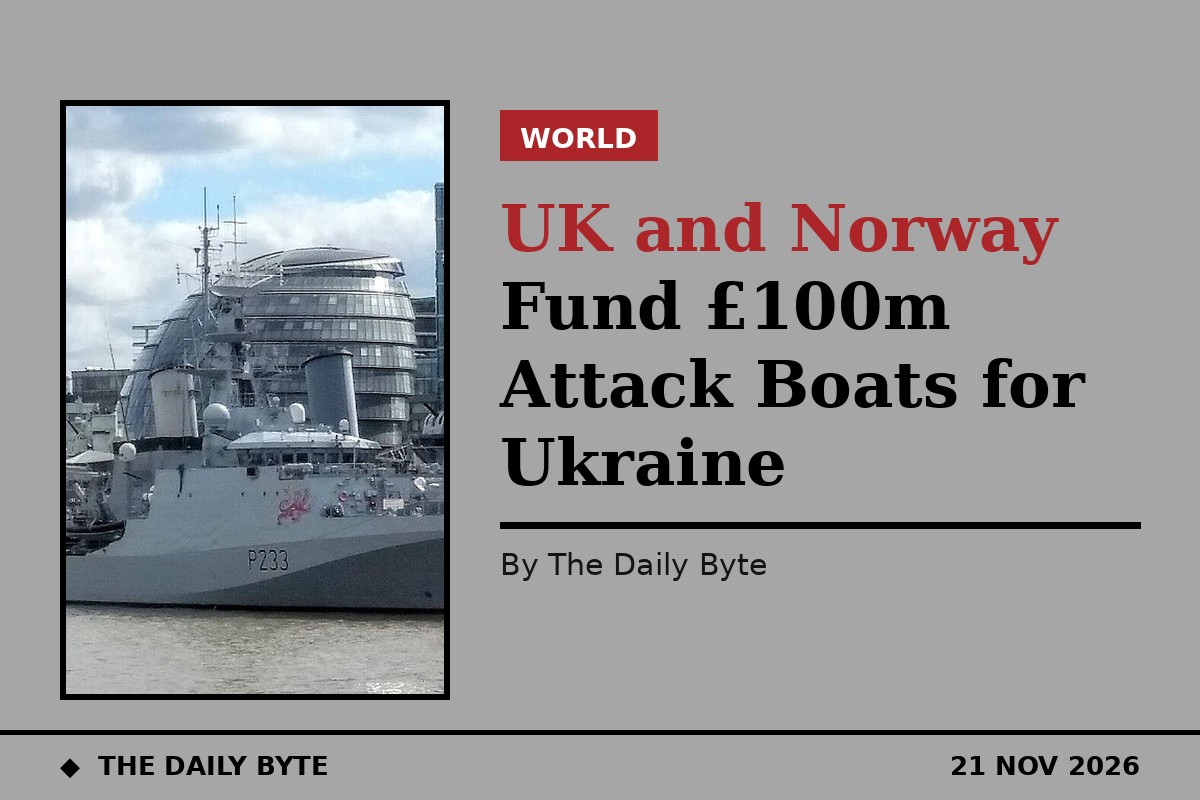
Britain and Norway will jointly fund two advanced fast attack boats for Ukraine's navy in a deal worth more than 100 million pounds, the UK government has announced, in the latest step to strengthen Kyiv's defences in the Black Sea.
The announcement was made on Thursday, 19 November, as Prime Minister Andy Burnham and Norway's Prime Minister Jonas Gahr Store joined allies at a Coalition of the Willing meeting in Berlin to step up support for Ukraine and strengthen its long-term security.
The two vessels will be built in the United Kingdom and paid for equally by London and Oslo through the Maritime Capability Coalition, the grouping the two countries jointly lead to turn allied support for Ukraine into practical military equipment. The programme is described by the UK government as a partial revival of a project first announced in October 2020.
What the boats will do
The 30-metre vessels will carry advanced air defence, missile and self-defence systems, and the UK government says they will have what it calls frigate-like capability, giving Ukraine's navy agile and powerful offensive and air defence capacity at a fraction of the price of a larger warship.
The aim, according to the announcement, is to strengthen Ukraine's ability to defend the Black Sea, protect its coastline and secure vital trade routes, including the grain corridor that carries Ukrainian exports to world markets. The Black Sea has been a central battleground of the war, with Ukraine using naval drones and missiles to push Russia's fleet back from its coast while Russia has repeatedly struck ports and shipping.
Prime Minister Burnham said the project would strengthen Black Sea defences and support European security. "Funded with Norway, built here at home in the UK, and delivering game-changing capability to the Ukrainians, this project will not just strengthen Black Sea defences, but supports European security too," he said.
The boats will be fitted with advanced systems supplied by European companies, bringing together defence technology and industrial expertise from across the continent. The UK government has not named the shipyard that will build the vessels, nor has it said when they will be delivered to Ukraine.
Part of a wider package
The two countries will also deepen their cooperation on artificial intelligence, including defensive AI for the battlefield, as part of the same announcement. The maritime deal sits alongside a much larger British commitment to Ukraine: at last month's budget, the prime minister and the chancellor announced more than 10 billion pounds in additional financial support for Ukraine, on top of the UK's standing commitment of 3 billion pounds a year in military assistance.
The Berlin meeting brought together leaders from more than 25 countries, with 40 allied delegations taking part, and was hosted by German Chancellor Friedrich Merz with Burnham and French President Emmanuel Macron. It followed an unprecedented three-way summit in Shenzhen, China, between US President Donald Trump, Russian President Vladimir Putin and Chinese leader Xi Jinping, which had raised fears in European capitals that decisions on Ukraine could be made over the heads of Kyiv and Europe.
European leaders used the Berlin meeting to set out shared principles for Europe's participation in future peace talks, including a call for a ceasefire on energy infrastructure over the winter and a starting point for any territorial settlement at the current line of contact. The fast attack boats are a reminder that, alongside the diplomacy, allies are still building up Ukraine's armed forces for a war that shows no sign of ending.
Sources: GOV.UK; Naval News; Navy Lookout.


