UK PMI Slips to 52.3 in November, Growth Robust
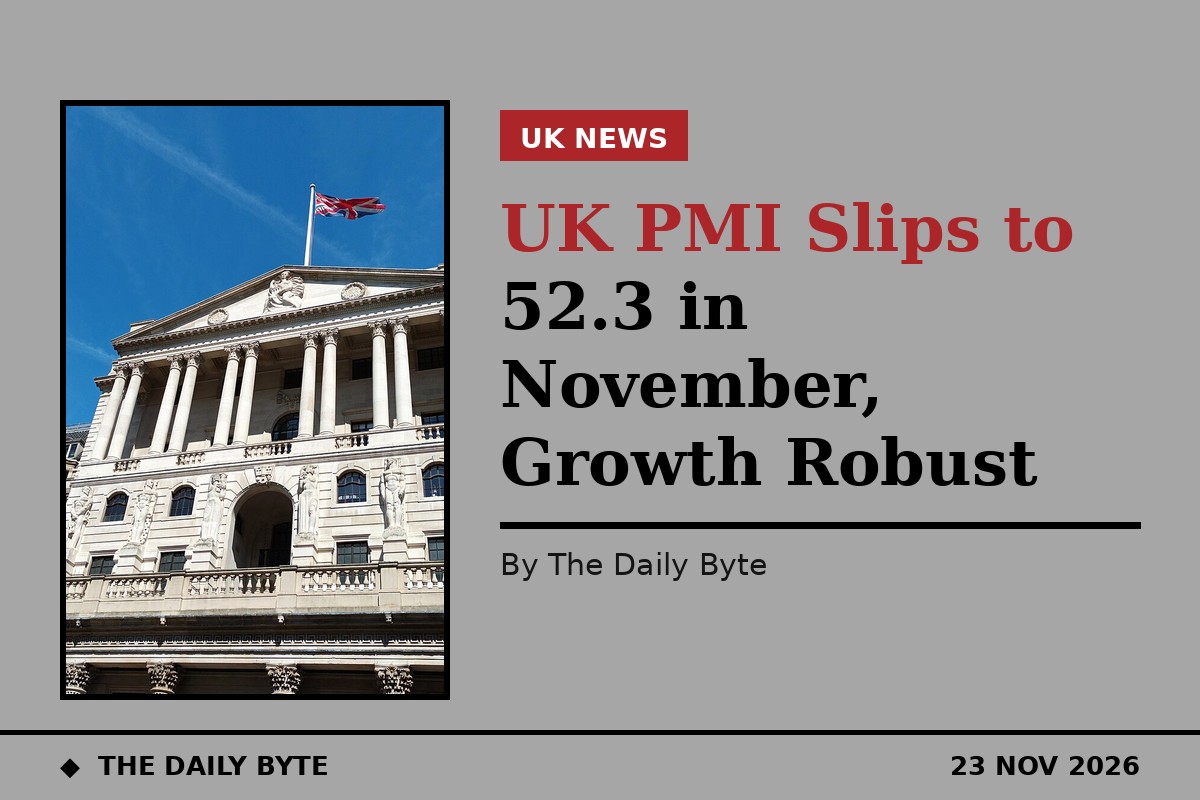
Growth in Britain's private sector slowed slightly in November, but the economy is still expanding at a healthy pace, according to the latest flash survey data published on Monday. The S&P Global composite Purchasing Managers' Index (PMI) eased to 52.3 in November, down from October's eight-month high of 52.9. The reading came in slightly below the median forecast in a Reuters poll of economists, but it remained within the range seen since July. A reading above 50 signals growth, while a reading below 50 points to contraction.
Services feel the squeeze
The slowdown was driven mainly by services, the largest part of the economy. The services PMI fell to a five-month low of 52.0, down from 52.8 in October, after economists had expected a small rise to 53.0. Survey respondents pointed to cost-of-living pressures on customers, subdued demand in the property market and headwinds from geopolitical uncertainty. Export orders in services fell at the fastest pace since February 2021, with firms blaming weaker sales to clients in Europe. Weaker foreign demand was one of the main drags on overall activity during the month.
Factories find support from AI and defence
Manufacturing held up better. The manufacturing PMI slipped only slightly, to 52.7 from 52.8, a two-month low. Its output component, which is sometimes seen as a better guide to underlying conditions, rose to 54.2 from 53.6 in October, its highest level since August 2024. Manufacturers reported a boost from the construction of AI data centres, higher defence spending and demand for food and drink. That support helped offset softer demand elsewhere and kept the factory sector in expansion.
Hiring falls as firms watch costs
Employment was the weak spot. Hiring fell in November after rising in October for the first time in more than two years. Services businesses said they were trying to offset higher costs and raise productivity by not replacing staff who left. Firms' input costs and the prices they charged continued to grow faster than their historical averages, but at the slowest rates since August and July respectively. Higher expenses reflected greater energy, fuel, raw material, technology and wage costs. Some businesses said suppliers had imposed surcharges because of increased fuel and logistics costs linked to the war involving Iran.
Rate rise in December looks near certain
Chris Williamson, chief business economist at S&P Global Market Intelligence, said the figures pointed to robust gross domestic product growth of 0.6 percent in the final quarter of 2026. He added that business confidence had improved, with optimism about the year ahead returning to the levels seen before the outbreak of war in the Middle East in February, suggesting the recent Budget had been generally well received by businesses. Combined with stubborn inflation pressures, he said, the figures made another Bank of England rate rise in December a near certainty and raised the likelihood of a further rise in February. The Bank raised rates by 25 basis points earlier this month, its first increase of the year, and money markets were pricing in around an 83 percent chance of another 25-point rise in mid-December.
Wider picture still points to growth
The survey fits with official figures showing the economy performed strongly earlier in the year. The Office for National Statistics reported annual growth of 1.9 percent for the third quarter, the fastest expansion since the first quarter of 2024, with a quarterly rise of 0.7 percent, partly driven by AI investment. Sterling edged higher against the dollar on Monday, trading around 1.31 dollars, after rising as high as 1.3144 earlier in the session. The flash PMI is a preliminary estimate based on early survey responses, and the final reading for November will follow. For now, the message is that growth has cooled a little, but has not stalled.