UK Rules Out Wholesale Water Nationalisation
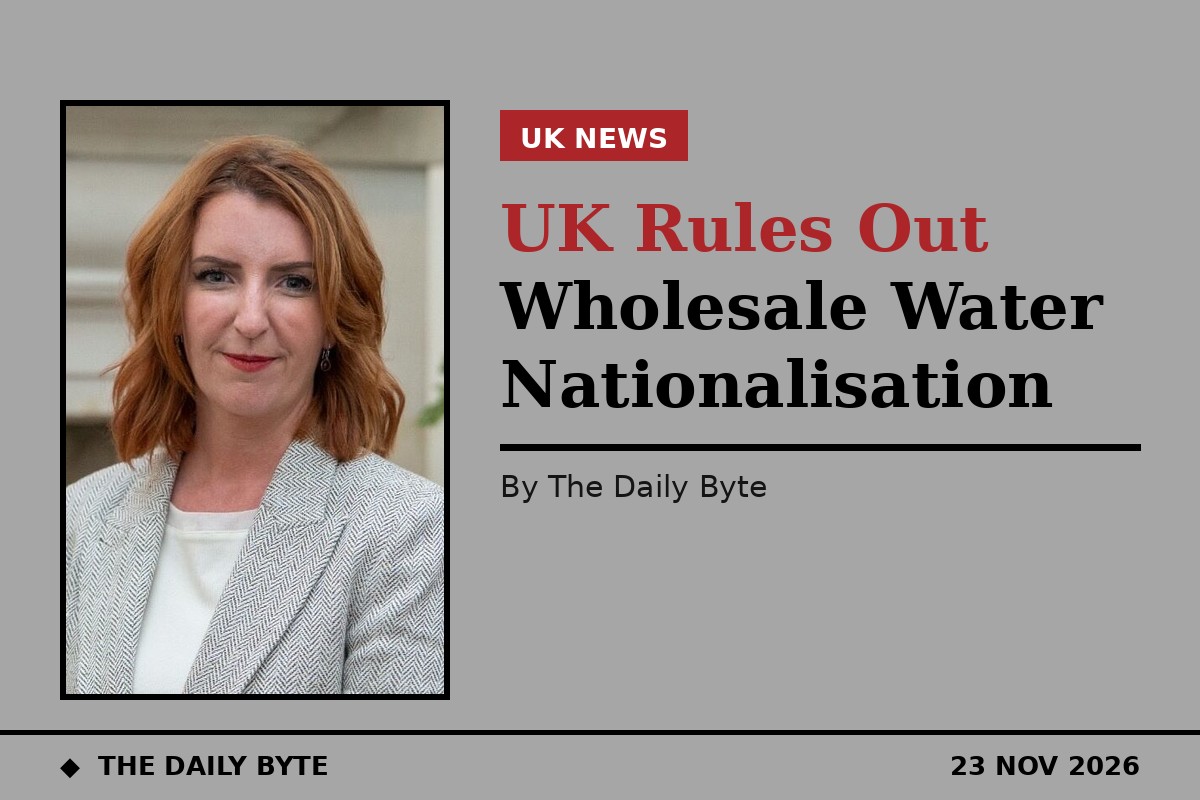
The government has ruled out taking England's water and energy utilities back into full public ownership, telling business leaders on Monday that it wants a new partnership with private capital instead. Louise Haigh, the First Secretary of State, set out the position in her address to the Confederation of British Industry's annual conference in London, saying ministers were not pursuing what she called "full fat" nationalisation. "Ownership is not a requirement," she told delegates.
A pragmatic case for public control
Haigh, who serves as Prime Minister Andy Burnham's effective deputy, argued that greater public control over essential services should not worry businesses. "Public control should not alarm anyone in this room. It's not ideological, it's pragmatic, and it's essential for people, for places, and for business," she said. She described Britain's current privatised model as "the ideological position", arguing that no other country had sought to copy the approach adopted in the 1980s and 1990s.
Burnham has blamed privatisation followed by weak regulation for excess profits, high energy prices and the failure of water companies to stop releasing sewage into rivers and the sea. Haigh told the conference that Britain was an outlier internationally in allowing foreign governments to own significant stakes in its utilities, noting that in the United States most consumers received their water from a public utility.
What the partnership would mean
According to Haigh's office, the government wants a new partnership with private capital "built on clear rules, clear expectations and a fair return on investment". She argued that clearer public oversight would reduce uncertainty and lower costs by speeding up decision-making by regulators. On energy, she pledged to bring costs in line with lower European levels over the next decade by accelerating connections to the electricity grid and building "an energy system for the benefit of its users, not producers".
Haigh also promised changes to the rules on judicial review, saying legal challenges to major infrastructure projects were "a chill factor" that left essential schemes "in limbo". She said: "Time is a tax, and we will empower Parliament to designate and authorise the country's most critical infrastructure projects. When challenge is unavoidable for the most critical projects, we will offer indemnities so that developers do not down tools."
Water reform and Thames Water
On water, where ministers face pressure to nationalise struggling companies, Haigh said the government would implement the recommendations of a review of the sector by Sir Jon Cunliffe and was willing to work with private operators that met a "public interest test". She said: "It will be a long-term project to right the wrong turn, to make water boring again."
Thames Water, which supplies 16 million customers in and around London, remains the most troubled company in the sector. It is restructuring about 20 billion pounds of debt after mounting fines for pollution and has been regarded as at risk of a costly renationalisation. Haigh's remarks ruled out a wholesale takeover of the industry, but did not settle the fate of individual failing companies. Burnham set out plans in September to reverse legislation that bars the government from owning more than 3 percent of water utilities in England, and more detail on utility regulation is expected next month.
Regulators and the regions
Ministers will also review the role of arms-length bodies, with Haigh accusing previous governments of avoiding accountability "by giving responsibility away from ministers to a sprawling web of regulators". She said the government would examine whether such bodies could be devolved, scrapped or brought into Whitehall departments, with work already under way on the Environment Agency, Natural England, Ofwat and the Drinking Water Inspectorate.
Haigh also announced that Juergen Maier, chairman of Great British Energy and a former chief executive of Siemens UK, would become the new Northern Economy and Reindustrialisation Commissioner, tasked with attracting private capital into the north of England.
Business and opposition reaction
The CBI's chief executive, Rain Newton-Smith, had sought reassurance before the speech that greater public control was consistent with "private capital at the table, not heading for the exit", and would not create undue fears of renationalisation. She has warned that the phrase "sounds like code for renationalisation" and called for certainty on industrial electricity bills and the government's jobs plans for young people.
Conservative leader Kemi Badenoch told business chiefs at the conference that they should be alarmed by the prospect of Labour politicians taking control of businesses. Green Party leader Zack Polanski said Labour was not going far enough and that water companies should return to full public ownership. The Conservatives' finance spokesperson, Andrew Griffith, said nationalisation would not lower bills. The government is expected to publish its 10-year plan for water in the coming months.