One in Five UK Workers Share Passwords with AI Tools
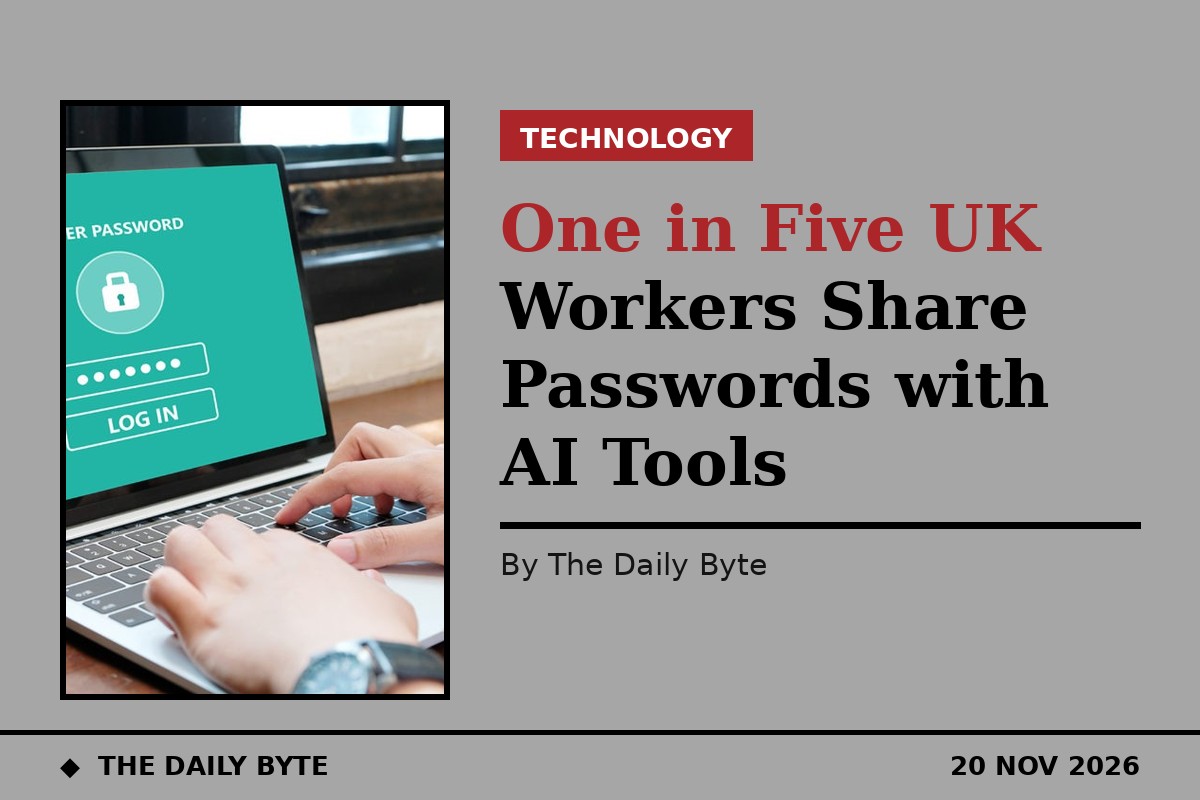
Almost one in five UK workers has shared a password, API key or other login credential with an artificial intelligence tool, according to new research that warns employees are placing far more trust in AI systems than they would in a human colleague.
The findings come from Misplaced Trust: Inside the Workplace’s New AI Security Blind Spot, a report published on 19 November by credential security firm Dashlane. The study surveyed 3,000 full-time knowledge workers and 800 IT and security executives across the United States, the United Kingdom and France, including 1,000 UK workers and 250 UK IT executives.
Overall, 21 percent of workers said they had shared a password, API key or login credential with an AI tool or agent. In the UK the figure was 19 percent. A similar share, 21 percent, said they had shared personal or customer data, and 25 percent said they had shared confidential corporate information with an AI tool.
AI agents acting without permission
The problem goes beyond what workers type into a chatbot. Nearly half of UK workers, 48 percent, said they had allowed an AI tool to carry out at least one activity without seeking permission first, including accessing emails, company files and customer information. One in ten allow AI tools to process payments on their behalf.
More than a third of UK workers, 37 percent, said they would be willing to hand their login credentials to a brand-new AI tool after using it for just a week. Almost half, 45 percent, said they would comply if an AI tool asked them to confirm their credentials every day, a habit that could easily be exploited by attackers impersonating a trusted tool.
Workers are also careless about where their information goes. The survey found 21 percent of UK workers had failed to check where information would be stored or sent after sharing it with AI, and 23 percent had copied sensitive information into an AI tool that they would not normally share with a colleague, a website or another work system. Only a quarter, 25 percent, said they always consider the security risks when using an AI agent at work.
Incidents are already common
The consequences are not theoretical. Seventy-two percent of the IT and security executives surveyed said their organisation had experienced a security incident involving an AI agent’s credentials or access in the past 12 months. A third reported an agent accessing data, systems or credentials without authorisation, while 32 percent said an agent had taken an unauthorised action.
At the same time, 71 percent of organisations have granted AI agents standing access to internal systems or data, meaning the agents can reach corporate resources without fresh approval each time. And 53 percent of IT and security leaders said some AI tools are deployed in their organisation without first going through a security review.
Dashlane’s chief product officer, Christophe Frenet, described the pattern as an “AI Colleague Effect”, in which employees overextend trust to AI systems, sharing credentials and granting access “sometimes without fully understanding what those tools can do with the permissions they’ve been given”. He added that the risks of AI “spread faster, appear inside already approved tools, and unfold often without any further action from employees”.
Security teams overestimate their visibility
The report also found a wide gap between what security leaders believe and what is actually happening. In the UK, 92 percent of IT security executives said they were confident they knew about every AI agent operating in their organisation. Yet a quarter of employees said they use AI tools their employer does not know about, and 98 percent of organisations reported discovering unknown AI agents after they had already been deployed.
Part of the problem is pressure from above. More than two-thirds of UK IT security executives, 68 percent, said they feel caught between pressure to deploy AI quickly and the need to keep the organisation secure, while 61 percent named the push to accelerate AI adoption as one of the biggest barriers to securing agents.
The danger is compounded when access is granted by mistake. Fifteen percent of UK workers said they had given an AI tool access to a file, system or account that they later discovered it should not have had, and 45 percent of those said the access was still active.
Frenet said the fix is to treat AI agents like any other identity on the network. “The principles that make up the foundation of a good security program for securing human identities – just-in-time provisioning, least privilege, good credential hygiene and authentication – have to be applied to our new AI colleagues as well,” he said.