Ukraine Peace Talks in Abu Dhabi Explained
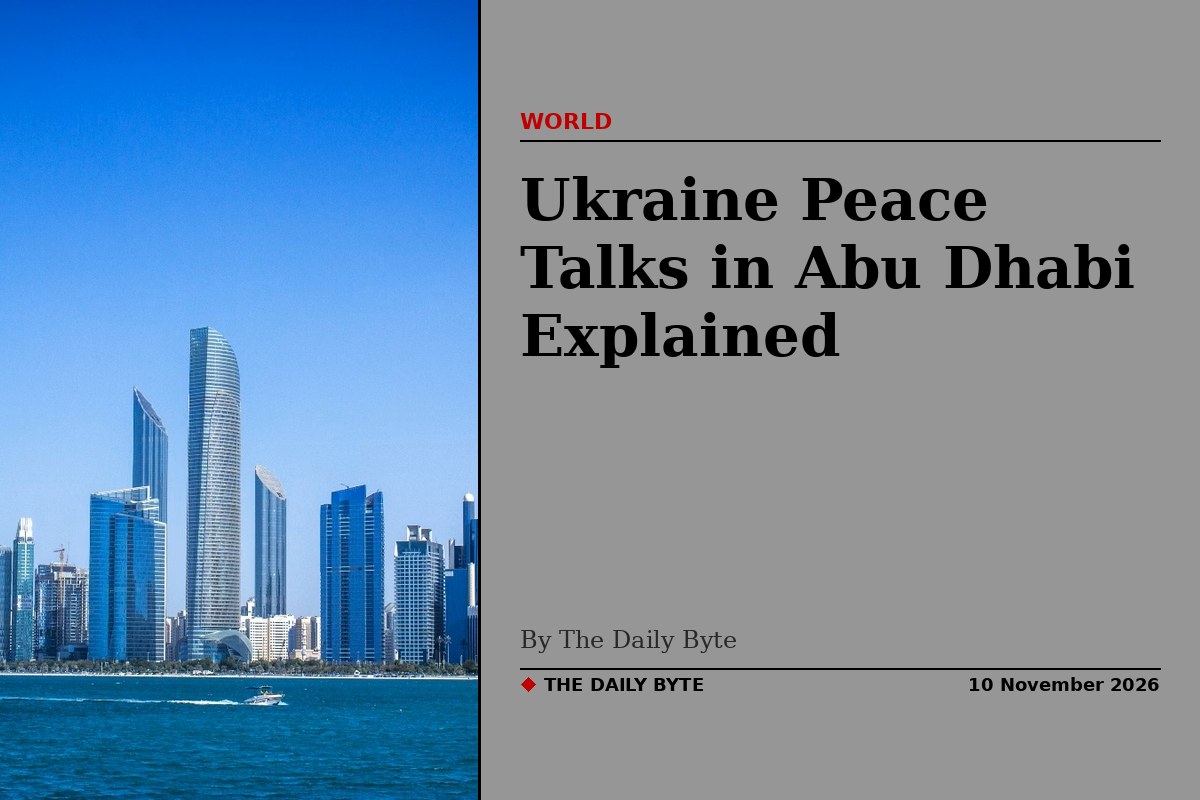
Russian and Ukrainian officials meet in Abu Dhabi on Tuesday 10 November 2026 for two days of talks mediated by the United States, their first direct meeting since February. President Donald Trump has said a broad peace deal is possible, and that he sees a strong inclination on both sides to end a war that has now lasted more than four and a half years.
The talks are the latest attempt to end Europe's deadliest conflict since the Second World War, a war that began with Russia's full-scale invasion of Ukraine in early 2022 and has killed thousands of people and displaced millions. Previous rounds of talks this year, including two earlier meetings in Abu Dhabi, have not come close to a breakthrough. This explainer sets out who is at the table, what is being discussed, why the question of territory is so difficult, and what, if anything, could realistically come out of two days in the capital of the United Arab Emirates.
Who is at the table
The talks are trilateral: Russia, Ukraine and the United States. The American mediation is led by two of President Trump's closest envoys, Steve Witkoff and Jared Kushner, who will head the United States delegation for the two days of discussions.
Russia's delegation is headed again by Kremlin aide Vladimir Medinsky, who has led the Russian side in earlier rounds. For the first time, it also includes Deputy Foreign Minister Sergei Ryabkov and a senior military officer, Yuri Zhigarlovsky. The presence of a deputy foreign minister and a senior officer suggests Moscow is treating this round as more substantive than a purely political exchange, although it does not by itself show that Russia is ready to compromise.
Ukraine's negotiating team is led by Rustem Umerov, the country's foreign intelligence chief and its primary negotiator. President Volodymyr Zelenskyy said on Monday that the Ukrainian team was already in the United Arab Emirates, and that it would propose de-escalatory steps at the meetings. He also said there must be an understanding about how to arrange a meeting of leaders at the level of presidents, to bring the war to an end fairly and for real.
European powers are not at the negotiating table, and that is itself a point of contention. France, Germany and the European Commission are sending officials to Abu Dhabi, but Russia has made clear that it does not want the Europeans to take part in the negotiations. Instead, Ukrainian delegates are expected to meet separately to brief their European allies on the progress of the discussions. The European Commission and the European Council confirmed on Monday that they would send a joint delegation, and European officials have said that talks about European security must wait for a ceasefire in Ukraine first.
What is on the agenda
The talks are scheduled to begin at around 06:30 GMT on Tuesday and to run for two days. According to a United States official who briefed reporters ahead of the meeting, security guarantees for Ukraine will be a major topic, including the potential for a NATO-style Article 5 defence commitment for Kyiv. Article 5 is the North Atlantic Treaty clause under which an attack on one member is treated as an attack on all, and a guarantee modelled on it would be intended to deter Russia from attacking Ukraine again after any settlement.
Territory is the other central question, and it is the hardest one. The American official said that both Russia and Ukraine were showing some flexibility in private on the possible exchange of territory, and that any territorial agreement would probably come at the end of the negotiations, once other items had been agreed, including a postwar security architecture.
Under the proposed deal as described to reporters, Ukraine would get an end to the war, security guarantees and a roadmap to accession to the European Union. The United States has also discussed a broader security deal that could involve all of Europe, although Trump has not provided details of what that would mean in practice. American negotiators believe the two presidents may each be willing to give a little on territory, the official said.
The territory question
To understand why territory is so difficult, it helps to know what each side holds and what each side says it wants. Russia occupies roughly 20 percent of Ukraine, including Crimea, which it annexed in 2014, and parts of the eastern Donbas region. That occupation has not been recognised by the international community.
Publicly, the two sides are far apart. Ukraine wants Russia pushed back to the original border between the two countries. President Putin wants to obtain all of the Donbas region, including territory his forces do not currently control. There has been no public sign that Putin is willing to drop his insistence that Ukraine surrender the entire eastern region of Donbas before a peace deal can be struck.
President Zelenskyy has staunchly refused to hand over land that his forces have died defending. A senior Ukrainian official strongly denied that the government would consider territorial concessions, saying the issue of territory could be discussed only at the level of leaders, and only in the context of appropriate security guarantees for Ukraine. That denial is important, because it shows the gap between what American officials say is happening in private and what Ukrainian officials are willing to say in public.
The American position is that the private picture is more flexible than the public one. The official who briefed reporters said both sides were privately showing some potential for a compromise on territory, with each side ceding a little. That claim cannot be verified from outside the room, and it is worth remembering that Trump has frequently said an agreement was close without a deal emerging. But it is the reason this round of talks is being watched more closely than some of the earlier ones.
What each side brings to the table
Zelenskyy said on Monday that Ukraine's leverage in the talks was increasing as a result of its recent battlefield performance, including retaking some territory in Donetsk, a coal-mining area of the Donbas. Ukrainian forces have also continued to strike Russian energy infrastructure, part of a campaign of tit-for-tat attacks on energy sites that has intensified in recent months.
Russia, for its part, has shifted tactics towards systematically targeting Ukraine's energy infrastructure, in an effort to trigger a nationwide winter blackout, according to diplomats. The front line has largely stabilised, making major breakthroughs unlikely for either side, but the war of attrition against power grids, heating and water supplies is putting severe pressure on Ukrainian civilians as winter approaches.
Trump's own position has also shifted in tone. Last month he blamed Zelenskyy for holding up peace efforts, saying the Ukrainian president had to want to settle the war. On Monday he struck a more optimistic note, telling reporters at the White House that Washington was seeing a very strong inclination towards ending the war, and that the conversation in Abu Dhabi was going well. Last week he said the war was close to being settled, and that ending it might involve all of Europe. He has also said that Ukraine will take a completely different shape after a peace agreement, without explaining what he meant.
The United States also signed a deal last month to buy Russian diesel, a step critics said would provide Russia with revenue to sustain the war. That deal, and Trump's engagement with the Kremlin, have made some of America's allies uneasy about whether Washington is pressing both sides equally.
Why expectations are low
Analysts are not hopeful of much progress from the Abu Dhabi talks, and the record supports their caution. The two sides have held three rounds of United States-mediated peace talks this year, including two in Abu Dhabi, and no talks have yet come close to a breakthrough. The war has continued through every round, and in some cases intensified while diplomats were talking.
Oleksandr Merezhko, a Ukrainian member of parliament, told reporters he did not expect any tangible progress, saying Putin had no intention of negotiating seriously and remained fixated on the destruction of Ukraine, and that the Russian president wanted Ukraine's surrender so he could subjugate Ukrainians. That is one Ukrainian view, and it reflects the deep distrust on the Kyiv side after more than four years of war.
There are also structural obstacles. Any deal would have to answer questions that go beyond the two warring parties: what security guarantees Ukraine receives, who provides them, whether Europe is a party to them, what happens to the territory Russia occupies, what happens to the millions of displaced Ukrainians, and how reconstruction is paid for. Two days of talks cannot settle all of that, and the American official's own account suggests the sequencing is deliberately slow, with territory left until the end.
What the talks can realistically do is narrower. They can test whether the private flexibility the American official described is real. They can agree de-escalatory steps, of the kind Zelenskyy said his team would propose, such as pauses in attacks on energy infrastructure. They can set up a meeting of leaders, which both sides have said at different times is the only level at which territory can be decided. And they can give the United States a clearer sense of whether a deal is possible in the coming weeks, or whether the war will continue into a fifth winter.
What happens after Abu Dhabi
After the two days of talks, the American envoys could travel to Russia to meet President Putin, according to the United States official. That would be the next step if the Abu Dhabi discussions produce anything worth taking to Moscow. European officials in Abu Dhabi will also be briefed by the Ukrainian delegation, and the question of Europe's role, and of a broader European security arrangement, is likely to become more prominent if the talks make progress.
If the talks fail, the war continues, and the focus returns to the battlefield and to the winter energy campaign. Ukraine's most urgent military vulnerability, according to diplomats, is a shortage of Patriot interceptors and other air defence systems, and sustaining military, financial and energy support for Ukraine through the winter is already the subject of separate discussions among its allies.
The talks begin on Tuesday morning. By Wednesday evening, it should be clear whether the private flexibility described by the American official was real, and whether the first direct meeting between Russia and Ukraine in nine months has produced anything more than another round of talks about talks.


