ULA Vulcan Amazon Leo launch delayed to Saturday
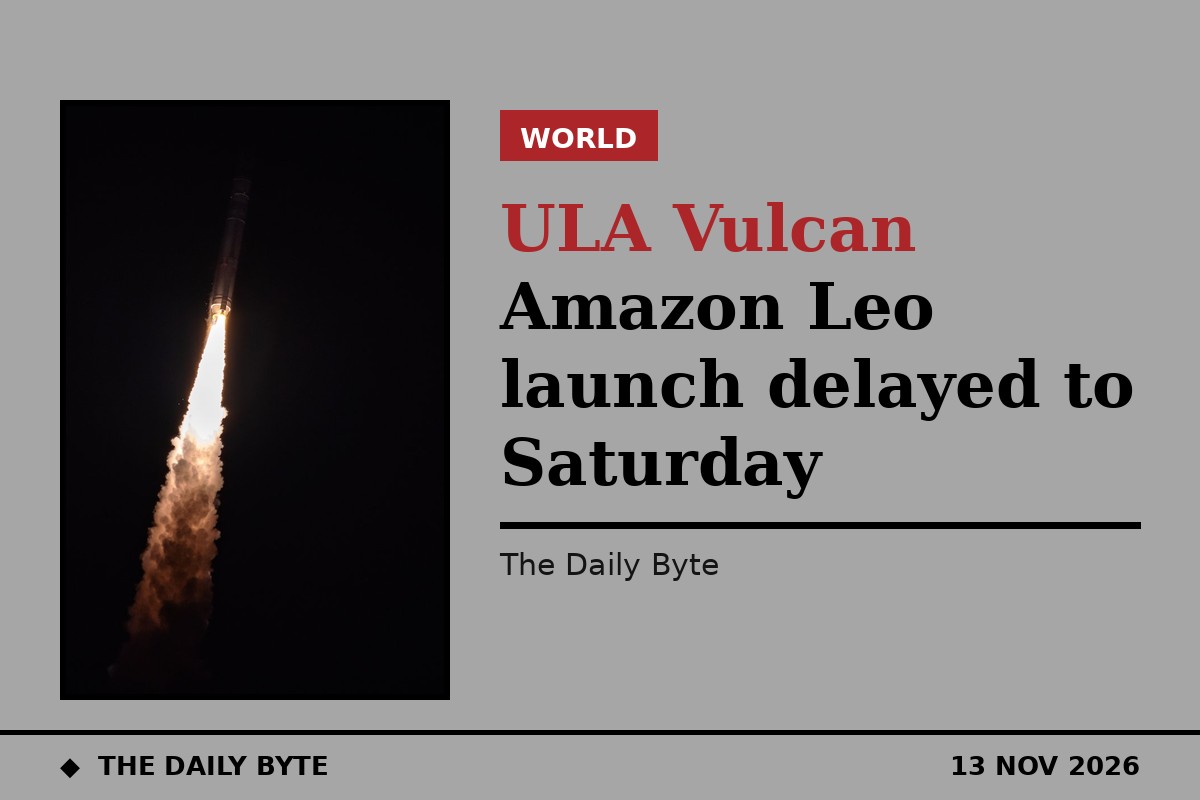
United Launch Alliance will try again on Saturday to launch its Vulcan rocket after a power interruption at a nitrogen plant scrubbed Friday's attempt, further postponing the vehicle's return to flight. The rocket is due to carry 40 Amazon Leo broadband satellites into orbit from Cape Canaveral Space Force Station in Florida.
ULA announced the delay at 8:41 a.m. EST on Friday, a little more than four hours before the originally scheduled liftoff and after the launch team had begun loading liquid oxygen into the rocket's Centaur 5 upper stage. Liftoff from Space Launch Complex 41 is now scheduled for 12:32:30 p.m. EST (17:32:30 UTC) on Saturday, 14 November.
What caused the scrub
"The launch of a United Launch Alliance Vulcan rocket carrying the Amazon [LV-01] mission is delayed due to a power interruption in the Air Liquide gaseous nitrogen plant which resulted in the loss of their high-pressure pumps," ULA said in a statement on Friday morning. "Without confirmation of sustained commodity flow, the team has decided to realign the launch to the back-up opportunity."
Gaseous nitrogen is used to purge and pressurise systems on the rocket and launchpad. The U.S. Space Force's 45th Weather Squadron is forecasting a zero percent chance of rain at the launch site on Saturday, with winds of 10 to 15 knots.
A long-awaited return to flight
The one-day delay extends a nine-month wait since the most recent solid rocket booster malfunction prompted the U.S. government to pause Vulcan's use for national security missions. During the 12 February Space Force mission, known as USSF-87, one of the Vulcan's four solid rocket boosters appeared to suffer a burn-through of its nozzle about 20 seconds after liftoff. The main engines and upper stage compensated, and the payloads reached their planned orbit, but it was the second such failure in four Vulcan flights. In October 2024, a nozzle came off one of the boosters on Vulcan's second certification launch.
ULA said the subsequent investigation, involving the company, Northrop Grumman, the Space Force and other government agencies, included laboratory materials testing and a full-scale test firing of the Graphite Epoxy Motor 63XL solid rocket booster used by Vulcan. The team identified three credible causes and took steps to mitigate all of them through changes to the nozzle's design and to how it is built, although ULA has not said what the causes were. The investigation will continue after the flight, and the Space Force will weigh its results before deciding whether to lift its pause.
Saturday's flight will be the first with a redesigned booster nozzle. It will also be the first flight of a Blue Origin-manufactured BE-4 engine since one of Blue Origin's New Glenn rockets exploded on the pad during a test in May. The New Glenn and Vulcan both use BE-4 engines, with Vulcan using two to power its first stage, producing more than 1 million pounds of thrust. ULA said Blue Origin had installed a retrofit kit for the rocket's BE-4 engines, which Blue Origin qualified through hot-fire testing.
Amazon's biggest batch yet
The delayed mission serves a private customer, Amazon, which has tasked ULA with ferrying 40 broadband internet satellites to expand its Leo constellation. It is the first of 38 Vulcan launches Amazon has purchased, and the 40 satellites are the largest batch Amazon has launched at once. The company has launched nearly 400 Leo satellites across 14 missions since April 2025, using a mix of Atlas 5, Falcon 9 and Ariane 6 rockets, but none since July.
The rocket will fly in a configuration ULA calls VC6L, using six side-mounted solid rocket boosters built by Northrop Grumman and a 70-foot-long payload fairing. It will be the first Vulcan to fly with six boosters and the first to use a shorter version of its Centaur 5 upper stage built for low Earth orbit. ULA says the rocket will carry more than 50,000 pounds of payload, a company record.
Should the countdown reach zero on Saturday, Vulcan's first stage and side-mounted boosters will power it above Florida's Space Coast, and two burns of its Centaur upper stage will propel it higher. Amazon's Leo satellites will begin separating about 70 minutes after liftoff, roughly 285 miles up, in 16 separation events over about 25 minutes, according to a ULA mission diagram.
That still leaves Amazon far behind SpaceX, which has more than 11,000 Starlink satellites in orbit, according to statistics maintained by astronomer Jonathan McDowell. The Federal Communications Commission expects Amazon to have its first-generation constellation of 3,232 satellites in orbit by July 2029. "Vulcan will launch close to half our first-generation constellation, making it our primary workhorse over the next several years," Melissa Wuerl, Amazon Leo's director of launch systems, said in a statement.


