ULA Vulcan Rocket Fails, 40 Amazon Leo Satellites Lost
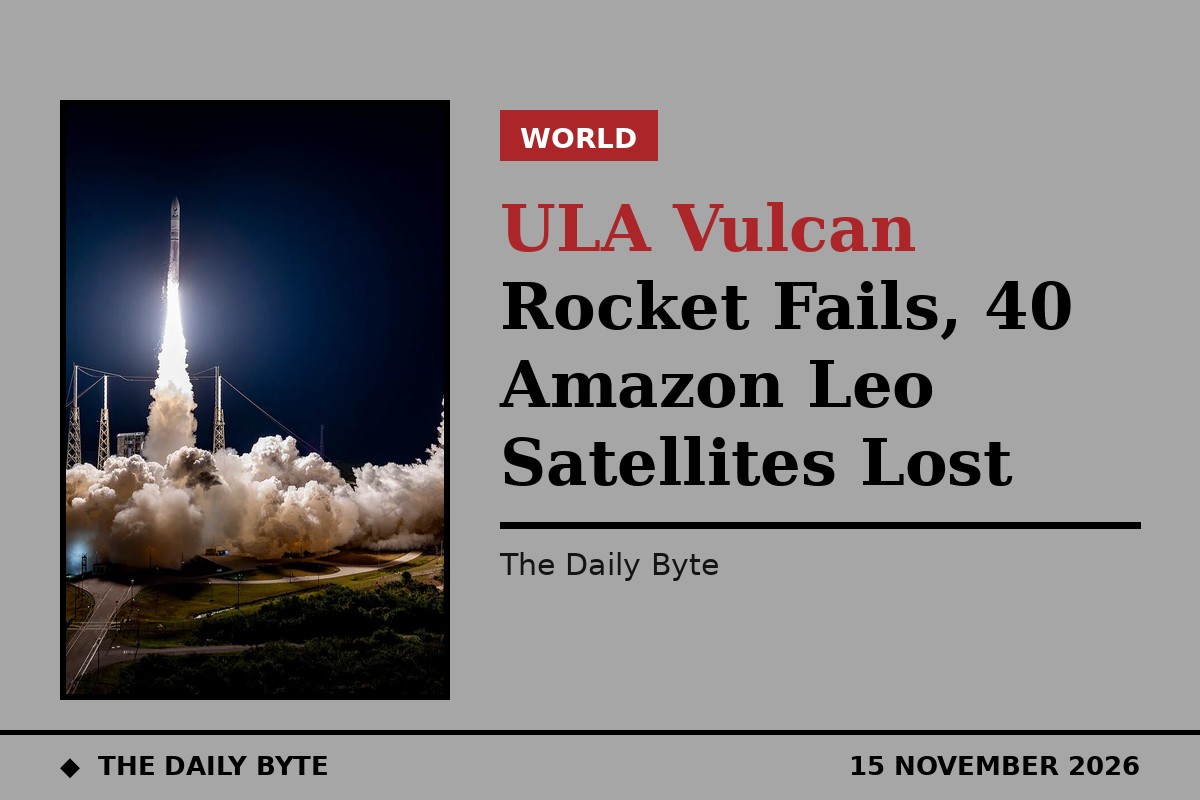
A United Launch Alliance (ULA) Vulcan rocket failed shortly after lift-off from Florida on Sunday, destroying its payload of 40 satellites for Amazon's Leo internet network in the company's first mission failure.
The rocket lifted off from Space Launch Complex 41 at Cape Canaveral Space Force Station at 12:40 p.m. Eastern time, carrying the first batch of Amazon Leo satellites to fly on Vulcan. About 10 minutes into the flight, during the burn of the Centaur upper stage, something went wrong and the mission was lost.
ULA confirmed the failure in a statement about 50 minutes after lift-off. "Based on data received by our Launch Director, we confirm that the Vulcan vehicle launched from Space Launch Complex 41 suffered an anomaly 10 minutes into the flight and failed to deliver the Amazon mission to orbit," the company said.
"We will work closely with our customer and other appropriate organizations to find the cause, determine the appropriate corrective action and return to flight as quickly as possible."
A first failure for ULA
The loss is the first outright failure of a ULA rocket since the company, a joint venture between Boeing and Lockheed Martin, was formed in 2006. Spaceflight Now reported that it was the first total mission failure in the company's history, ending a run of around 170 successful launches across its Delta IV, Atlas V and Vulcan rockets.
It was only the fifth flight of the Vulcan rocket, which is replacing ULA's Atlas V fleet, and the first in nine months. Two earlier Vulcan flights were affected by problems with the nozzles on the strap-on solid-fuel boosters, in October 2024 and again on a US Space Force mission in February this year. Sunday's failure, however, occurred on the Centaur upper stage rather than the boosters, according to early reporting.
NASA Administrator Jared Isaacman said the space agency was ready to help ULA investigate if needed.
Two delays before launch
The mission, known as LV-01, had already been delayed twice. Attempts on 13 and 14 November were called off because of ground system problems, first a power loss at the plant supplying nitrogen gas to the launch pad and then a communications fault between ground equipment and the rocket.
On Sunday, controllers held the countdown at 20 seconds before lift-off because of a problem with a pressure-reducing valve. The issue was resolved and the rocket launched at the end of its 29-minute window, powered by two methane-burning BE-4 engines and six solid rocket boosters producing about 3.8 million pounds of thrust.
What it means for Amazon Leo
The flight was the first of 38 Vulcan launches Amazon has booked with ULA to build out Leo, its satellite internet network, formerly known as Project Kuiper. The 40 satellites on board would have been the largest single group launched for the constellation so far. Had they been deployed, the network would have grown to 432 satellites in orbit.
Amazon said there was risk with any launch, especially an inaugural mission such as LV-01. The company faces a US Federal Communications Commission requirement to have half of its planned 1,616-satellite constellation in orbit by July 2028.
Leo is designed to compete with Elon Musk's Starlink and other satellite broadband providers by delivering internet access to areas poorly served by ground networks. The cause of Sunday's failure is not yet known, and ULA said it had no specific data on what went wrong in the hours after the launch. An investigation will now decide when Vulcan can fly again, and any lengthy grounding could put pressure on Amazon's deployment schedule.
Sources: Reuters and Spaceflight Now.


