UN Killer Robot Talks Drag Past Deadline in Geneva
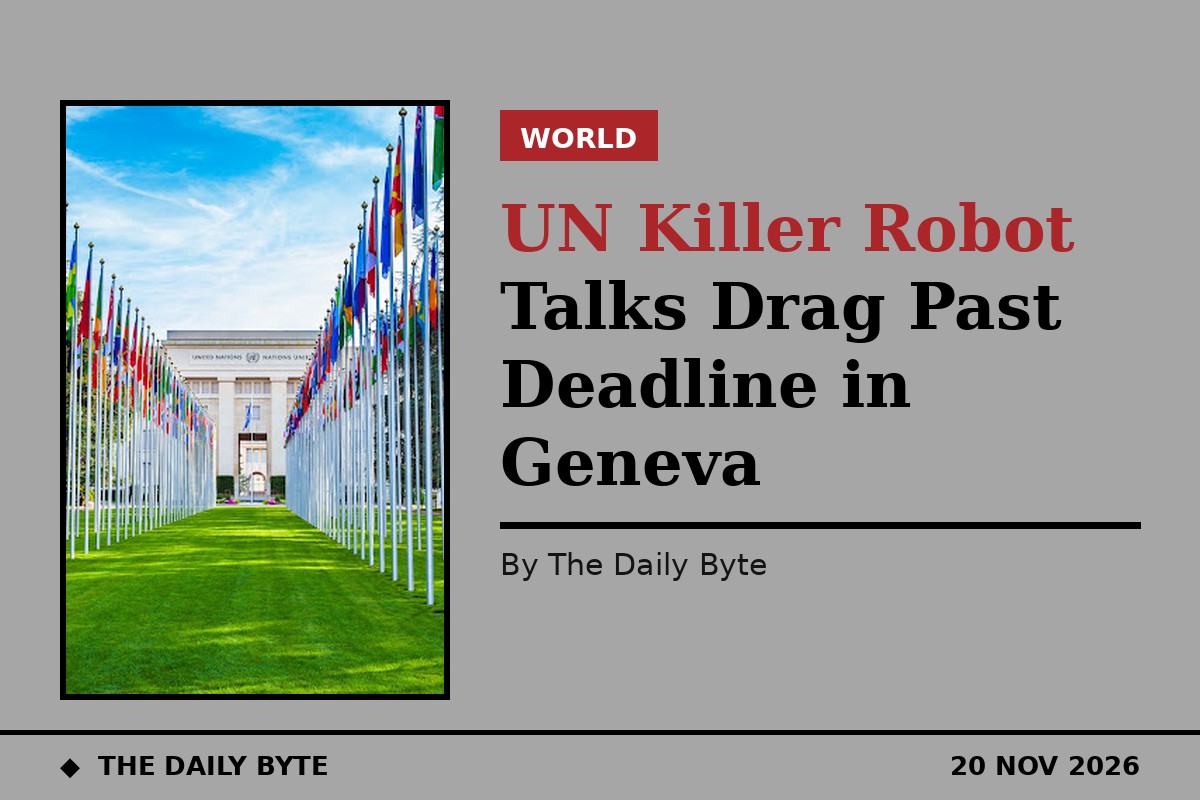
United Nations talks on regulating lethal autonomous weapons — the so-called "killer robots" — ran past their deadline in Geneva on Friday, with negotiators working into the early hours of Saturday in search of a compromise.
Five days of talks at the review conference of the Convention on Certain Conventional Weapons (CCW) had been due to end at 6pm (1700 GMT). Diplomats were split over whether a deal could still be reached, with one seeing signs of positions converging and another describing them as "very, very entrenched", Reuters reported.
What the talks must decide
The 128 states party to the convention spent the week deciding whether to launch formal negotiations on rules for lethal autonomous weapons systems (LAWS) — weapons that can identify and attack targets with varying degrees of autonomy, sometimes without any human deciding to fire.
A draft deal seen by Reuters showed that legally binding rules would not immediately be considered, despite support from about 100 states. Instead, countries would "progressively develop further rules and other possible measures" — wording that campaigners said would keep the issue drifting.
The big arms-producing nations — the United States, Russia and Israel — oppose legally binding rules, arguing that existing humanitarian law is sufficient. Washington has proposed five more years of expert work towards a non-binding instrument, while the conference chair, Swiss ambassador Julien Thoeni, has proposed a two-year mandate to negotiate a legally binding protocol.
Russia's objections slow the talks
Russia repeatedly took the floor on Friday with objections and minor amendments, and Russian and US delegates huddled around the Swiss chair as the initial deadline approached.
Moscow had already stalled the conference on its opening day on Monday, objecting to the longstanding practice of letting observers — including the European Union and civil society groups — address the meeting, which blocked adoption of the agenda and forced discussions into an informal format.
Because the convention works by consensus, all 128 state parties must agree — a rule that has kept formal negotiations out of reach for more than a decade, despite repeated warnings that the technology is moving faster than the diplomacy.
Campaigners warn of empty hands
"On the final day of talks, a minority of states continue to block progress, acting in the interests of tech bosses and arms profiteers," said Anna Hehir, head of military AI governance at the Future of Life Institute, on the sidelines of the talks.
Magnus Løvold of the Lex International Fund said the draft proposal "looks designed to keep talks trapped in the dysfunctional consensus process for years to come", and some civil society groups called for a new process outside the current UN framework.
Others urged compromise rather than collapse. "We cannot leave the table with empty hands," said Frederico Meyer, Brazil's ambassador to the UN Conference on Disarmament. "(No deal) would be terrible for the world, terrible for the United Nations and terrible for human beings."
AI-assisted weapons have already been used in Ukraine, Sudan and the Middle East, and the UN secretary-general, the Pope and the Red Cross have all called for strong and legally binding rules. Last month, a UN disarmament committee voted 163 to 5 to steer the convention towards negotiations, with the United States, Russia, Belarus, Israel and North Korea opposed.
Whether the overnight session produces even a modest mandate will decide if the Geneva process still has a pulse — or whether the effort to set rules for machines that can kill without human approval moves outside the United Nations altogether.


