UN Killer Robot Talks End Without Binding Rules
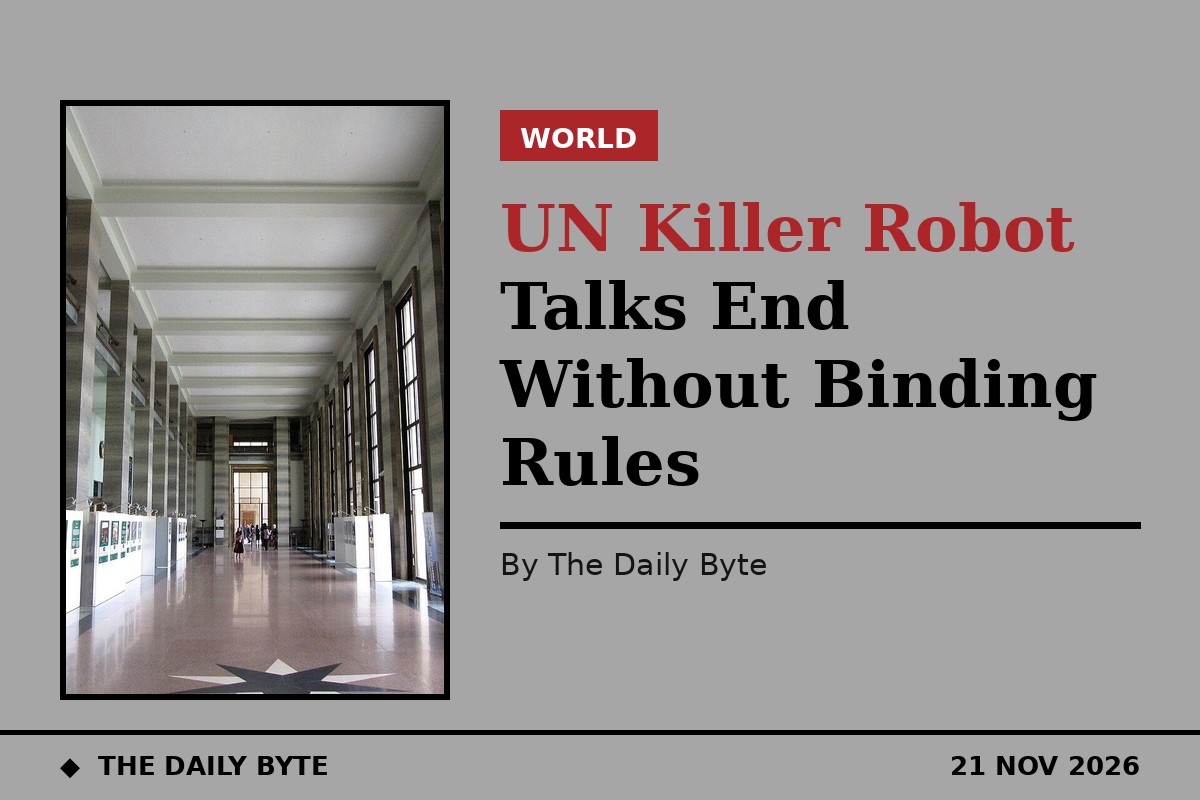
United Nations talks on regulating lethal autonomous weapons ended in Geneva early on Saturday with an agreement to keep working towards new rules by 2028, but without any commitment to a legally binding treaty.
The week-long review conference of the Convention on Certain Conventional Weapons, which has been ratified by 128 countries, ran from 16 to 20 November. Negotiators worked through the night and reached their compromise after 4am, agreeing to elaborate a possible international instrument on lethal autonomous weapons systems over the next two years.
About 100 countries had backed legally binding rules within a short timeframe for weapons that can identify and engage targets with varying degrees of autonomy, sometimes called killer robots. But major arms-producing nations, including the United States, Russia and Israel, opposed that approach, and the final text leaves open whether any future measures will be legally binding.
What the deal does, and does not, promise
The agreement settles on the word elaborate rather than negotiate for the next phase of work. A group of government experts will now work towards recommendations on what the instrument should contain and whether it should take the form of a binding protocol.
Before the meeting, seven countries, Austria, Belgium, Brazil, Ireland, Mexico, New Zealand and Panama, had proposed launching negotiations on a rulebook that could prevent or limit machines killing without human control or accountability. That effort fell short. The International Committee of the Red Cross had urged binding rules within a year, while the United States proposed a five-year window to discuss non-binding, optional guidelines.
The outcome also misses a deadline set by UN Secretary-General Antonio Guterres, who leaves office at the end of the year. He had called for negotiations towards an agreement on autonomous weapons to be launched in 2026. Pope Leo XIV has also called for strong rules, framing the issue as one that must be settled before such weapons become too commonplace to regulate.
Disappointment, and a partial win
Campaigners criticised the result. Stop Killer Robots called it a watered-down mandate, and its executive director, Nicole van Rooijen, said delaying a legally binding instrument puts civilians and humanity at risk. Beatrice Fihn, founder of the advocacy group Lex International, said the decision amounts to pushing the can down the road for two more years.
Others saw a partial success. The meeting’s Swiss chair, Julien Thoni, called the deal a significant achievement for humanitarian disarmament after more than a decade of talks. Izumi Nakamitsu, the UN’s high representative for disarmament affairs, described it as a glass half full or half empty scenario, acknowledging Guterres’s hopes for a legally binding deal this year.
The difficulty is built into the forum. The convention decides by consensus, so any single member state can block an agreement, and any deal is likely to rest on the lowest common denominator. Diplomats said Russian objections to procedural rules had forced the cancellation of some formal meetings during the week, and that negotiators spent hours arguing over a handful of words overnight.
Concern about the weapons is growing as they are used in conflicts including in Ukraine, Sudan and the Middle East. Activists say armed drones that can independently strike targets have already been deployed in some cases, although widespread rollout has not happened. Technology is moving faster than diplomacy, Brazil’s ambassador, Frederico Meyer, told the conference. Diplomats are very slow.


