UN Warns Winter Floods Are Swamping Gaza Shelters
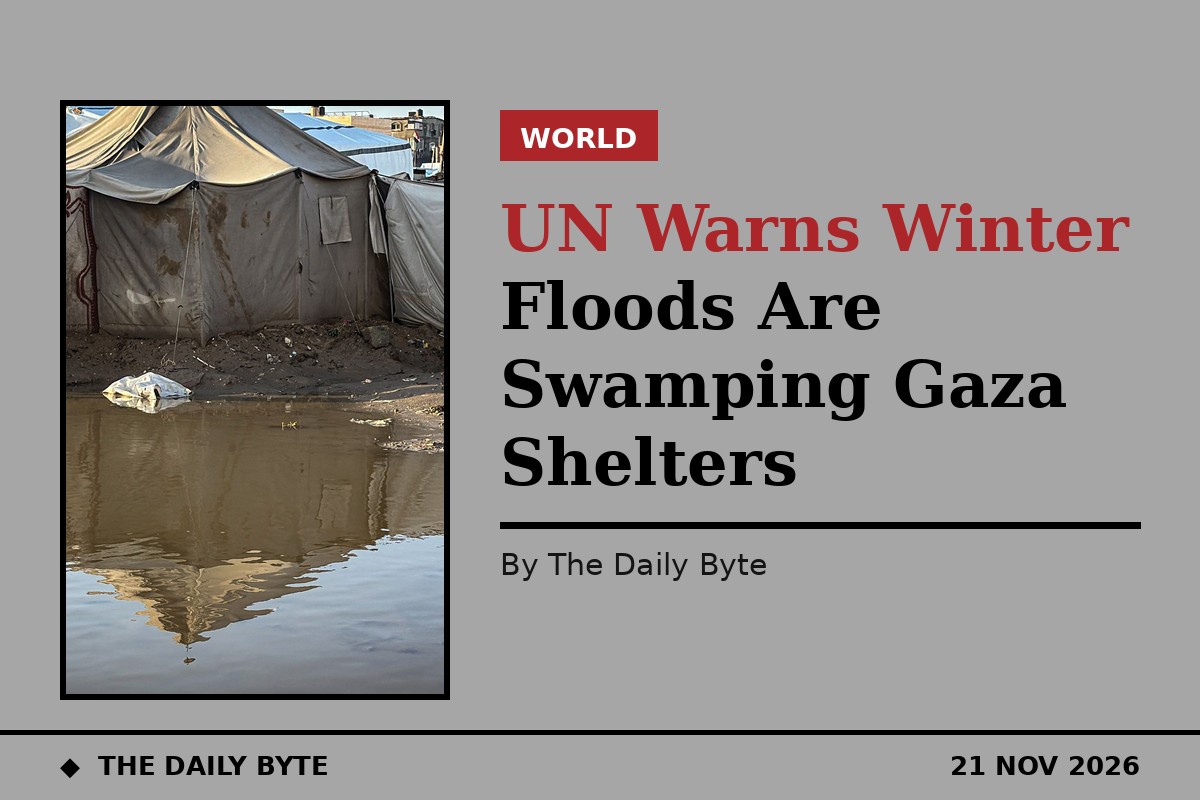
Winter rains are flooding tents, destroying food supplies and leaving displaced families struggling to stay warm in Gaza, United Nations agencies have warned, as more than 1.7 million people face a fourth winter living in tents and damaged buildings.
The International Organization for Migration (IOM) and the World Food Programme (WFP) warned on 17 November that critical funding shortfalls and continued restrictions on aid deliveries were threatening humanitarian operations just as winter places new pressure on vulnerable families.
After just one day of rain, tens of thousands of shelters were damaged or destroyed, according to Karl Baker, the IOM's regional crisis coordinator. Since early November, at least 40,000 additional shelters have been damaged or destroyed, the agencies said.
Five killed as a sand bank collapsed
At least five people were killed just over a week ago when a rain-soaked sand bank collapsed onto tents south of Deir al-Balah, Gaza's civil defence service said. Humanitarian partners also reported that two children had died in fires started accidentally by families trying to stay warm by cooking inside their tents.
The season's first winter storm, over the weekend of 7-8 November, flooded the tents and shelters of about 26,000 households across Gaza, soaking mattresses, blankets and clothes, according to the UN. Drainage systems are failing without fuel and spare parts, leaving water pooled around tents and roads cut off.
"Most people burn rubbish to cook their food. Now even the rubbish is wet," said Shaun Hughes, the WFP's country director for Palestine, briefing journalists in Geneva after a visit to the territory. Floodwater and sewage had destroyed food stocks stored in tents, he said, while cooking gas and firewood are unavailable or unaffordable.
One hot meal every two days
The agencies said 1.4 million people in Gaza face acute hunger and 1.98 million require shelter assistance. In the tented camps, the WFP used to provide one hot meal a day. "Now it's one hot meal every two days," Hughes said.
According to the latest Integrated Food Security Phase Classification assessment, as many as 1.9 million people, or 90 per cent of Gaza's population, could face acute food insecurity by the end of 2026 if humanitarian assistance is not sustained.
The WFP faces a funding shortfall of 436 million US dollars over the next six months to reach two million people across Palestine. The IOM requires 173 million dollars to sustain the shelter response, including tents, tarpaulins, blankets and repair materials, plus a further nine million dollars for drainage, lighting, heating points and other site improvements.
More than half of sites are flood-prone
More than half of Gaza's 1,700 displacement sites are in flood-prone areas, with the population forced into less than 40 per cent of the territory. Most sites need sandbags to reinforce shelters and pathways, while more than 40 per cent require drainage and ground-improvement work.
The shelter cluster, which coordinates shelter aid in Gaza, estimated at the start of November that families still needed about 121,000 tents, 561,000 tarpaulins, 57,000 emergency shelter kits and 1.7 million mattresses. Aid groups had about 2,800 tents in stock inside Gaza and no emergency shelter kits.
"When you're in Gaza, it does not feel like a ceasefire," Hughes said. Israeli military control across nearly 70 per cent of Gaza means people have almost no space to grow their own food, he added, and unemployment is over 80 per cent, "so without humanitarian assistance, people have little or no alternate means of survival."
Humanitarian teams have worked for months to prepare sites for winter, digging drainage channels, reinforcing pathways and repurposing flour bags as sandbags. The agencies say those efforts need urgent funding and access to basic tools such as shovels, sandbags and nails if families are to get through the winter.


