Uncontacted Awá Emerge From Amazon in Rare Contact
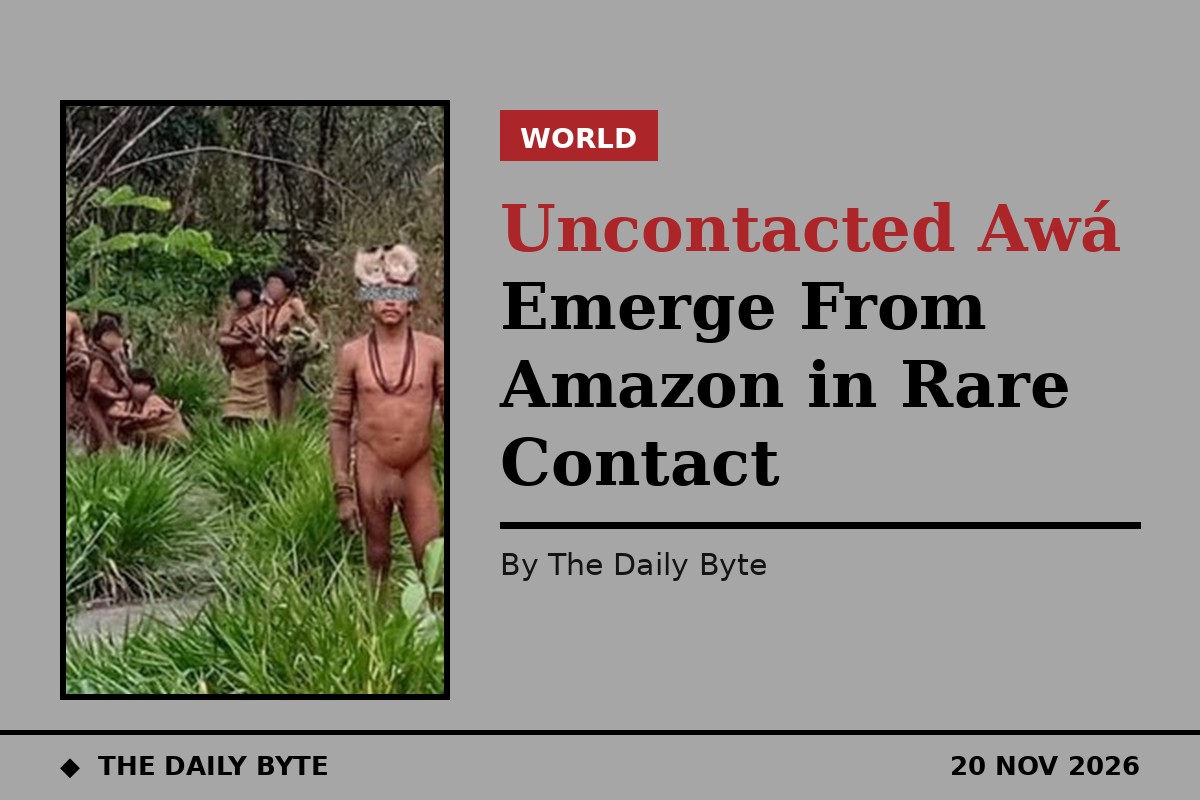
About 20 uncontacted Awá Indigenous people emerged from Brazil's Amazon rainforest on Monday and approached a government post in the Arariboia Indigenous Territory, in a rare break with decades of voluntary isolation. They asked for yams, accepted the food offered to them, and carried it back into the forest.
The encounter took place on 16 November near the Guajajara village of Tawari in the north-eastern state of Maranhão, according to Brazil's Ministry of Indigenous Peoples. Members of the neighbouring Guajajara people, who support the government post the Awá approached, filmed the exchange on their mobile phones. Le Monde, reporting on the encounter on 20 November, put the number of people at about 15; Survival International, which first publicised the footage, reported about 20.
According to the National Indian Foundation, known as FUNAI, no encounter of this kind had occurred in the region for at least 50 years. The Awá are expert hunter-gatherers who have lived in voluntary isolation, relying on the rainforest for almost everything they need.
Why they may have come out
The exact reason behind the approach remains unknown. The two groups do not speak the same language, and the exchange was brief. But experts say the decision to break isolation is itself a warning sign.
"These are groups that avoid us for their own survival, because, historically, all contacts have ended in either massacres and enslavement or, more recently, in epidemics and the disappearance of much of their population," François-Michel Le Tourneau, a geographer and research director at France's National Centre for Scientific Research, told Le Monde. "So, if they decided to overcome this fear and the risks of contact, it means there were probably things that were even more dangerous that pushed them to do so."
One likely explanation is the climate. Brazil is experiencing an intense El Niño, and drought has spread across the rainforest. On 19 October, the National Water and Sanitation Agency announced that the entire territory of Maranhão state had experienced drought in September. "It is therefore possible that the Awá-Guajá, who are hunter-gatherers, found themselves cut off from food resources," Le Tourneau said.
Survival International said pressure from invaders could also be why the group sought food. In recent years, illegal loggers, hunters and cattle ranchers have closed in on the Awá's territory, known as Arariboia.
A forest under pressure
Arariboia is a 413,000-hectare protected area running across part of the Amazon rainforest and the Cerrado savanna in central Maranhão. Nearly 10,000 Indigenous people live there. According to O Globo, by 2022, 75 percent of the Amazon forest in Maranhão state had already been razed. In 2015, enormous fires destroyed about half of the Arariboia territory itself.
A team of Guajajara people known as the Forest Guardians has battled for years against the illegal loggers and cattle ranchers who constantly invade Arariboia. Many of the Guardians have lost their lives in recent years protecting the territory they share with the uncontacted Awá.
"The situation in the forest is challenging: climate change, fires, deforestation and land encroachment are having a direct impact on their lands and the Awá way of life, which depends exclusively on hunting and gathering," the Forest Guardians said in a statement.
Survival International's director, Caroline Pearce, said: "This is a troubling indication of how the continued invasion of uncontacted peoples' forests puts otherwise self-sufficient Indigenous people in real danger. The uncontacted Awá are under extreme pressure as intruders encroach from all sides of their territory, driving them into an ever-smaller island of the Amazon rainforest, surrounded by destruction."
The health risk now
The immediate priority is preventing the transmission of contagious diseases. Illnesses that are benign for outsiders could prove deadly for an isolated group whose immune systems are entirely different from the rest of the world's population.
FUNAI personnel and Indigenous health workers are now in the area, and the authorities have activated an emergency coordination mechanism to assess potential contact situations and health risks. Health Ministry and FUNAI officials have already been placed in quarantine before being sent to assist the Awá-Guajá, Le Monde reported.
Survival International has previously estimated that around 100 Awá remain uncontacted, while other Awá live in settled villages and maintain contact with outsiders. The group has been described as "Earth's most threatened tribe." The Forest Guardians and Indigenous organisations in Maranhão are demanding immediate action from the Brazilian authorities to protect Arariboia from the loggers and ranchers razing it, in direct dialogue with the Guardians and the local Indigenous leadership.
Sources
Survival International: Brazil: Uncontacted Awá Indigenous people make contact as loggers enter their territory
Le Monde: Isolated Indigenous group resurfaces in Brazil, raising fears over their survival


