UNICEF: Gaza Floods Kill Children in Deir al-Balah
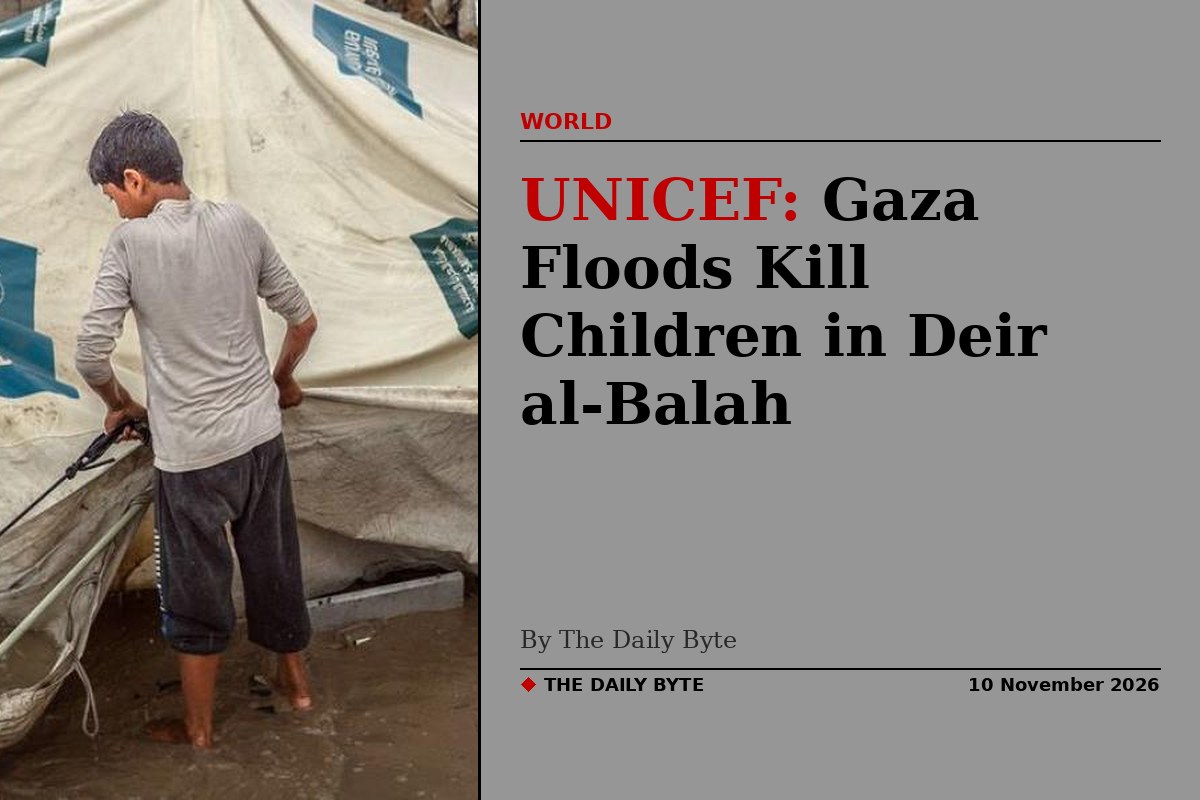
Three children aged four, five and eight died alongside their mother when a sand dune collapsed onto their tent in Deir al-Balah, central Gaza, after days of heavy rain, the United Nations children’s agency UNICEF has said.
The deaths came as the first major storm of the winter swept across Gaza, flooding displacement camps, collapsing damaged buildings and leaving tens of thousands of families without shelter. The United Nations aid coordination office, OCHA, said five people were killed when the dune collapsed at Al Berka Reservoir, west of Deir al-Balah — three children and two women — and one other person was injured. An infant was also reported to have drowned in the flooding.
UNICEF Executive Director Catherine Russell said the deaths reflected the desperate conditions facing displaced families. “These children and their mother have died because they did not have a safe place to sleep,” she said.
More than 106,000 people affected by the storm
According to UNICEF, recent heavy rains have affected more than 106,000 people across Gaza, destroying or damaging tents, sanitation facilities and essential household belongings. Around 950,000 displaced residents are living in flood-prone areas, including about 400,000 people in locations considered extremely dangerous, nearly half of them children.
Rain and strong winds began lashing Gaza on Friday night, flooding displacement sites and disrupting services across all five governorates, OCHA said in an update released on Monday. By 8 November, humanitarian partners had received appeals for aid from more than 26,000 households whose shelters or belongings were damaged. More than 6,000 family shelters were destroyed and 17,400 damaged, and more than 3,900 households currently have no shelter at all.
Water levels rose to 1.5 metres in some locations. Gaza’s civil defence units received 2,166 distress calls but were able to respond to only 218. At least 55 learning spaces serving some 55,000 children were flooded, and health facilities were also damaged, forcing some medical teams to suspend services.
Save the Children said rescue teams were still trying to locate two missing people after the flooding and the landslide in Deir al-Balah.
Tents flooded as winter approaches
Some 65 per cent of Gaza’s population, about 1.4 million people, live in tents or makeshift shelters, according to OCHA. Gaza’s Government Media Office said about 70,000 displacement tents were flooded within 12 hours of the storm striking, with damage estimated at $3 million.
UN Deputy Special Coordinator Ramiz Alakbarov, speaking from Ramallah, said that while rain could not be prevented, more must be done to protect the vulnerable, noting that most Gazans are living in worn-out tents that cannot withstand what would be considered a moderate storm elsewhere.
An estimated 1.7 million displaced people continue to shelter in tents, temporary structures and damaged buildings as they prepare for their fourth winter under extremely difficult conditions. During the previous winter, 11 children were reportedly killed by hypothermia.
UNICEF calls for urgent help and equipment
UNICEF and humanitarian partners are distributing winter clothing, thermal blankets, tarpaulins and hygiene supplies to families affected by the flooding. During the past week, the organisation reached at least 10,000 children with winter clothing and thermal blankets, provided temporary shelter materials to families whose tents had flooded, and cleared sewage and stormwater from more than 50 locations.
The agency has urged Israeli authorities to permit the immediate entry of pumps, generators, spare parts and essential repair equipment needed to restore damaged facilities, including the Sheikh Radwan stormwater basin in Gaza City, where only two of six pumps are still working, and the Sheikh Ejleen wastewater treatment plant. None of Gaza’s wastewater treatment plants is currently operational.
UNICEF is calling on the international community to support the entry of life-saving humanitarian equipment and provide urgent funding for its US$97.5 million winter response in Gaza. It has warned that additional child deaths could occur unless vulnerable families receive adequate shelter and essential winter supplies before conditions deteriorate further.


