Unitree Guardian V3.0: Robot Mirrors Humans at 80ms
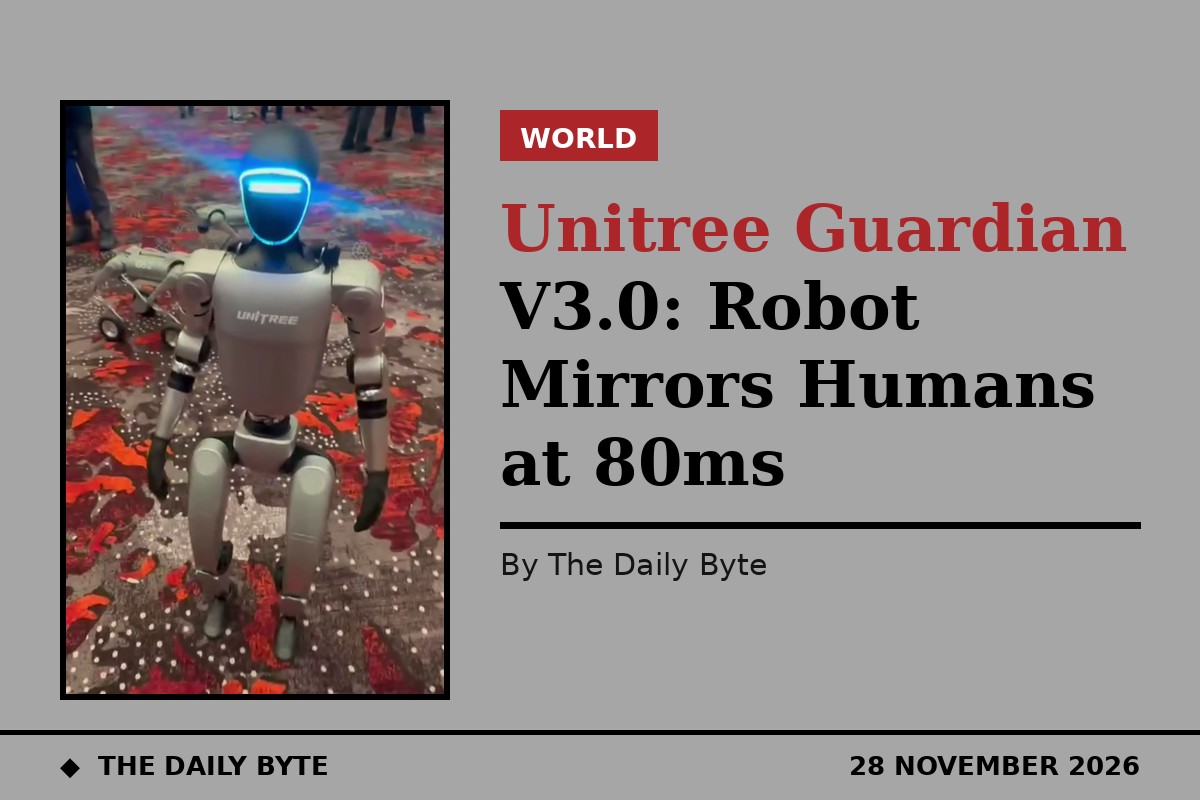
Unitree Robotics has unveiled the third generation of its full-body teleoperation system for humanoid robots, saying an operator can now drive a robot's whole body almost as fast as the operator moves. The Chinese robotics company announced Embodied Avatar V3.0 Guardian on Friday 27 November 2026, with demonstrations showing its G1 humanoid performing cartwheels, kicks, flips and martial-arts sequences while following a human operator wearing a motion-capture suit.
What Guardian does
Guardian gives a human operator direct control over the robot's body through a motion-capture setup. The operator's movements are mapped onto the robot in real time, so the G1 mirrors the person controlling it. Unitree says the system supports both fully autonomous operation and real-time teleoperation on the same hardware, letting operators take over when a robot needs help and then hand control back.
The launch videos show the G1 in motion mode, the faster of two settings shown in the footage, performing dynamic whole-body movements. Unitree is positioning the system for remote work, supervised deployment and policy evaluation, where a human-operated run can be compared with an autonomous run on the same robot and task.
The numbers behind the claim
Unitree reports a motion synchronisation rate of up to 99.8 percent and end-to-end latency as low as 80 milliseconds. Chinese-language documentation on the company's site adds more detail: system response under 100 milliseconds, full-body motion-capture delay of around 20 milliseconds, data collection at 60 hertz and tracking at 200 hertz, with average position error of 5 centimetres or less and angle error of 6 degrees or less.
For scale, human visual reaction time typically sits near 200 milliseconds, so an 80-millisecond loop sits well below the threshold at which most people would notice a delay. That matters for fast, coordinated movement: even modest latency forces operators to slow down or exaggerate their motions, which degrades the quality of the recorded data.
Why teleoperation matters for training
Unitree is presenting Guardian first and foremost as a tool for collecting demonstration data, not only as a remote control. Humanoid control policies need demonstrations that match the target machine's body and environment. Video imitation requires translating human motion onto a robot with different proportions, joints and actuator limits, and simulation rarely reproduces contact, friction and object behaviour exactly.
Teleoperation records commands and sensor observations directly on the robot. Each operator session can then become a training trajectory grounded in the G1's physical limits, feeding imitation-learning workflows. The G1 has already appeared in Amazon research projects such as OmniRetarget and ResMimic, which examine motion retargeting and learned humanoid control, and Guardian could supply those efforts with operator-guided trajectories.
What Unitree has not said
The headline figures come with gaps. Unitree has not published the methodology behind the 80-millisecond result, so it is not clear which stages of the loop it covers: motion capture, pose estimation, network transmission, command processing, actuation, camera encoding and visual feedback to the operator can all count. The 99.8 percent synchronisation rate also lacks a standard industry definition, and the company has not disclosed pricing, availability, supported motion-capture hardware, software interfaces or safety controls beyond guidance to keep 2 to 5 metres of separation from the robot and to avoid dangerous modifications.
Rivals are building the same loop: 1X offers an Expert Mode for its NEO humanoid, and direct comparisons remain difficult because vendors use different robots, networks, tasks and latency definitions. Guardian's published figures describe a fast, closely tracked control loop with clear uses in remote operation and data collection. Whether it becomes a widely used tool will depend on disclosed benchmarks, accessible developer interfaces and concrete release terms.


