US airmen convicted of child abuse avoided UK trial
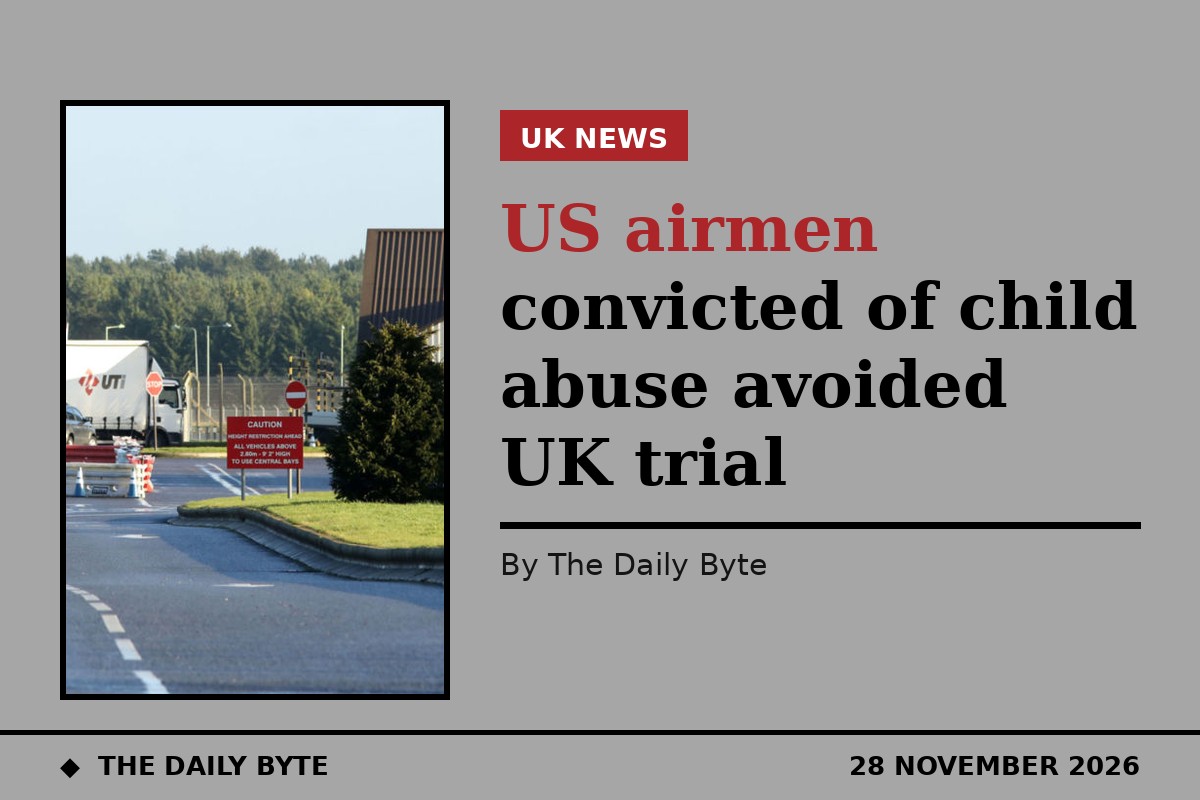
At least 21 American airmen stationed in the United Kingdom have been convicted of child sexual abuse offences over the past decade, but only three of them were prosecuted in a British court, a Guardian investigation published on Saturday 28 November has found. The rest were dealt with by US courts martial held on American airbases in Britain, a system critics say offers a more limited form of justice than the open British courts.
The investigation centres on the case of Jacob Ozbirn, an American airman formerly stationed at RAF Mildenhall in Suffolk. One summer evening, Ozbirn drove two hours from the base to a country lane near a hotel in Derbyshire, expecting to meet a 12-year-old girl he had been grooming for sex. He had sent explicit messages to her and two other girls, encouraging them to send naked photographs, although all three had told him they were aged 12 or 13. In one message, he wrote: “There is nothing to be afraid of. I will take care of you! And please can I have one more picture.”
Ozbirn had walked into a sting run by members of the public who pose online as girls to lure suspected paedophiles to meetings. He told them he was simply trying to educate the girls about dangerous predators, but they notified Derbyshire police, who detained him. He should then have been investigated by the local force and, if necessary, prosecuted in a British criminal court. Instead, Derbyshire police handed the investigation to the US military police. Ozbirn was brought before a court martial held on the Mildenhall base and, in May 2018, was sentenced to three years in a US military jail, given a dishonourable discharge and reduced to the lowest enlisted rank.
The Guardian identified other cases handled the same way. In 2016, technical sergeant Brandon Justice was sentenced to 47 years in a military jail after a court martial at RAF Lakenheath, where military investigators had described him as a “multi-child molester”. In 2024, staff sergeant Christopher Toolan received a 30-year sentence at Lakenheath. In October 2026, two more airmen were convicted in separate courts martial at Lakenheath: one received 10 years for sexually abusing a child and possessing and obtaining child pornography, while William Berroa was sentenced to two years for possessing and viewing child abuse images, with the US Air Force publishing no details of his offences.
A system under scrutiny
More than 12,000 US military personnel work at 15 or more bases and facilities across the UK. Of 63 US personnel convicted at courts martial in the UK since 2016, 18 were convicted of child sexual abuse offences, more than a quarter of the total. Under an agreement dating back to the 1950s, US personnel accused of breaking the law should be investigated by a British police force unless the alleged offences were committed on duty or against another member of the US armed forces, its property, or a dependant.
The legal framework is the 1951 NATO Status of Forces Agreement, incorporated into British law through the Visiting Forces Act 1952. Under Article VII of the agreement, the country deploying military personnel generally has primary jurisdiction over offences arising from official military duties or directed exclusively against its own personnel, their dependants, property or national security. In other cases where both countries have jurisdiction, the host country ordinarily has the primary right to prosecute, although either country can ask the other to waive that right.
Critics argue that US courts martial provide a more limited form of justice. Juries, sometimes all-male, are made up of the defendant’s fellow service personnel. Unlike hearings in the open British courts, members of the public are unable to easily attend courts martial held on US airbases, and accounts of the proceedings are often too sparse to determine whether UK police have, or should have, been involved. Court martial records are published on a public register inconsistently, often disappearing with no explanation.
The Guardian found a growing number of cases in which UK police forces agreed to US military requests to take control of investigations into alleged wrongdoing by American personnel. The agreement is now the subject of a high-level internal inquiry, involving at least four Whitehall departments and police chiefs, examining whether US military personnel stationed in Britain are being prosecuted properly.
The inquiry followed the case of US pilot Jacob Wulfson, tried by court martial after UK police let the US military take over the investigation into the strangling of a British woman in Cambridge. Wulfson was convicted of strangulation and disobeying an order. The US Air Force Office of Special Investigations said it worked with UK partners to determine investigative primacy and that local authorities retain the right of first refusal on all investigative matters.


